
Get Expert Guidance
What Our Plans Cover
-
Bodily injury to attendees and mem...
-
Damage to third-party property
-
Liability arising from temporary s...
-
Liability for the acts of your sta...
-
Legal defence costs and expenses
-
Vendors and exhibitors
-
Set-up and dismantling periods
Who Can Consider This Plan?
- A registered business, professional practice or organisation
- Activities within the classes the insurer writes
- Accurate disclosure of turnover, activities and territories
- Disclosure of all known circumstances that could give rise to a claim
- Compliance with any statutory licensing applicable to the activity
What May Not Be Covered?
- Injury to your own employees, which is an employer's liability matter
- Damage to equipment you own or have hired in
- Event cancellation, which is a separate cover
- Activities not declared — fireworks, adventure elements, water activity
- Alcohol-related incidents where licensing was breached
Always check the policy wording before you commit.
Why Choose Wealth & Covers?
- Expert advice to choose the right plan
- Plans from leading insurance companies
- Hassle-free process and documentation
- End-to-end support, including claim assistance
- Dedicated relationship manager
Our Insurance Partners
- Star Health Insurance
- Care Health Insurance
- Niva Bupa Health Insurance
- HDFC ERGO
- ICICI Lombard
- Bajaj Allianz
We represent multiple providers to help you find the most suitable option at the best price.
- Expert Guidance Personalised advice from experienced insurance professionals.
- End-to-End Support From choosing the right plan to claim assistance, we are with you always.
- Claims Assistance Hassle-free claim support to ensure you get what you deserve.
- Transparent Process Clear information, easy documentation and a hassle-free experience.
Overview
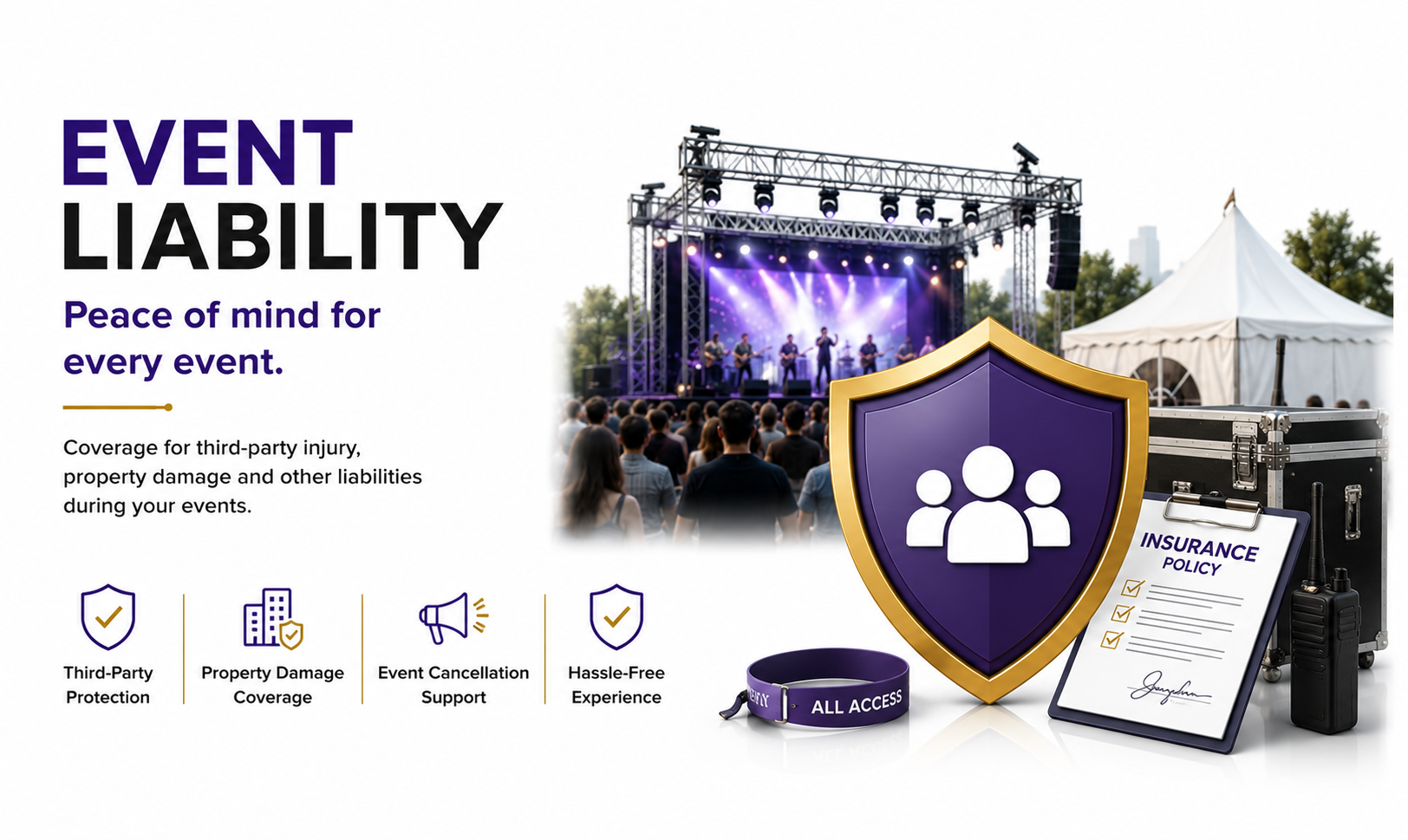
Event liability covers the organiser against claims by attendees, performers, vendors and the public for injury or property damage arising from an event. It can be written for a single event or as an annual policy across a season.
Venues almost universally require it now, and the required limit is usually stated in the hire agreement. That figure is a contractual minimum rather than a risk assessment, and for larger crowds it is frequently well below what a serious incident would produce.
The exposure scales with attendance and with what happens at the event. A conference of two hundred is a different risk from a music festival of twenty thousand with temporary structures, and the policy needs to be built for the one you are actually running.
Who should consider it
Event organisers, conference producers, wedding planners, exhibition organisers and venues. Anyone hiring a venue that requires liability cover as a condition of the booking.
Benefits
- Covers claims by attendees, performers and vendors
- Satisfies the liability requirement in venue hire agreements
- Available for a single event or across a season
- Extends to temporary structures, staging and equipment
- Legal defence costs included
- Can be arranged quickly, often within a day
What is covered, and what is not
Read the right-hand column first. It is the one that decides whether a claim is paid.
Typically covered
- Bodily injury to attendees and members of the public
- Damage to third-party property, including the hired venue
- Liability arising from temporary structures and staging
- Liability for the acts of your staff and volunteers
- Legal defence costs and expenses
- Vendors and exhibitors, where declared
- Set-up and dismantling periods, where included
Typically not covered
- Injury to your own employees, which is an employer's liability matter
- Damage to equipment you own or have hired in
- Event cancellation, which is a separate cover
- Activities not declared — fireworks, adventure elements, water activity
- Alcohol-related incidents where licensing was breached
- Attendance materially above the declared number
- Professional advice given at the event
Inclusions and exclusions vary between providers and between plans from the same provider. The wording in your own policy document is what governs — we will walk you through it before you buy.
How it works with us
- 1 We map the exposure before choosing a policy What you do, who it touches, and where a claim would come from. Liability cover follows the exposure, not the industry label.
- 2 Trigger and retroactive date agreed first Occurrence or claims-made, and how far back the cover reaches. These decide more than the limit does.
- 3 Limits tested against a realistic worst case Not the average claim — the one that would matter. Defence costs are part of that calculation.
- 4 Underwriting and, for larger risks, a survey Insurers price liability on process and controls. Good documentation genuinely lowers the premium.
- 5 Policy issued, and notification process explained Late notification is the leading cause of declined liability claims. We make sure your team knows when to call.
Important considerations
The things a brochure tends to leave out. Read these before you decide.
- Declare the expected attendance honestly. Material under-declaration affects the claim, and crowd size is the primary rating factor.
- Include set-up and dismantling in the policy period. A significant share of event injuries happen when the public is not even there.
- Declare unusual elements: fireworks, adventure activities, water, animals, motorised displays. Each is excluded unless specifically included.
- The venue's required limit is a contractual minimum, not an assessment. For a large crowd it is frequently well short of a realistic serious claim.
- Event cancellation is a different cover entirely. If losing your deposits and production costs to a washout would hurt, that needs arranging separately.
Documents required
- Business registration and constitution documents
- Description of activities, products or services
- Annual turnover and, where relevant, export turnover
- Number of employees and details of contractors engaged
- Claims and incident history, usually for five years
- Existing policy schedules, where cover is being replaced
- Contracts specifying required indemnity limits, where applicable
Frequently Asked Questions
The venue asks for a specific limit. Is that enough?
It is a contractual minimum, set for the venue's comfort rather than from an assessment of your event. For a large crowd or an event with temporary structures, it is frequently well below what a serious injury claim would produce.
Does it cover cancellation if the event is called off?
No. Liability cover responds to claims made against you; event cancellation is a separate policy covering your lost deposits, production costs and revenue. Organisers frequently need both and often buy only one.
Are the set-up and dismantling days covered?
Only if the policy period includes them, and they should. A large proportion of event injuries occur during rigging and derigging, when the public is not present but contractors and crew are.
What about fireworks or adventure activities?
Excluded unless specifically declared and covered. Every unusual element — pyrotechnics, water activity, animals, motorised displays — needs naming individually, and each affects the premium.
I run several events a year. Should I buy annually?
Almost certainly. An annual policy across a season is cheaper than separate covers and removes the risk of an event slipping through unarranged in a busy period.
Want a shortlist instead of a catalogue?
Tell us the situation and an advisor comes back with two or three options that actually fit — and names what each one gives up.