
Check your eligibility
What These Loans Fund
-
Hospital admission deposits
-
Treatment costs above the insuranc...
-
Non-medical consumables that polic...
-
Treatment for conditions inside a...
-
Post-hospitalisation care
-
Travel and accommodation for treat...
Who Can Consider This Loan?
- Indian resident, generally aged 21 to 60
- Salaried: minimum monthly income set by the lender and city
- Self-employed: two to three years of business vintage with filed returns
- Credit score is the dominant factor in both approval and rate
- Total EMI obligations usually capped at 50 to 55% of net income
- Employment with a recognised employer improves both terms and speed
What May Not Be Funded?
- Processing fee, usually deducted from disbursal
- A preferential rate, beyond expedited processing at some lenders
- Amounts beyond what your income supports
- Tax deduction on the interest
Always check the sanction letter before you commit.
Why Choose Wealth & Covers?
- Expert advice to choose the right plan
- Plans from leading loans companies
- Hassle-free process and documentation
- End-to-end support, including claim assistance
- Dedicated relationship manager
- Expert Guidance Personalised advice from experienced loans professionals.
- End-to-End Support From choosing the right plan to claim assistance, we are with you always.
- Claims Assistance Hassle-free claim support to ensure you get what you deserve.
- Transparent Process Clear information, easy documentation and a hassle-free experience.
Overview
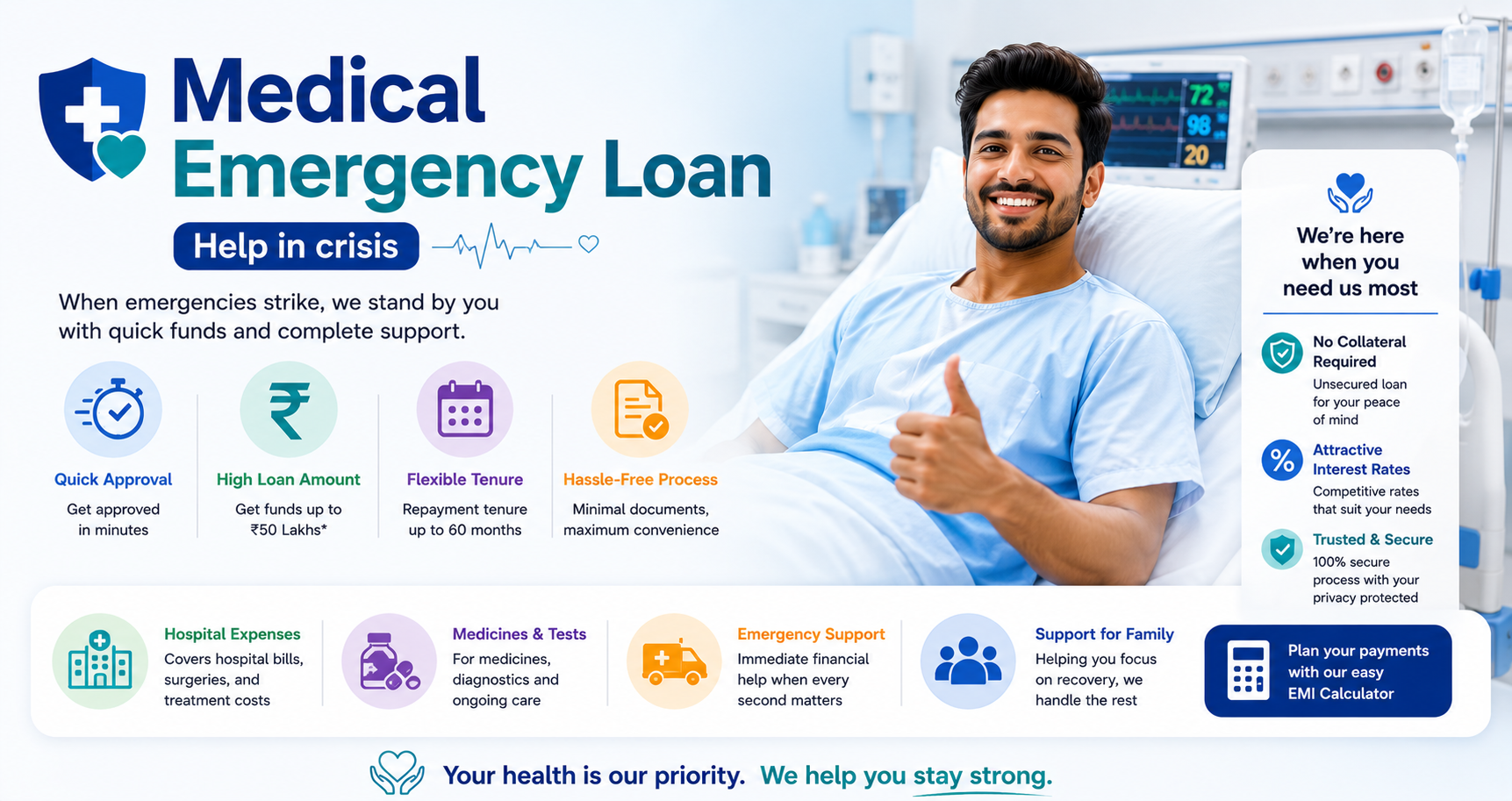
A medical emergency loan is a personal loan disbursed quickly to meet hospital costs. Some lenders offer expedited processing for medical purposes, and disbursal within a day is realistic where documentation is ready.
It does a genuine job in a crisis. Hospitals ask for deposits, cashless approval can be partial, and non-medical items are never covered — all of which produce an immediate cash requirement that a family may not have available.
It is also, almost always, evidence of an insurance gap. The reason a family is borrowing at eleven per cent for a hospital bill is usually a sum insured set years ago, a room rent limit that reduced the settlement, or no cover at all. Once the immediate crisis is handled, that gap is the thing worth fixing.
Who should consider it
Families facing an immediate hospital payment beyond their liquid savings. Patients whose insurance has partially settled and left a shortfall. Anyone needing treatment not covered by their policy.
Benefits
- Fast disbursal, often within a day where documents are ready
- No collateral required at a moment when nothing can be arranged
- Covers hospital deposits and non-medical items insurance excludes
- Fixed EMI so the repayment is predictable afterwards
- Can bridge the gap while an insurance claim is processed
- Available for treatment your policy does not cover
What the loan funds, and what it does not
Read the right-hand column first. It is the one that decides how much you have to arrange yourself.
Usually funded
- Hospital admission deposits
- Treatment costs above the insurance settlement
- Non-medical consumables that policies exclude
- Treatment for conditions inside a waiting period
- Post-hospitalisation care, medication and rehabilitation
- Travel and accommodation for treatment in another city
Usually not funded
- Processing fee, usually deducted from disbursal
- A preferential rate, beyond expedited processing at some lenders
- Amounts beyond what your income supports
- Tax deduction on the interest
Funding limits and the treatment of add-ons vary between lenders and move with the borrower profile. The sanction letter you receive is what governs — we will walk you through it before you sign.
How it works with us
- 1 Eligibility checked before any application is filed Each rejected application marks your credit file. We match your profile to lenders who will actually approve it, rather than applying everywhere.
- 2 Compared on total cost, not the advertised rate Processing fee, insurance bundling and prepayment terms often matter more than the headline number.
- 3 We name the cheaper alternative if there is one A top-up on your home loan or a loan against securities is often half the cost. If that applies to you, we will say so.
- 4 One document set, submitted once Prepared properly the first time, which is what makes same-day approval realistic.
- 5 Sanction, disbursal and a repayment plan The sanction states rate, fee and prepayment terms. We set out how prepaying would work before you need it.
Important considerations
The things a brochure tends to leave out. Read these before you decide.
- Exhaust the insurance first. Even a partial cashless approval reduces what you need to borrow, and a reimbursement claim can be filed afterwards.
- Check whether the hospital offers a payment plan. Many do, at no interest, and it is worth asking before borrowing.
- A loan against a fixed deposit or securities disburses almost as quickly and costs far less. If you hold either, use them.
- Once the crisis has passed, fix the cover. A super top-up above a deductible is inexpensive and would have removed most of this exposure.
- Keep every bill and prescription. Even where insurance has declined initially, a properly documented claim can succeed on review.
Documents required
- Identity proof — Aadhaar, PAN or passport
- Address proof
- Salaried: last three months of salary slips and Form 16
- Self-employed: last two years of income tax returns with computation
- Bank statements for the last six months
- Employment proof or business registration
- Recent passport-size photograph
- Existing loan and credit card statements
Frequently Asked Questions
How quickly can the money reach me?
Often the same day where your documentation is in order, and some lenders expedite medical cases specifically. Having identity, income and bank documents ready is what makes that speed real rather than theoretical.
Should I borrow if my insurance claim is pending?
Sometimes — a hospital deposit cannot wait for a claim to process. Where possible, use the loan to bridge and repay it when the settlement arrives. Just make sure the loan does not carry a prepayment lock-in that prevents that.
Is there a cheaper way in an emergency?
A loan against a fixed deposit or against securities disburses almost as fast and costs far less, because it is secured. If you hold either, that is the better route. Many hospitals also offer interest-free payment plans that are worth asking about.
Why do you say this indicates an insurance gap?
Because the usual reasons for borrowing to pay a hospital bill are a sum insured set years ago, a room rent limit that reduced the settlement, or no cover at all. Once the immediate crisis is handled, that is the thing worth fixing — a super top-up above a deductible is inexpensive and closes most of it.
Are non-medical items covered by the loan?
The loan covers whatever you need it to. That matters because insurance policies exclude non-medical consumables entirely, and on a long admission those items add up to a substantial part of the bill.
Want a shortlist instead of a catalogue?
Tell us the situation and an advisor comes back with two or three options that actually fit — and names what each one gives up.