
Get Expert Guidance
What Our Plans Cover
-
Building structure and common area...
-
Lifts
-
Compound wall
-
Clubhouse
-
Fire
-
Public liability in common areas
-
Terrorism
-
Debris removal after a loss
Who Can Consider This Plan?
- Legal ownership, or an insurable interest such as a lease
- Property of permanent construction, meeting the insurer's standards
- Accurate declaration of occupancy and use
- Sum insured set on a defensible valuation basis
- Compliance with any fire safety requirements applicable to the premises
What May Not Be Covered?
- Interior finishes and contents of individual flats
- Personal belongings of residents
- Damage from lack of maintenance of common areas
- Unauthorised construction and illegal alterations
- Gradual deterioration, seepage and rising damp
Always check the policy wording before you commit.
Why Choose Wealth & Covers?
- Expert advice to choose the right plan
- Plans from leading insurance companies
- Hassle-free process and documentation
- End-to-end support, including claim assistance
- Dedicated relationship manager
Our Insurance Partners
- Star Health Insurance
- Care Health Insurance
- Niva Bupa Health Insurance
- HDFC ERGO
- ICICI Lombard
- Bajaj Allianz
We represent multiple providers to help you find the most suitable option at the best price.
- Expert Guidance Personalised advice from experienced insurance professionals.
- End-to-End Support From choosing the right plan to claim assistance, we are with you always.
- Claims Assistance Hassle-free claim support to ensure you get what you deserve.
- Transparent Process Clear information, easy documentation and a hassle-free experience.
Overview
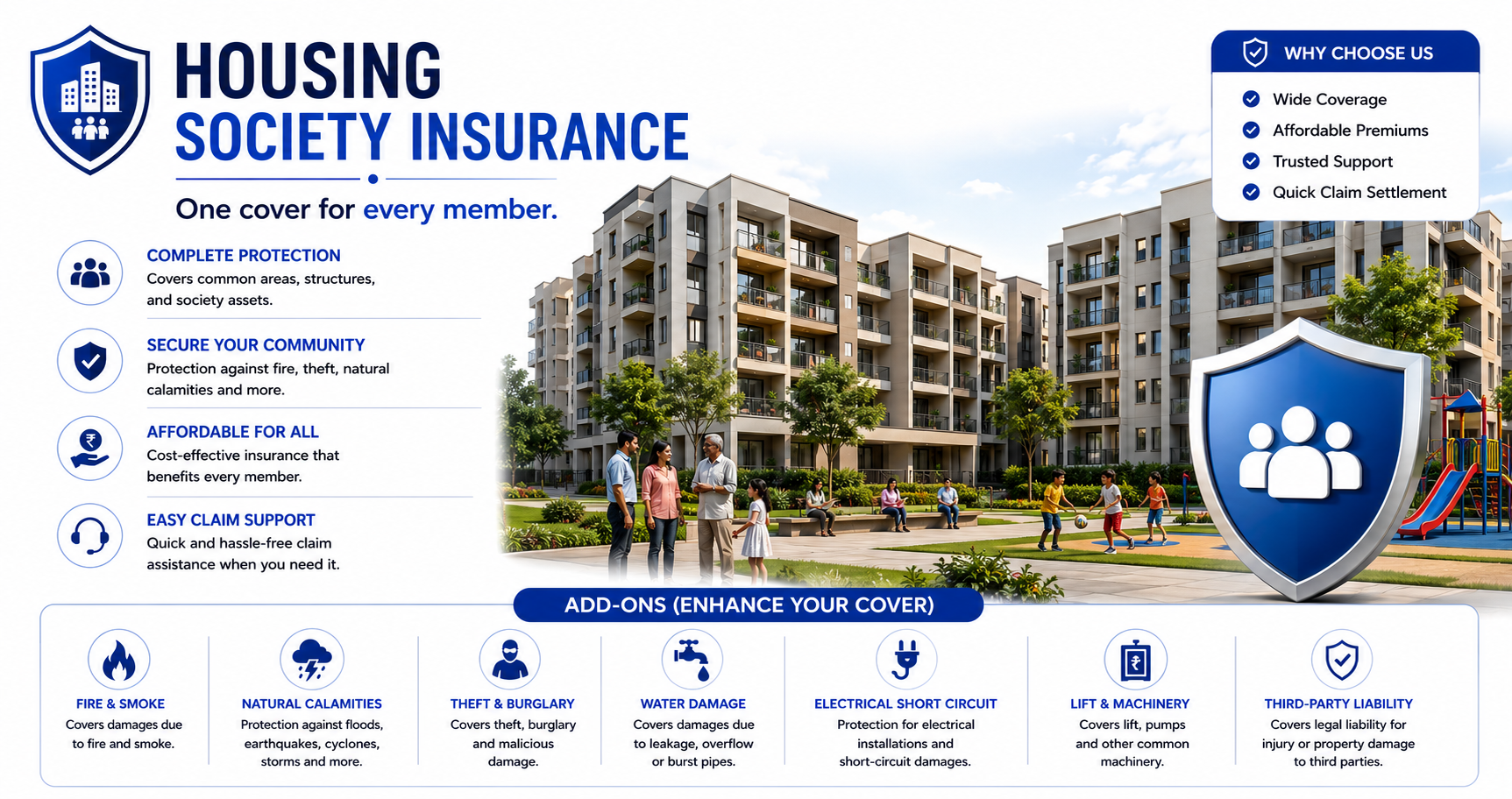
A housing society policy covers the building structure and the common assets — lifts, pumps, generators, gates, the clubhouse, the compound wall — that belong collectively to the members rather than to any individual flat owner.
The boundary between the society's cover and an individual flat owner's cover is where most disputes start. Broadly, the society insures the structure and shared plant; the owner insures the interior finishes and contents. Where exactly that line sits should be written down before a claim, not argued afterwards.
The second issue is the sum insured. Societies frequently insure on a figure set when the building was new and never revisited. Reconstruction costs have risen substantially, and a society insured on a twenty-year-old valuation is materially under-insured.
Who should consider it
Co-operative housing societies, apartment owners' associations and resident welfare associations. In many states some cover is a statutory obligation of the managing committee.
Benefits
- Covers the structure and common assets no individual owner insures
- Public liability for accidents in common areas
- Machinery breakdown cover for lifts, pumps and generators
- Terrorism cover, which individual policies often omit
- Cost shared across all members, so the per-flat cost is small
- Protects the committee against personal exposure for uninsured losses
What is covered, and what is not
Read the right-hand column first. It is the one that decides whether a claim is paid.
Typically covered
- Building structure and common areas
- Lifts, pumps, generators and other common plant
- Compound wall, gates and external fittings
- Clubhouse, gym and shared amenities
- Fire, flood, earthquake and other natural perils
- Public liability in common areas
- Terrorism, where the cover is taken
- Debris removal after a loss
Typically not covered
- Interior finishes and contents of individual flats
- Personal belongings of residents
- Damage from lack of maintenance of common areas
- Unauthorised construction and illegal alterations
- Gradual deterioration, seepage and rising damp
- Consequential loss, including loss of maintenance income
- Structural defects present from construction
Inclusions and exclusions vary between providers and between plans from the same provider. The wording in your own policy document is what governs — we will walk you through it before you buy.
How it works with us
- 1 We value the risk before we quote it Reinstatement cost of the structure, current value of the contents, and what a total loss would actually cost to rebuild today.
- 2 Perils matched to the location A coastal warehouse, a basement in a flood-prone city and a first-floor office are three different risks. The policy should reflect which one you are.
- 3 Quotes compared on sum insured basis, not premium Market value against reinstatement value changes what you receive far more than the premium difference between insurers.
- 4 Survey where the value warrants it Larger risks are surveyed before cover. It is also the moment to fix anything that would reduce a claim later.
- 5 Policy issued, and reviewed annually We revisit the sum insured every renewal. Under-insurance is the single most common reason property claims are cut.
Important considerations
The things a brochure tends to leave out. Read these before you decide.
- Revalue the sum insured every few years. Societies insured on the original construction cost are commonly under-insured by a wide margin, and the average clause then reduces every claim.
- Write down the boundary between society cover and flat-owner cover, and circulate it. Disputes about whether a leak is structural or internal are far easier to settle before the leak.
- Public liability in common areas is genuinely important. A fall in a stairwell or a lift entrapment injury is a claim against the society, not against any resident.
- Lift and pump breakdown cover is usually an extension. It is inexpensive and covers the most frequent expensive failure a society faces.
- Circulate the policy summary to members annually. Residents who know what is not covered are far more likely to insure their own flats.
Documents required
- Proof of ownership or the lease agreement
- Details of construction — age, materials, number of floors
- Valuation or reinstatement cost estimate of the structure
- Inventory and value of contents, stock or equipment
- Details of fire protection and security arrangements
- Previous policy and claims history, where applicable
- Photographs of the premises, for larger risks
Frequently Asked Questions
What does the society policy cover and what must I insure myself?
Broadly, the society covers the structure, common areas and shared plant. You cover your flat's interior finishes, fittings and contents. The exact boundary should be documented and circulated — most disputes after a loss are about where that line sits.
How often should the sum insured be revised?
Every three to five years at minimum. Construction costs have risen substantially and societies insured on a figure set when the building was new are almost always under-insured, which reduces every claim through the average clause.
Is the society liable if a visitor is injured in the lobby?
Potentially yes, which is why public liability cover in common areas matters. It responds to injuries in stairwells, lobbies, parking areas and lifts, and those are the most frequent liability claims a society faces.
Are lifts and generators covered for breakdown?
Not under the basic fire and perils cover — breakdown is a separate machinery extension. It is inexpensive and covers exactly the failures that cost societies most.
Is society insurance mandatory?
Several states require co-operative housing societies to maintain insurance on the structure, and the managing committee carries the responsibility. Check your state's co-operative societies rules; where it applies, the committee is personally exposed if it is not in place.
Want a shortlist instead of a catalogue?
Tell us the situation and an advisor comes back with two or three options that actually fit — and names what each one gives up.