
Plan your investment
What Our Plans Cover
-
Investment across the fund's unlis...
-
Professional sourcing
-
Periodic valuation and investor re...
-
Distributions as positions are exi...
-
Management of post-listing lock-in...
Who Can Consider This Plan?
- Minimum commitment of ₹1 crore per investor, as regulated
- Indian resident individual, HUF, trust, company or NRI
- Completed KYC with the fund
- Ability to meet capital calls through the drawdown period
- Acceptance by the fund manager, which is discretionary
What May Not Be Covered?
- Any assurance that portfolio companies will list
- Liquidity before the fund realises positions
- Valuations based on traded prices rather than estimates
- Any guarantee of return
- Immediate sale on listing, given lock-in restrictions
Always check the policy wording before you commit.
Why Choose Wealth & Covers?
- Expert advice to choose the right plan
- Plans from leading investments companies
- Hassle-free process and documentation
- End-to-end support, including claim assistance
- Dedicated relationship manager
- Expert Guidance Personalised advice from experienced investments professionals.
- End-to-End Support From choosing the right plan to claim assistance, we are with you always.
- Claims Assistance Hassle-free claim support to ensure you get what you deserve.
- Transparent Process Clear information, easy documentation and a hassle-free experience.
Overview
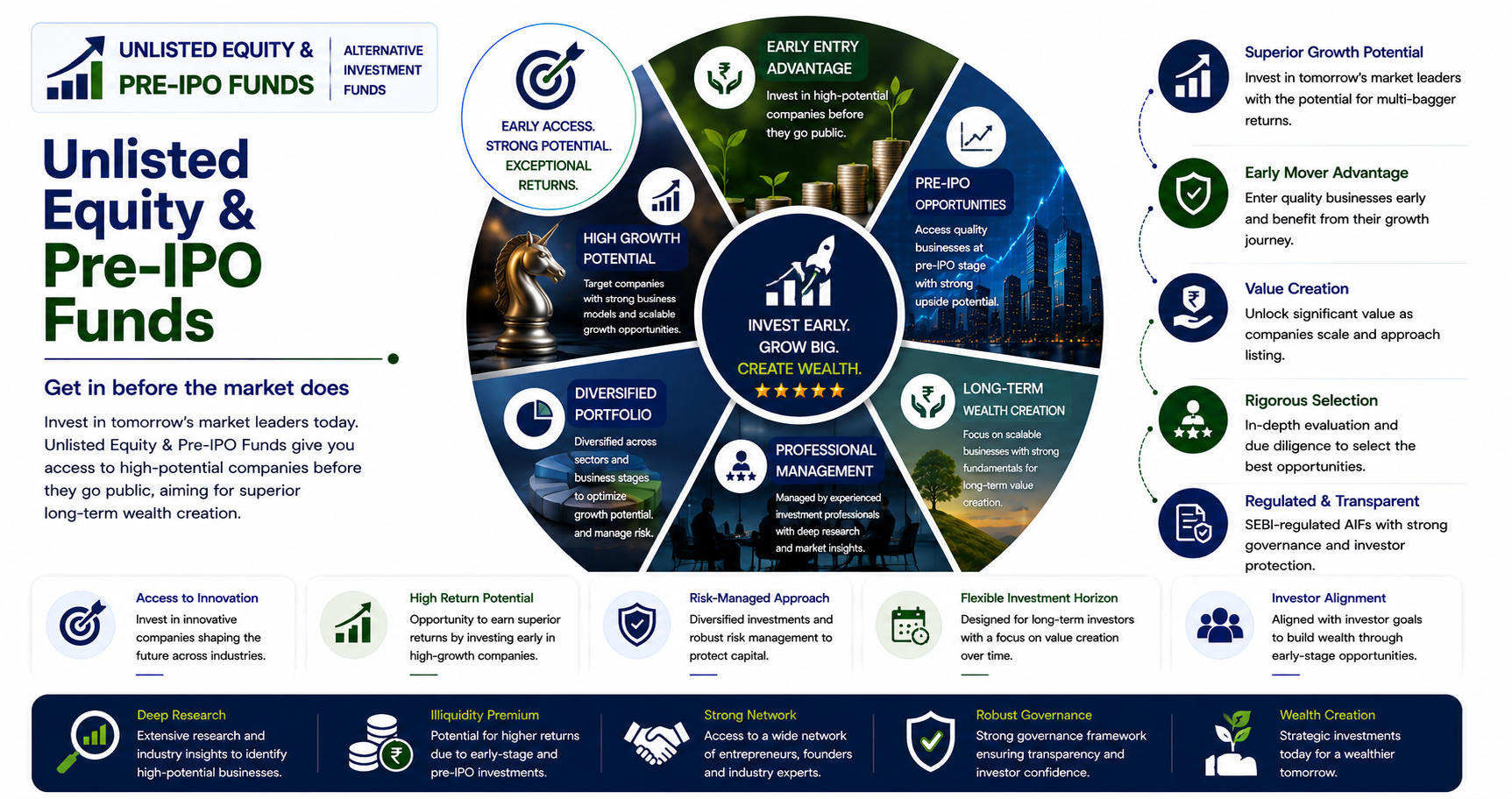
Pre-IPO and unlisted equity funds buy shares in companies before they list, on the expectation of a listing at a higher valuation. Compared with buying unlisted shares directly, a fund brings diligence capability, negotiating power and diversification across several companies.
Those advantages are real. A fund can access allocations individuals cannot, negotiate terms, and spread across positions so that one disappointment does not determine the outcome.
The core risks remain unchanged. A listing may not happen, or may happen at a valuation below the entry price. Post-listing lock-in periods restrict when the fund can sell. And valuations before listing are estimates rather than prices, so reported performance is less firm than it appears.
Who should consider it
Investors seeking pre-listing exposure who prefer professional diligence to buying unlisted shares directly. Investors able to lock capital for several years and absorb the possibility that listings do not occur.
Benefits
- Professional diligence on companies with limited public disclosure
- Access to allocations individuals cannot obtain
- Diversification across several pre-listing positions
- Negotiating power on price and terms
- Management of lock-in periods and exit timing
- Better information access than an individual buyer
What is included, and what is not
Read the right-hand column first. It is the one that tends to surprise people later.
Included
- Investment across the fund's unlisted portfolio
- Professional sourcing, diligence and negotiation
- Periodic valuation and investor reporting
- Distributions as positions are exited
- Management of post-listing lock-in periods
Not included
- Any assurance that portfolio companies will list
- Liquidity before the fund realises positions
- Valuations based on traded prices rather than estimates
- Any guarantee of return
- Immediate sale on listing, given lock-in restrictions
Terms vary between providers and between plans from the same provider. The offer document you receive is what governs — we will walk you through it before you commit.
How it works with us
- 1 We start with whether an AIF suits you at all A one-crore minimum, multi-year lock-ins and higher fees. If a mutual fund does the same job, we will say so.
- 2 Category and strategy matched to the objective Category I, II and III are genuinely different things. Choosing between them is the substantive decision.
- 3 Fees and terms read in full Management fee, carry, hurdle rate, catch-up and drawdown schedule. These vary enormously and compound over a fund's life.
- 4 Commitment and drawdown planned You commit capital that is called over time. Liquidity has to be arranged for calls you cannot decline.
- 5 Reporting tracked through the fund life Valuations are periodic and taxation differs by category. We keep the reporting straight through to wind-up.
Important considerations
The things a brochure tends to leave out. Read these before you decide.
- A listing is an expectation, not a commitment. Companies postpone and abandon IPOs, and the fund holds an illiquid position when they do.
- Reported valuations before listing are estimates. Interim performance figures are considerably softer than they look.
- Post-listing lock-ins restrict when the fund can sell, so a listing pop does not necessarily translate into a realised gain.
- Assess the manager's realised exits rather than paper gains. In this category the difference between the two is the whole question.
- Diversification across positions is what makes the strategy work. A concentrated pre-IPO fund is a very different risk.
Documents required
- PAN card
- Aadhaar or other identity proof
- Address proof
- Demat account details
- Bank account proof
- Net worth or income evidence, where the fund requires it
- Completed KYC and contribution agreement
Frequently Asked Questions
Why use a fund rather than buying unlisted shares directly?
Diligence, access, diversification and negotiating power. An individual buying unlisted shares from a dealer has limited information, no leverage on price and a concentrated position. A fund addresses all four, which is the case for paying the fees.
What if the companies do not list?
The fund holds illiquid positions with no ready market. Companies postpone and abandon IPOs regularly, and there is no obligation to list. This is the central risk of the strategy and it should be assumed rather than discounted.
Can the fund sell immediately on listing?
Not usually. Pre-IPO holdings are subject to lock-in periods after listing, so a strong debut does not immediately convert into a realised gain. Managing those windows is part of what the manager is doing.
How reliable are the interim valuations?
They are estimates rather than traded prices, so reported performance before exits is considerably softer than it appears. Assessing a manager on realised exits rather than paper valuations is the only meaningful test.
How diversified should the portfolio be?
Enough that no single position determines the outcome. A concentrated pre-IPO fund carries much of the risk of buying unlisted shares directly while still charging fund fees, which is the worst combination.
Want a shortlist instead of a catalogue?
Tell us the situation and an advisor comes back with two or three options that actually fit — and names what each one gives up.