
Get Expert Guidance
What Our Plans Cover
-
Survival benefits at the scheduled...
-
Death benefit at the full sum assu...
-
Maturity benefit with accrued bonu...
-
Bonuses declared by the insurer
-
Loan facility against the surrende...
-
Optional riders at additional prem...
Who Can Consider This Plan?
- Entry age typically 18 to 60, varying sharply by product
- Income sufficient to sustain the premium for the full term
- Full disclosure of health, lifestyle and family medical history
- Medical examination above a threshold age or sum assured
- Indian resident or NRI, subject to the insurer's country rules
What May Not Be Covered?
- Market-linked returns — this is a guaranteed, low-return structure
- Suicide within the first twelve months
- Full value on early surrender
- Any guarantee of the bonus rate, which is declared annually
- Death from material facts concealed at proposal
Always check the policy wording before you commit.
Why Choose Wealth & Covers?
- Expert advice to choose the right plan
- Plans from leading insurance companies
- Hassle-free process and documentation
- End-to-end support, including claim assistance
- Dedicated relationship manager
Our Insurance Partners
- Star Health Insurance
- Care Health Insurance
- Niva Bupa Health Insurance
- HDFC ERGO
- ICICI Lombard
- Bajaj Allianz
We represent multiple providers to help you find the most suitable option at the best price.
- Expert Guidance Personalised advice from experienced insurance professionals.
- End-to-End Support From choosing the right plan to claim assistance, we are with you always.
- Claims Assistance Hassle-free claim support to ensure you get what you deserve.
- Transparent Process Clear information, easy documentation and a hassle-free experience.
Overview
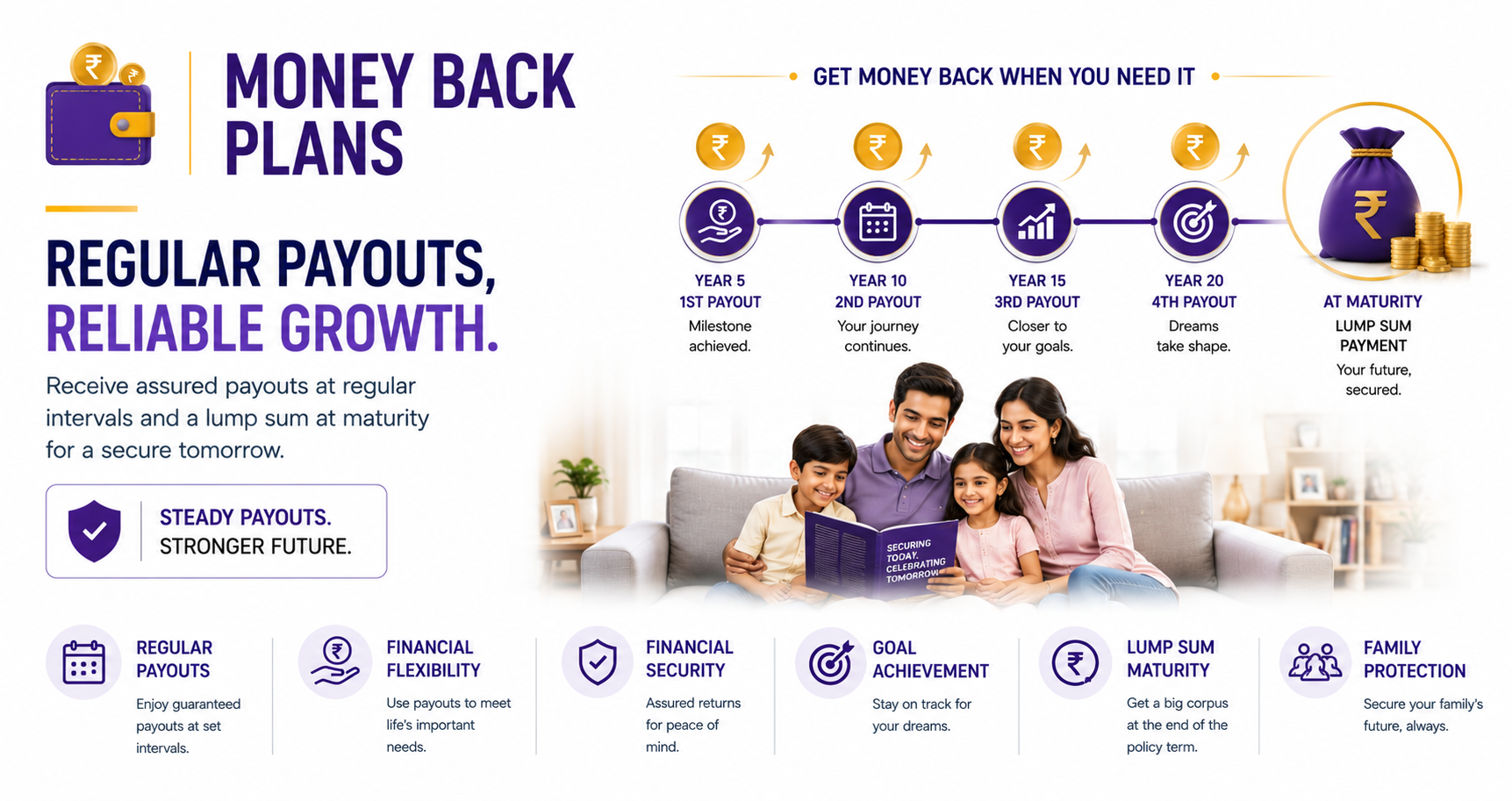
A money back plan returns a portion of the sum assured at intervals during the policy term — commonly every five years — and pays the balance with bonuses at maturity. The life cover remains at the full sum assured throughout, regardless of how much has already been paid out.
Its appeal is liquidity. Money arrives periodically rather than only at the end, which suits buyers who want the discipline of a long contract without the wait.
Its cost is return. Money paid back early is money no longer compounding, so the effective return on a money back plan is typically lower than an endowment of the same premium. You are buying access, and access has a price.
Who should consider it
Buyers who want periodic liquidity from a long-term contract — perhaps to meet a recurring expense — and who value the certainty of a guaranteed schedule.
Anyone whose goal is maximum accumulation should look at an endowment or, more likely, at a term plan plus a systematic investment. The periodic payouts here are convenient rather than efficient.
Benefits
- Guaranteed payouts at defined intervals during the term
- Life cover stays at the full sum assured despite payouts made
- Maturity benefit with accrued bonuses at the end
- Predictable schedule with no market risk on the guaranteed portion
- Section 80C on premium; proceeds generally exempt under Section 10(10D)
- Loan facility against the policy after it acquires value
What is covered, and what is not
Read the right-hand column first. It is the one that decides whether a claim is paid.
Typically covered
- Survival benefits at the scheduled intervals
- Death benefit at the full sum assured, irrespective of payouts already made
- Maturity benefit with accrued bonuses
- Bonuses declared by the insurer, on participating variants
- Loan facility against the surrender value
- Optional riders at additional premium
Typically not covered
- Market-linked returns — this is a guaranteed, low-return structure
- Suicide within the first twelve months
- Full value on early surrender
- Any guarantee of the bonus rate, which is declared annually
- Death from material facts concealed at proposal
- Flexibility to change the payout schedule once set
Inclusions and exclusions vary between providers and between plans from the same provider. The wording in your own policy document is what governs — we will walk you through it before you buy.
How it works with us
- 1 Start with the goal, not the plan A school fee in 2038, an income from 2045, an estate to pass on. The goal decides the structure; the brand is the last decision, not the first.
- 2 We separate the protection from the saving You see what the cover costs and what the savings portion is projected to return, as two numbers rather than one blended promise.
- 3 Compared against the honest alternative Term insurance plus a mutual fund, on the same premium and the same horizon. Sometimes this plan wins; often it does not, and we say so.
- 4 Proposal, medicals and financial underwriting Medicals arranged at home. For larger premiums, insurers assess income as well as health.
- 5 Issued, with the illustration on file We keep the benefit illustration you were shown, so what was promised is on record for the whole term.
Important considerations
The things a brochure tends to leave out. Read these before you decide.
- The periodic payouts reduce compounding, which is why the effective return is lower than an endowment on the same premium. Convenience has a cost and this is it.
- Calculate the internal rate of return on the actual cash flows rather than adding up the payouts. The headline total always looks larger than the return justifies.
- The life cover here is modest relative to the premium. Do not treat it as your protection — hold a term plan alongside.
- Bonuses are declared annually and are not guaranteed. Only the guaranteed portion is contractually certain, and the illustration shows both separately.
- If you do not actually need the periodic money, taking it and spending it defeats the purpose. Be honest about whether the liquidity is a need or a preference.
Documents required
- Completed proposal form with full health disclosure
- Identity proof — Aadhaar, passport or PAN
- Address proof
- PAN card, mandatory for life insurance
- Income proof — Form 16, salary slips or filed returns
- Bank statements, for larger premiums
- Medical reports, where the insurer requires them
- Recent passport-size photograph
Frequently Asked Questions
Does the life cover reduce after each payout?
No. The death benefit stays at the full sum assured throughout the term regardless of how much has already been paid out as survival benefits. That is a genuine feature of the structure.
What return can I expect?
Modest — guaranteed plans of this type typically deliver returns in the region of a fixed deposit rather than an equity portfolio. Ask for the internal rate of return on the actual cash flows, not the sum of the payouts, which always looks better than it is.
Is it better than an endowment plan?
It offers liquidity an endowment does not, and returns slightly less as a result. If you genuinely need money at intervals, the trade is reasonable. If you do not, the endowment accumulates more.
Are the bonuses guaranteed?
No. Bonuses are declared annually by the insurer based on its performance and can vary. Only the guaranteed portion is contractually certain, and your benefit illustration separates the two.
Should I use this as my main life cover?
No. The sum assured relative to the premium is low. Hold a term plan sized to your family's actual needs, and treat this as a savings instrument that happens to include some cover.
Want a shortlist instead of a catalogue?
Tell us the situation and an advisor comes back with two or three options that actually fit — and names what each one gives up.