
Plan your investment
What Our Plans Cover
-
Units in a listed real estate inve...
-
Periodic distributions from rental...
-
Exposure to a diversified portfoli...
-
Holding in your demat account
-
Ability to buy and sell on the exc...
Who Can Consider This Plan?
- Indian resident individual, HUF, trust or company
- NRIs, subject to the applicable investment routes
- A demat account and a trading account
- PAN and completed KYC
- Minimum investment as per the exchange lot size
What May Not Be Covered?
- Any guarantee of distribution amount or frequency
- Protection against unit price falls
- Direct ownership of any specific building
- Tax exemption — distributions are taxable, with components treated differently
- Behaviour resembling physical property, which does not reprice daily
Always check the policy wording before you commit.
Why Choose Wealth & Covers?
- Expert advice to choose the right plan
- Plans from leading investments companies
- Hassle-free process and documentation
- End-to-end support, including claim assistance
- Dedicated relationship manager
- Expert Guidance Personalised advice from experienced investments professionals.
- End-to-End Support From choosing the right plan to claim assistance, we are with you always.
- Claims Assistance Hassle-free claim support to ensure you get what you deserve.
- Transparent Process Clear information, easy documentation and a hassle-free experience.
Overview
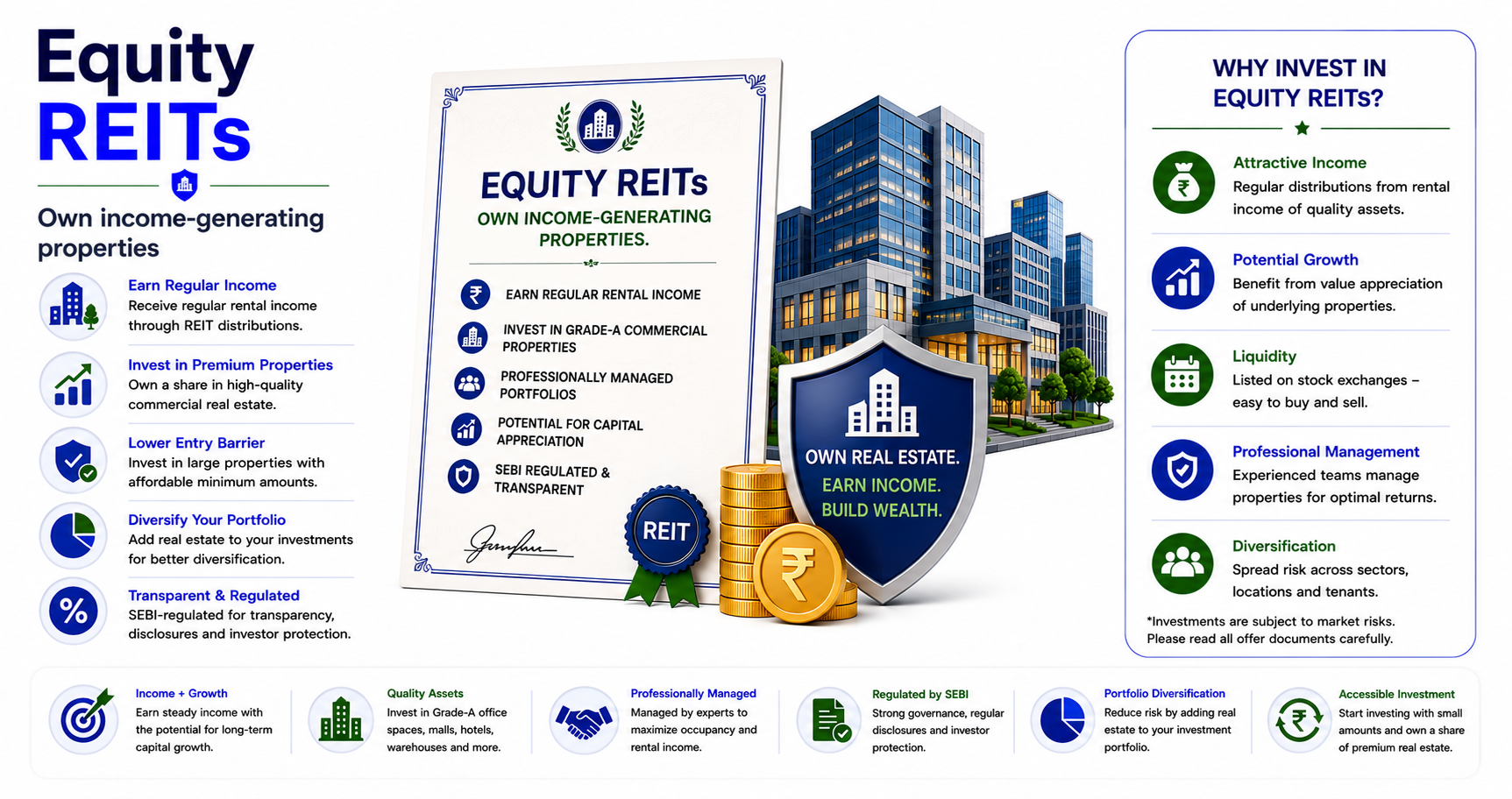
An equity REIT owns commercial property — offices, malls, warehouses — and distributes the rental income it collects to unitholders. Indian regulations require a REIT to distribute the large majority of its distributable cash flows, which is what makes the income relatively predictable.
For a retail investor the appeal is access. Institutional-grade commercial property is otherwise unreachable: the ticket sizes run into hundreds of crores. A REIT lets you own a fraction of a portfolio of such buildings for the price of a few units.
What it does not do is behave like property. REIT units are listed and trade continuously, so the price moves daily with markets and sentiment, and it can fall sharply while the underlying buildings are perfectly fine. Investors expecting property-like stability are usually surprised by their first serious drawdown.
Who should consider it
Investors wanting commercial property exposure without buying a building. Investors seeking regular income with some inflation linkage through rent escalation. Anyone diversifying away from residential property, which is what most Indian households already own.
Benefits
- Access to institutional-grade commercial property at retail ticket sizes
- Mandated distribution of the majority of distributable cash flows
- Rental income with escalation clauses providing some inflation linkage
- Liquidity that direct property ownership never offers
- Professional management of the underlying assets
- No maintenance, tenant management or registration to deal with
What is included, and what is not
Read the right-hand column first. It is the one that tends to surprise people later.
Included
- Units in a listed real estate investment trust
- Periodic distributions from rental income
- Exposure to a diversified portfolio of commercial assets
- Holding in your demat account
- Ability to buy and sell on the exchange
Not included
- Any guarantee of distribution amount or frequency
- Protection against unit price falls
- Direct ownership of any specific building
- Tax exemption — distributions are taxable, with components treated differently
- Behaviour resembling physical property, which does not reprice daily
Terms vary between providers and between plans from the same provider. The offer document you receive is what governs — we will walk you through it before you commit.
How it works with us
- 1 We explain what a REIT actually is first Not a property purchase and not a fixed deposit. A listed security whose income comes from rent, and whose price moves with markets.
- 2 Distribution yield examined properly Yield alone is not the answer. The mix of rent, occupancy, lease expiries and debt is what tells you whether it is sustainable.
- 3 Allocation sized against your existing property exposure Most Indian households already hold a great deal of real estate. A REIT should complement that, not concentrate it further.
- 4 Purchase through the exchange REIT units trade like shares and settle into your demat account. The mechanics are simple; the analysis is where the work is.
- 5 Distributions tracked and taxed correctly REIT distributions have several components with different tax treatments. We make sure they are reported properly.
Important considerations
The things a brochure tends to leave out. Read these before you decide.
- A REIT trades like a security, not like a building. Expect the price to move daily and to fall in market declines even when occupancy and rent are unchanged.
- Look at occupancy, lease expiry schedule and tenant concentration, not just the yield. A high yield with a cluster of leases expiring next year is a different proposition.
- Distributions have several components — interest, dividend, rental income, return of capital — each taxed differently. Getting this right in your return matters.
- Most Indian households are already heavily exposed to real estate through their home. A REIT should diversify that, not add to it.
- Distributions are not guaranteed. They depend on rent actually collected, and occupancy can fall.
Documents required
- PAN card
- Aadhaar or other identity proof
- Address proof
- Demat account details
- Bank account proof for distribution credit
- Completed KYC with the broker
Frequently Asked Questions
Is a REIT like buying property?
In what it owns, yes; in how it behaves, no. A REIT is a listed security whose price moves daily with markets, and it can fall sharply while the underlying buildings are fully occupied and performing. Investors expecting property-like stability are usually surprised by their first serious drawdown.
How reliable are the distributions?
Indian regulations require REITs to distribute the majority of distributable cash flows, which makes the income relatively predictable — but not guaranteed. Distributions depend on rent actually collected, and occupancy, lease renewals and tenant defaults all affect that.
How are distributions taxed?
By component. A distribution can include interest, dividend, rental income and return of capital, each with its own treatment. The REIT provides a breakdown, and reporting it correctly in your return matters more than in most investments.
What should I look at besides the yield?
Occupancy, the lease expiry schedule, tenant concentration and the trust's debt levels. A high yield with a large block of leases expiring shortly, or with one tenant dominating the rent roll, is a very different proposition from the same yield with staggered expiries and a diverse tenant base.
Should I hold this alongside my home?
Consider that your home already gives you substantial real estate exposure. A REIT holding commercial property diversifies that meaningfully; treating it as an additional bet on the same asset class concentrates rather than diversifies.
Want a shortlist instead of a catalogue?
Tell us the situation and an advisor comes back with two or three options that actually fit — and names what each one gives up.