
Plan your investment
What Our Plans Cover
-
Units in an InvIT holding towers
-
Distributions from contracted leas...
-
Exposure across a portfolio of sit...
-
Tenancy and operational data in pe...
-
Holding in your demat account
Who Can Consider This Plan?
- Indian resident individual, HUF, trust or company
- NRIs, subject to the applicable investment routes
- A demat account and a trading account
- PAN and completed KYC
- Minimum investment as per the exchange lot size
What May Not Be Covered?
- Protection against tenant concentration risk
- Protection against technology change reducing asset requirements
- Any guarantee of contract renewal
- Any guarantee of distribution
Always check the policy wording before you commit.
Why Choose Wealth & Covers?
- Expert advice to choose the right plan
- Plans from leading investments companies
- Hassle-free process and documentation
- End-to-end support, including claim assistance
- Dedicated relationship manager
- Expert Guidance Personalised advice from experienced investments professionals.
- End-to-End Support From choosing the right plan to claim assistance, we are with you always.
- Claims Assistance Hassle-free claim support to ensure you get what you deserve.
- Transparent Process Clear information, easy documentation and a hassle-free experience.
Overview
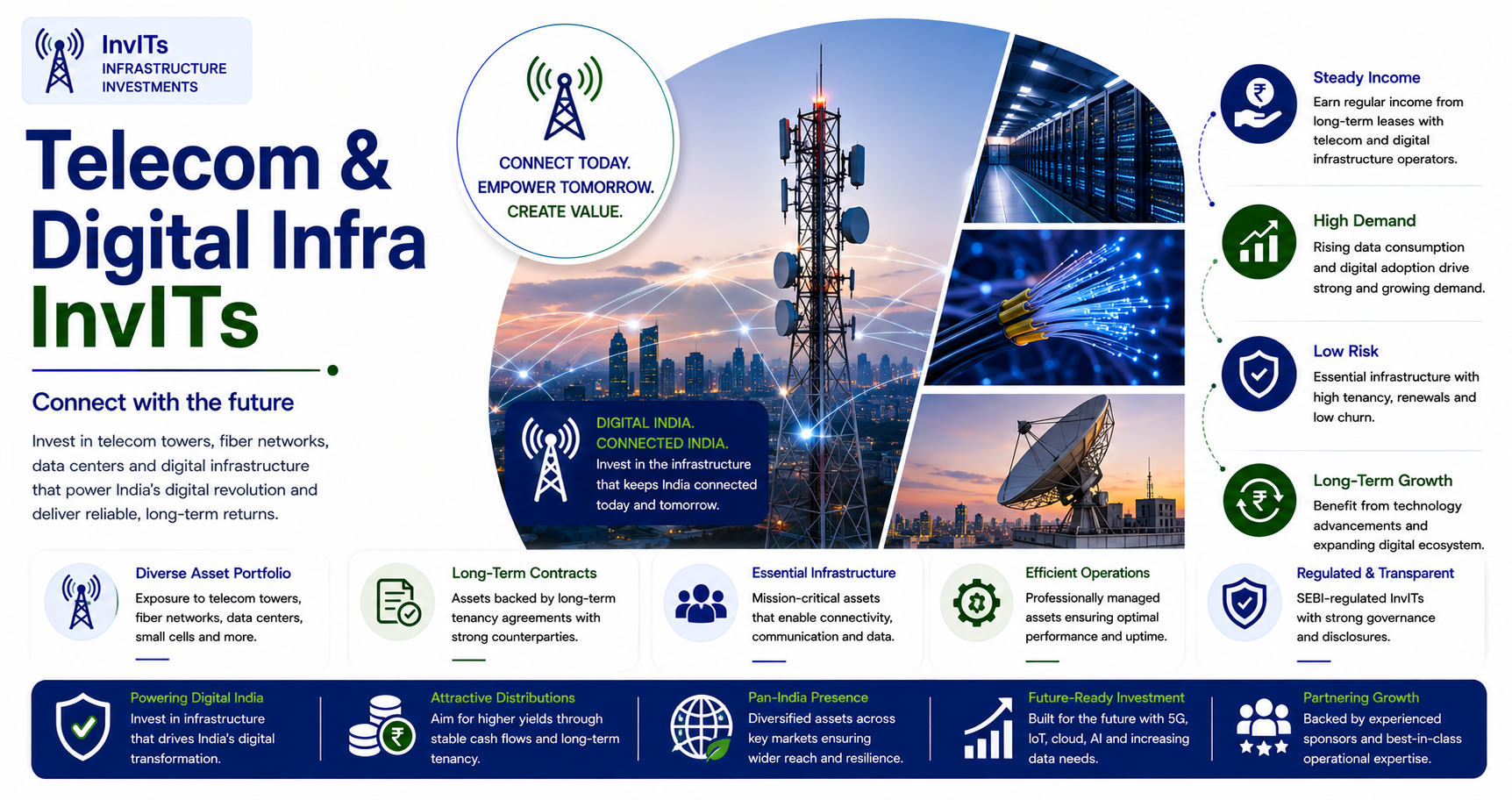
Telecom and digital infrastructure InvITs hold passive assets — mobile towers, fibre networks, data centre facilities — and lease them to telecom operators and digital service providers under long-term contracts.
The economics are attractive in principle. A tower shared by three operators earns three tenancies from one structure, and the incremental cost of the second and third tenant is small. Contracts are long, escalation clauses are common, and the tenants have little practical alternative once equipment is installed.
The concentration risk is the counterweight. The Indian telecom market has consolidated to a small number of operators, so a large share of a portfolio's revenue typically comes from very few counterparties. The financial health of those operators is therefore not a background consideration — it is the central one.
Who should consider it
Investors wanting exposure to digital infrastructure. Income-focused investors comfortable with telecom counterparty concentration. Anyone with a view on data consumption growth and network expansion.
Benefits
- Long-term contracts with escalation clauses
- Tenancy sharing improves economics on existing structures
- High switching costs for tenants once equipment is installed
- Exposure to growth in data consumption and network density
- Passive assets with relatively predictable operating costs
- Listed liquidity
What is included, and what is not
Read the right-hand column first. It is the one that tends to surprise people later.
Included
- Units in an InvIT holding towers, fibre or digital infrastructure
- Distributions from contracted lease revenue
- Exposure across a portfolio of sites and networks
- Tenancy and operational data in periodic disclosure
- Holding in your demat account
Not included
- Protection against tenant concentration risk
- Protection against technology change reducing asset requirements
- Any guarantee of contract renewal
- Any guarantee of distribution
Terms vary between providers and between plans from the same provider. The offer document you receive is what governs — we will walk you through it before you commit.
How it works with us
- 1 We explain the finite-life point first Most InvIT assets have a concession period. Part of the yield is your own capital returning, and that changes how to read it.
- 2 Distribution quality examined, not just the number How much is genuinely surplus cash and how much is capital return, and what happens to it as the concession runs down.
- 3 Counterparty and concession terms read carefully Who pays the revenue, under what contract, and for how long. That is where the real risk in an InvIT sits.
- 4 Purchase through the exchange Listed InvIT units trade like shares and settle into your demat account.
- 5 Distributions tracked and taxed by component Interest, dividend and return of capital are taxed differently. Reporting them correctly is part of holding these.
Important considerations
The things a brochure tends to leave out. Read these before you decide.
- Tenant concentration is the defining risk. The Indian telecom market has few operators, and a large share of revenue typically comes from very few counterparties.
- Tenancy ratio — tenants per tower — drives the economics. Improving it adds revenue with very little additional cost, and it is the metric worth tracking.
- Technology change affects asset requirements. Network architecture evolves, and what operators need from passive infrastructure changes with it.
- Contract renewal terms matter as much as current revenue. Long contracts eventually expire, and renewal pricing depends on the operators' bargaining position at that point.
- Distributions depend on operators actually paying. Telecom operator finances have been under pressure at various points, and that flows through directly.
Documents required
- PAN card
- Aadhaar or other identity proof
- Address proof
- Demat account details
- Bank account proof for distribution credit
- Completed KYC with the broker
Frequently Asked Questions
What makes tower economics attractive?
Sharing. A single structure can host equipment from several operators, and the incremental cost of a second or third tenant is small relative to the additional revenue. Tenancy ratio is therefore the metric that drives returns in this category.
How concentrated is the tenant base?
Very. The Indian telecom market has consolidated to a small number of operators, so a large share of a portfolio's revenue typically comes from a handful of counterparties. Their financial health is not background context — it is the central risk.
Do tenants switch easily?
Not readily. Once equipment is installed and a site is integrated into a network, relocating is expensive and disruptive. That switching cost supports renewals, though it does not guarantee the terms on which they happen.
Does technology change threaten these assets?
It changes what operators need from them. Network architecture evolves — densification, small cells, fibre backhaul — and passive infrastructure requirements shift with it. That is a slower risk than it sounds, but it is real over a long holding period.
What happens when contracts come up for renewal?
They are renegotiated, at terms reflecting the operators' bargaining position at that time. Long contracts provide visibility now and a renewal question later, so the maturity profile of the contract book is worth understanding.
Want a shortlist instead of a catalogue?
Tell us the situation and an advisor comes back with two or three options that actually fit — and names what each one gives up.