
Check your eligibility
What These Loans Fund
-
Repayment of credit card outstandi...
-
Closure of existing small personal...
-
Consumer durable and BNPL balances
-
Any other high-cost unsecured borr...
-
A single consolidated tenure and E...
Who Can Consider This Loan?
- Indian resident, generally aged 21 to 60
- Salaried: minimum monthly income set by the lender and city
- Self-employed: two to three years of business vintage with filed returns
- Credit score is the dominant factor in both approval and rate
- Total EMI obligations usually capped at 50 to 55% of net income
- Employment with a recognised employer improves both terms and speed
What May Not Be Funded?
- Secured debt, which is already cheaper and should usually stay
- Processing fee on the consolidation loan
- Foreclosure charges on the loans being closed
- Any protection against re-accumulating card debt
Always check the sanction letter before you commit.
Why Choose Wealth & Covers?
- Expert advice to choose the right plan
- Plans from leading loans companies
- Hassle-free process and documentation
- End-to-end support, including claim assistance
- Dedicated relationship manager
- Expert Guidance Personalised advice from experienced loans professionals.
- End-to-End Support From choosing the right plan to claim assistance, we are with you always.
- Claims Assistance Hassle-free claim support to ensure you get what you deserve.
- Transparent Process Clear information, easy documentation and a hassle-free experience.
Overview
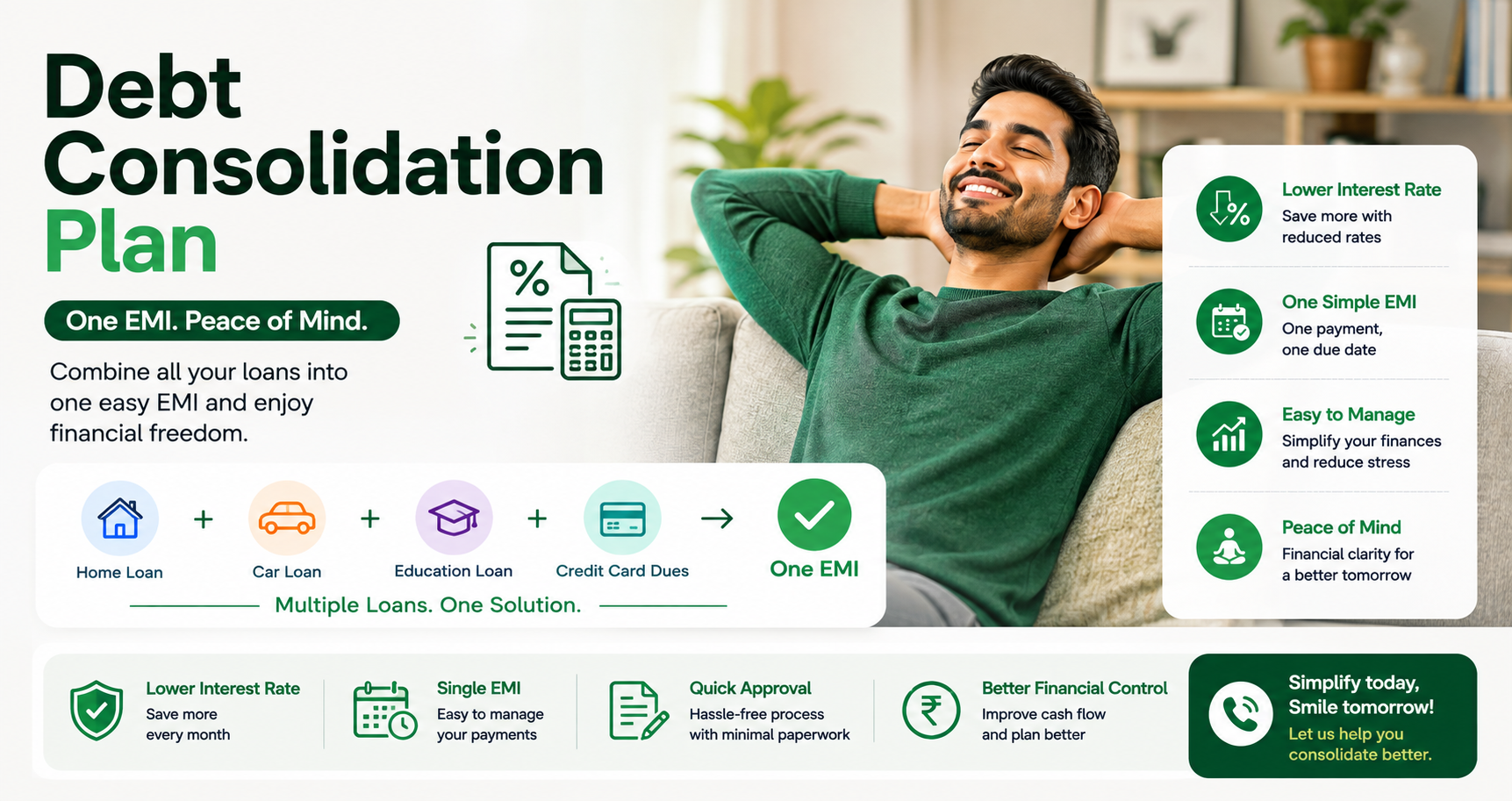
Debt consolidation replaces multiple high-cost borrowings — credit card balances, small personal loans, consumer durable finance — with a single loan at a lower rate. One EMI replaces several, and the total interest cost falls substantially.
The arithmetic is usually compelling. Credit card revolving interest runs around thirty-six per cent a year; a personal loan is a third of that, and a secured facility is a third again. Moving twenty lakh of card debt to a personal loan can save several lakh over the repayment period.
The reason consolidation fails is behavioural rather than financial. Cards cleared by the consolidation loan are cards with available limits again, and borrowers who do not close or freeze them frequently end up servicing both the loan and fresh card balances within two years. That is the single thing that determines whether this works.
Who should consider it
Borrowers servicing multiple high-rate debts, particularly revolving credit card balances. Anyone whose total EMIs have become difficult to track. Borrowers who have addressed the spending that created the debt.
Benefits
- A materially lower rate than credit card and consumer finance debt
- One EMI and one due date instead of several
- A defined end date, unlike revolving card debt which can run indefinitely
- Total interest cost falls substantially
- Credit score improves as card utilisation drops
- Cheaper still where a secured facility is available
What the loan funds, and what it does not
Read the right-hand column first. It is the one that decides how much you have to arrange yourself.
Usually funded
- Repayment of credit card outstanding balances
- Closure of existing small personal loans
- Consumer durable and BNPL balances
- Any other high-cost unsecured borrowing
- A single consolidated tenure and EMI
Usually not funded
- Secured debt, which is already cheaper and should usually stay
- Processing fee on the consolidation loan
- Foreclosure charges on the loans being closed
- Any protection against re-accumulating card debt
Funding limits and the treatment of add-ons vary between lenders and move with the borrower profile. The sanction letter you receive is what governs — we will walk you through it before you sign.
How it works with us
- 1 Eligibility checked before any application is filed Each rejected application marks your credit file. We match your profile to lenders who will actually approve it, rather than applying everywhere.
- 2 Compared on total cost, not the advertised rate Processing fee, insurance bundling and prepayment terms often matter more than the headline number.
- 3 We name the cheaper alternative if there is one A top-up on your home loan or a loan against securities is often half the cost. If that applies to you, we will say so.
- 4 One document set, submitted once Prepared properly the first time, which is what makes same-day approval realistic.
- 5 Sanction, disbursal and a repayment plan The sanction states rate, fee and prepayment terms. We set out how prepaying would work before you need it.
Important considerations
The things a brochure tends to leave out. Read these before you decide.
- Close or freeze the cards you clear. This is the whole game. Borrowers who leave the limits open frequently end up servicing both the consolidation loan and fresh card balances.
- If you have a home loan, a top-up is usually half the cost of a personal loan for the same consolidation. Compare before defaulting to the faster route.
- Do not consolidate secured debt into unsecured borrowing. Your home loan is already the cheapest money you have.
- Check foreclosure charges on the loans you are closing. They reduce the benefit and occasionally eliminate it.
- Address what created the debt. Consolidation fixes the cost of the borrowing, not the pattern that produced it.
Documents required
- Identity proof — Aadhaar, PAN or passport
- Address proof
- Salaried: last three months of salary slips and Form 16
- Self-employed: last two years of income tax returns with computation
- Bank statements for the last six months
- Employment proof or business registration
- Recent passport-size photograph
- Existing loan and credit card statements
Frequently Asked Questions
How much can consolidation actually save?
A great deal against credit card debt. Revolving card interest runs around thirty-six per cent a year while a personal loan is roughly a third of that, and a home loan top-up a third again. On a substantial balance the saving over the repayment period runs into lakhs.
What is the biggest risk?
Running the cards back up. Cards cleared by the loan have their full limits available again, and borrowers who leave them open frequently end up servicing both the consolidation loan and fresh card balances within two years. Closing or freezing them is the single thing that determines whether this works.
Will it hurt my credit score?
Usually the opposite. Card utilisation falls sharply, which is a significant scoring factor, and a single well-serviced loan looks better than several stretched balances. Closing very old card accounts can slightly reduce your average account age, but the utilisation improvement generally outweighs it.
Should I consolidate my home loan too?
No. Your home loan is almost certainly the cheapest borrowing you have. Consolidation is for replacing expensive debt with cheaper debt, not the other way round.
Is a home loan top-up better than a personal loan for this?
Substantially, where you have one. A top-up at around nine per cent against a personal loan at eleven to eighteen makes a large difference over the repayment period. The trade is that your home secures it, which is a reason for discipline rather than a reason to avoid it.
Want a shortlist instead of a catalogue?
Tell us the situation and an advisor comes back with two or three options that actually fit — and names what each one gives up.