
Plan your investment
What Our Plans Cover
-
Investment across the fund's portf...
-
Professional management
-
Periodic valuation and investor re...
-
Distributions as portfolio exits o...
-
Participation through a contributi...
Who Can Consider This Plan?
- Minimum commitment of ₹1 crore per investor, as regulated
- Indian resident individual, HUF, trust, company or NRI
- Completed KYC with the fund
- Ability to meet capital calls through the drawdown period
- Acceptance by the fund manager, which is discretionary
What May Not Be Covered?
- Liquidity — capital is committed for the fund life
- Any guarantee of return or of capital
- Control over individual investment decisions
- Redemption on demand
- Predictable distribution timing
Always check the policy wording before you commit.
Why Choose Wealth & Covers?
- Expert advice to choose the right plan
- Plans from leading investments companies
- Hassle-free process and documentation
- End-to-end support, including claim assistance
- Dedicated relationship manager
- Expert Guidance Personalised advice from experienced investments professionals.
- End-to-End Support From choosing the right plan to claim assistance, we are with you always.
- Claims Assistance Hassle-free claim support to ensure you get what you deserve.
- Transparent Process Clear information, easy documentation and a hassle-free experience.
Overview
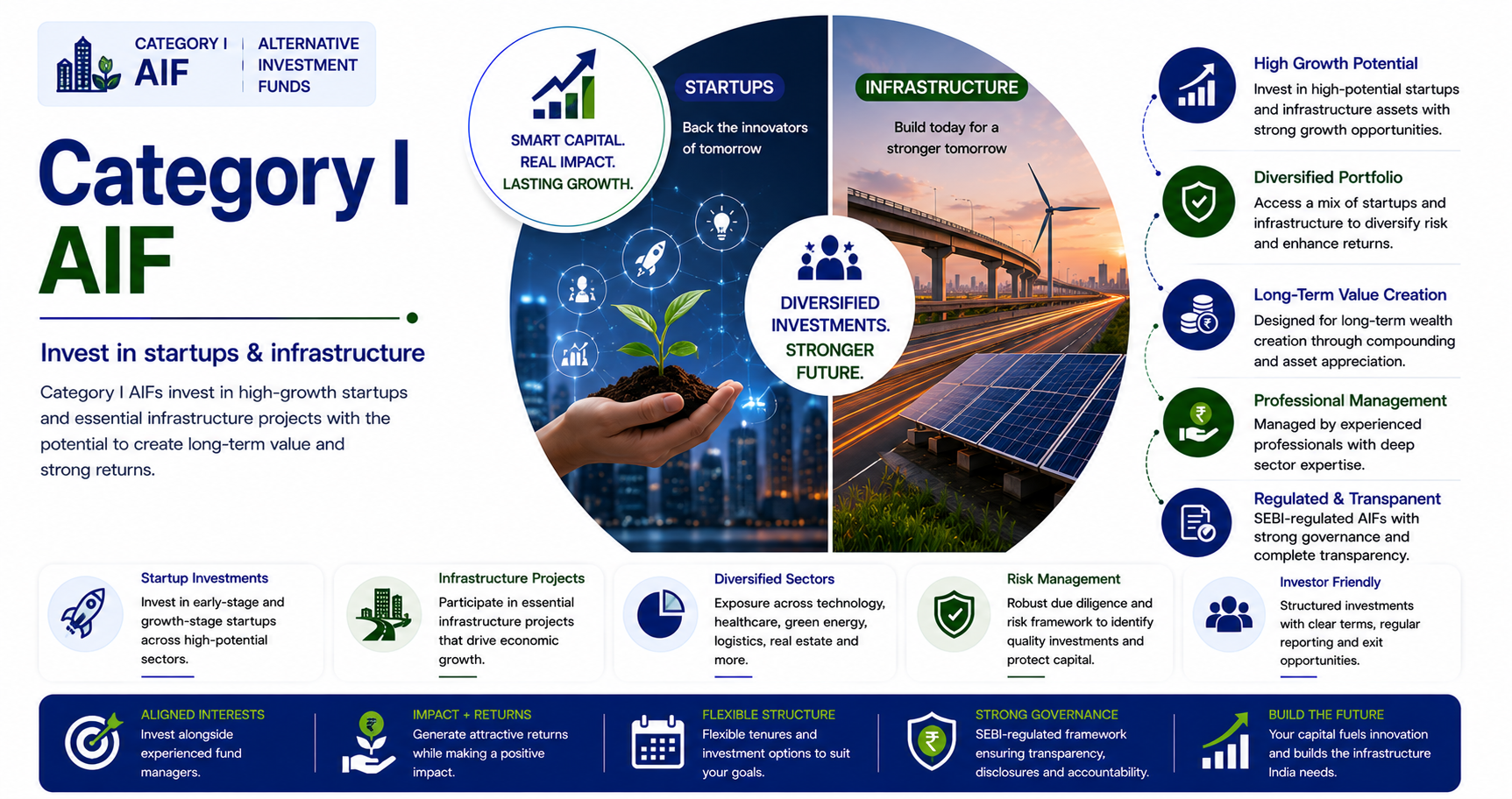
Category I alternative investment funds invest in areas the regulator considers socially or economically desirable: start-ups, early-stage ventures, small and medium enterprises, infrastructure and social impact. Venture capital funds and angel funds sit here.
The category attracts certain concessions in recognition of that purpose, and it is where most Indian venture capital activity is formally structured.
The return profile is what it sounds like. Early-stage investing produces a distribution in which most positions return little and a small number return a great deal. That mathematics only works with genuine diversification across many investments and a horizon measured in years, not with a concentrated position taken opportunistically.
Who should consider it
Investors with substantial portfolios allocating a small portion to early-stage and venture exposure. Investors who can lock capital for eight to ten years and absorb a total loss on the allocation.
It is not appropriate for anyone who needs the capital, cannot assess the manager's track record, or is investing on the strength of one portfolio company's story.
Benefits
- Exposure to early-stage and venture investments not otherwise accessible
- Professional sourcing, diligence and portfolio construction
- Diversification across many companies within one commitment
- Regulatory concessions recognised for this category
- Access to managers with genuine deal flow
- Participation in businesses long before any public listing
What is included, and what is not
Read the right-hand column first. It is the one that tends to surprise people later.
Included
- Investment across the fund's portfolio companies
- Professional management, monitoring and exits
- Periodic valuation and investor reporting
- Distributions as portfolio exits occur
- Participation through a contribution agreement
Not included
- Liquidity — capital is committed for the fund life
- Any guarantee of return or of capital
- Control over individual investment decisions
- Redemption on demand
- Predictable distribution timing
Terms vary between providers and between plans from the same provider. The offer document you receive is what governs — we will walk you through it before you commit.
How it works with us
- 1 We start with whether an AIF suits you at all A one-crore minimum, multi-year lock-ins and higher fees. If a mutual fund does the same job, we will say so.
- 2 Category and strategy matched to the objective Category I, II and III are genuinely different things. Choosing between them is the substantive decision.
- 3 Fees and terms read in full Management fee, carry, hurdle rate, catch-up and drawdown schedule. These vary enormously and compound over a fund's life.
- 4 Commitment and drawdown planned You commit capital that is called over time. Liquidity has to be arranged for calls you cannot decline.
- 5 Reporting tracked through the fund life Valuations are periodic and taxation differs by category. We keep the reporting straight through to wind-up.
Important considerations
The things a brochure tends to leave out. Read these before you decide.
- The manager is the investment. In early-stage investing, sourcing and diligence capability determines outcomes far more than the sector or the vintage.
- Diversification within the fund matters. A portfolio of twenty-five companies has a very different distribution of outcomes from one of eight.
- Capital is called over time and you cannot decline a call. Keep liquidity available for the full drawdown schedule.
- Fund life of eight to ten years frequently extends. Plan for longer than the documents suggest.
- Individual portfolio companies failing entirely is normal in this category, not a sign that something has gone wrong.
Documents required
- PAN card
- Aadhaar or other identity proof
- Address proof
- Demat account details
- Bank account proof
- Net worth or income evidence, where the fund requires it
- Completed KYC and contribution agreement
Frequently Asked Questions
What does Category I actually cover?
Funds investing in areas the regulator considers socially or economically desirable — start-ups, early-stage ventures, SMEs, infrastructure and social impact. Venture capital and angel funds sit here, and the category attracts certain concessions in recognition of that purpose.
How does the return profile work?
Most positions return little and a small number return a great deal. That is the arithmetic of early-stage investing, and it only works with genuine diversification across many companies and a long horizon. A concentrated position in the same asset class is a different and much worse proposition.
How long is my money committed?
Typically eight to ten years, and extensions are common. Capital is drawn down over the first few years and returned as exits occur, so the effective commitment is long and the timing is not in your control.
What should I assess about the manager?
Sourcing and diligence capability, and the track record of actual realised exits rather than paper valuations. In this category the manager genuinely is the investment, more so than in any listed strategy.
Is a total loss on some investments expected?
Yes, and it is normal rather than a failure. Early-stage portfolios include companies that do not survive. What matters is whether the successful positions are large enough to carry the portfolio, which is why diversification and manager quality dominate everything else.
Want a shortlist instead of a catalogue?
Tell us the situation and an advisor comes back with two or three options that actually fit — and names what each one gives up.