
Get Expert Guidance
What Our Plans Cover
-
Damage to the works under construc...
-
Materials stored on site
-
Materials in transit to site
-
Fire
-
Theft of materials from site
-
Third-party bodily injury and prop...
-
Debris removal after an insured lo...
-
The maintenance or defects liabili...
Who Can Consider This Plan?
- Legal ownership, or an insurable interest such as a lease
- Property of permanent construction, meeting the insurer's standards
- Accurate declaration of occupancy and use
- Sum insured set on a defensible valuation basis
- Compliance with any fire safety requirements applicable to the premises
What May Not Be Covered?
- Defective design, workmanship and materials, on most policies
- Normal wear during construction and gradual deterioration
- Contractual penalties and liquidated damages for delay
- Loss of documents, drawings and plans
- Consequential loss of any kind
Always check the policy wording before you commit.
Why Choose Wealth & Covers?
- Expert advice to choose the right plan
- Plans from leading insurance companies
- Hassle-free process and documentation
- End-to-end support, including claim assistance
- Dedicated relationship manager
Our Insurance Partners
- Star Health Insurance
- Care Health Insurance
- Niva Bupa Health Insurance
- HDFC ERGO
- ICICI Lombard
- Bajaj Allianz
We represent multiple providers to help you find the most suitable option at the best price.
- Expert Guidance Personalised advice from experienced insurance professionals.
- End-to-End Support From choosing the right plan to claim assistance, we are with you always.
- Claims Assistance Hassle-free claim support to ensure you get what you deserve.
- Transparent Process Clear information, easy documentation and a hassle-free experience.
Overview
A property under construction is not covered by an ordinary property policy, which assumes a completed and occupied building. Construction risk is its own class, covering the works as they are built, the materials stored on site, and the liability arising from the activity itself.
The exposure is genuinely different. A partially built structure has no fire protection, no security, and no completed envelope against weather. Materials arrive and sit on site in quantity. Contractors, workers and visitors move through an active hazard.
The policy is usually written as contractors' all risk, covering the works and third-party liability together, with the sum insured based on the completed contract value rather than on progress to date.
Who should consider it
Anyone building a house, developers building for sale, and owners undertaking major reconstruction or extension. Contractors are usually contractually required to hold it.
Benefits
- Covers the works during the vulnerable construction phase
- Materials on site and in transit are included
- Third-party liability arising from construction activity
- Cover for damage during testing and commissioning
- A maintenance period after handover on most policies
- Satisfies the insurance obligations in most construction contracts
What is covered, and what is not
Read the right-hand column first. It is the one that decides whether a claim is paid.
Typically covered
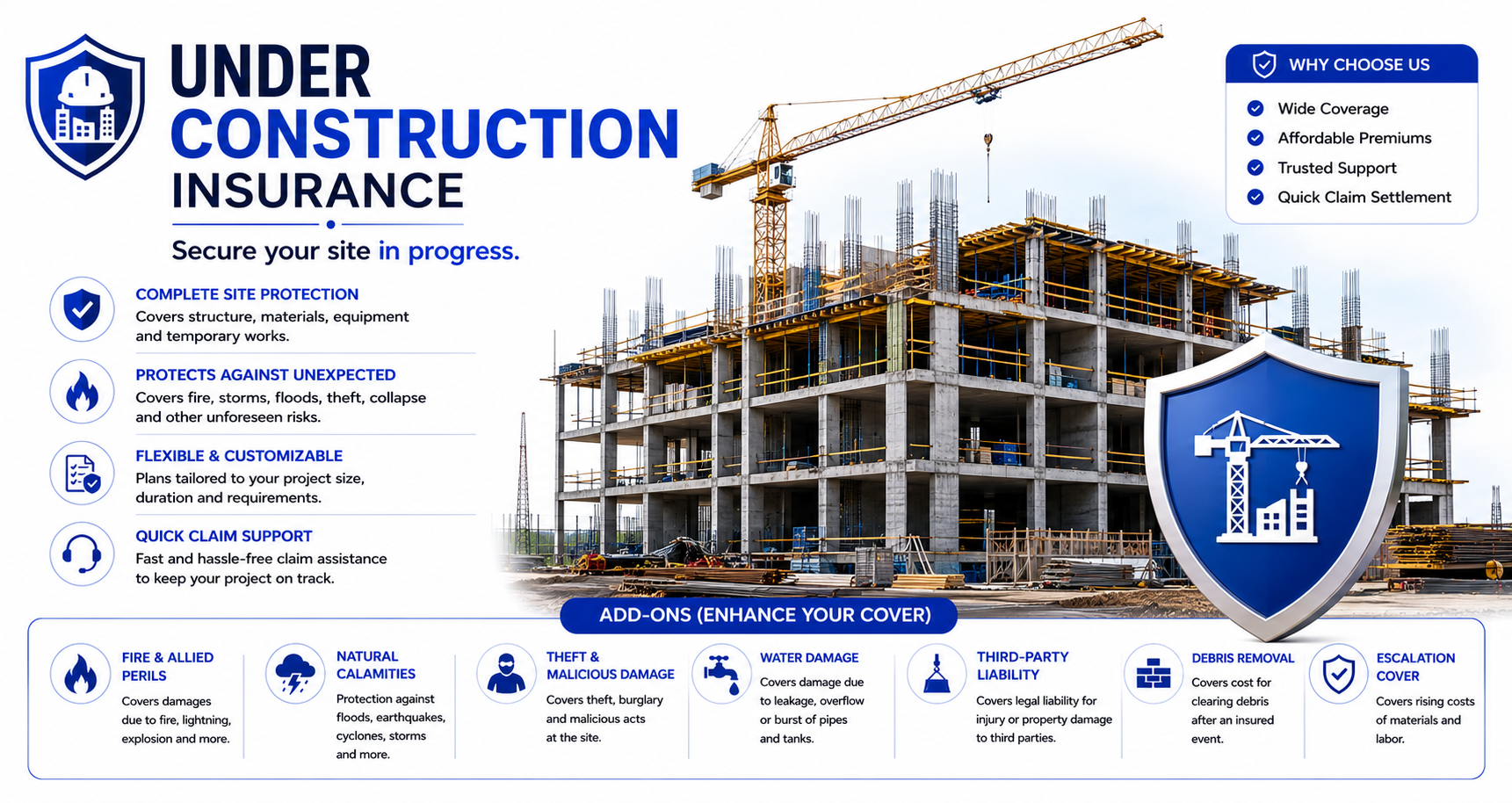
- Damage to the works under construction
- Materials stored on site
- Materials in transit to site, where covered
- Fire, flood, storm and earthquake during construction
- Theft of materials from site
- Third-party bodily injury and property damage
- Debris removal after an insured loss
- The maintenance or defects liability period after completion
Typically not covered
- Defective design, workmanship and materials, on most policies
- Normal wear during construction and gradual deterioration
- Contractual penalties and liquidated damages for delay
- Loss of documents, drawings and plans
- Consequential loss of any kind
- Work carried out without required approvals
- Damage to existing structures, unless specifically covered
Inclusions and exclusions vary between providers and between plans from the same provider. The wording in your own policy document is what governs — we will walk you through it before you buy.
How it works with us
- 1 We value the risk before we quote it Reinstatement cost of the structure, current value of the contents, and what a total loss would actually cost to rebuild today.
- 2 Perils matched to the location A coastal warehouse, a basement in a flood-prone city and a first-floor office are three different risks. The policy should reflect which one you are.
- 3 Quotes compared on sum insured basis, not premium Market value against reinstatement value changes what you receive far more than the premium difference between insurers.
- 4 Survey where the value warrants it Larger risks are surveyed before cover. It is also the moment to fix anything that would reduce a claim later.
- 5 Policy issued, and reviewed annually We revisit the sum insured every renewal. Under-insurance is the single most common reason property claims are cut.
Important considerations
The things a brochure tends to leave out. Read these before you decide.
- Insure on the completed contract value from day one. Insuring on progress to date leaves you under-insured for most of the project, and the average clause applies.
- If you are extending or renovating, the existing structure needs specific inclusion. It is not automatically covered by a policy written for the new works.
- Establish who is insuring what before work starts. A gap between your policy and the contractor's is discovered only after an incident.
- Extend the policy if the project overruns. Cover ends on the stated date regardless of whether the building is finished, and overruns are normal.
- Third-party liability during construction deserves a real limit. Neighbouring property damage and injury to passers-by are the claims most likely to be large.
Documents required
- Proof of ownership or the lease agreement
- Details of construction — age, materials, number of floors
- Valuation or reinstatement cost estimate of the structure
- Inventory and value of contents, stock or equipment
- Details of fire protection and security arrangements
- Previous policy and claims history, where applicable
- Photographs of the premises, for larger risks
Frequently Asked Questions
Does my home insurance cover the house while it is being built?
No. Ordinary property policies assume a completed structure. Construction is a distinct risk requiring contractors' all risk or an equivalent construction policy, and the gap between the two is exactly the period of highest exposure.
Who should hold the policy — me or the contractor?
Either can, and the answer should be written into the contract. What matters is that someone does, that the sum insured is right, and that both parties know which policy responds. Assumed cover is the most common failure on construction sites.
What if the project runs late?
Cover ends on the policy expiry date whether or not the work is complete. Extensions are routine and inexpensive, but they must be arranged before expiry — not after an incident on an expired policy.
Is faulty workmanship covered?
Generally not. Most policies exclude the cost of correcting defective work, though some cover resulting damage to other parts of the works. It is one of the more variable clauses, so read your specific wording.
I am extending my existing house. Is that covered?
The new works are; the existing structure needs specific inclusion. Damage to the existing house arising from the construction is a common claim and a common gap.
Want a shortlist instead of a catalogue?
Tell us the situation and an advisor comes back with two or three options that actually fit — and names what each one gives up.