
Plan your investment
What Our Plans Cover
-
Shares in mid and small capitalisa...
-
Dividends where declared
-
Voting rights and corporate action...
-
Direct holding in your demat accou...
Who Can Consider This Plan?
- Indian resident individual, HUF, trust or company
- NRIs, through a portfolio investment scheme account
- PAN and completed KYC
- A demat account with a registered depository participant
- A trading account with a registered broker
What May Not Be Covered?
- Any protection against severe declines
- Reliable liquidity, particularly during falls
- Analyst coverage comparable to large caps
- Any guarantee of return or of business survival
Always check the policy wording before you commit.
Why Choose Wealth & Covers?
- Expert advice to choose the right plan
- Plans from leading investments companies
- Hassle-free process and documentation
- End-to-end support, including claim assistance
- Dedicated relationship manager
- Expert Guidance Personalised advice from experienced investments professionals.
- End-to-End Support From choosing the right plan to claim assistance, we are with you always.
- Claims Assistance Hassle-free claim support to ensure you get what you deserve.
- Transparent Process Clear information, easy documentation and a hassle-free experience.
Overview
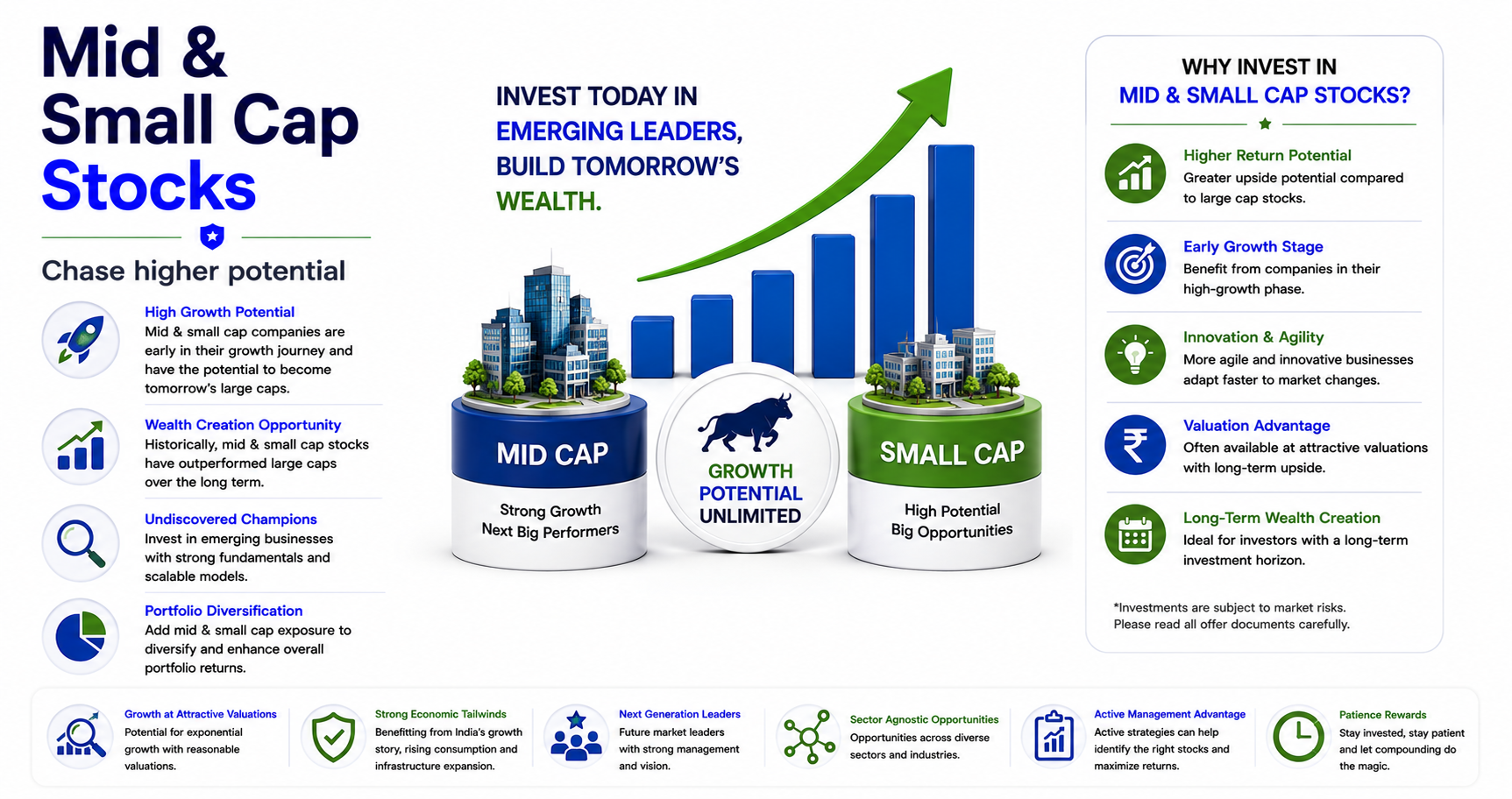
Mid and small cap stocks are shares in companies below the largest tier by market capitalisation. They are less researched, less liquid and considerably more volatile than large caps, and they include both the businesses that will become tomorrow's large companies and those that will not survive.
The growth potential is real. A smaller company can grow at rates a large one structurally cannot, and the market's under-coverage of this segment means genuine mispricing occurs more often than in heavily analysed large caps.
The risks are equally real and are frequently underestimated. Falls of fifty per cent or more happen in this segment during market downturns. Liquidity can disappear precisely when you want to sell, leaving you unable to exit at any sensible price. And business failure is a genuine possibility rather than a theoretical one.
Who should consider it
Experienced investors with a long horizon and genuine tolerance for large declines. Investors allocating a satellite portion of an already diversified portfolio. Anyone prepared to research individual businesses properly rather than following recommendations.
It is not appropriate for a first equity investment, for money needed within five years, or for anyone who would sell during a severe fall.
Benefits
- Higher growth potential than established large companies
- Less analyst coverage, so genuine mispricing occurs more often
- Exposure to businesses in an earlier growth phase
- Meaningful position sizes possible with modest capital
- Diversification away from a large-cap-dominated portfolio
What is included, and what is not
Read the right-hand column first. It is the one that tends to surprise people later.
Included
- Shares in mid and small capitalisation listed companies
- Dividends where declared, though less common than in large caps
- Voting rights and corporate actions
- Direct holding in your demat account
Not included
- Any protection against severe declines
- Reliable liquidity, particularly during falls
- Analyst coverage comparable to large caps
- Any guarantee of return or of business survival
Terms vary between providers and between plans from the same provider. The offer document you receive is what governs — we will walk you through it before you commit.
How it works with us
- 1 We establish whether direct equity suits you at all For many investors a diversified fund does the same job with less to go wrong. That conversation comes before anything else.
- 2 Allocation set before any stock is discussed How much of your portfolio belongs in direct equity, and what stays in funds and fixed income. Position sizing prevents most permanent damage.
- 3 Demat and trading account set up properly KYC, nomination and the mandates. Done once, correctly, so nothing stalls when you want to transact.
- 4 Research shared, decisions left with you We provide analysis and context. We do not provide tips, and we will not tell you a stock will go up.
- 5 Reviewed against the thesis, not the price The question at review is whether the reason you bought still holds — not whether the price has moved since.
Important considerations
The things a brochure tends to leave out. Read these before you decide.
- Falls of fifty per cent or more occur in this segment during downturns. If that would cause you to sell, this is the wrong place for your money.
- Liquidity disappears when you most want it. In a sharp fall, small cap shares can have no buyers at any reasonable price for extended periods.
- Size positions so that a total loss in any one company does not damage your overall position. Business failure is a real outcome here.
- Research the business, not the price chart. In an under-covered segment, the work is the edge — and following a recommendation without doing it is how retail investors lose money here.
- Equity investments are subject to market risk, and this segment carries materially higher risk including permanent loss of capital.
Documents required
- PAN card, mandatory for all securities transactions
- Aadhaar or other identity proof
- Address proof
- Bank account proof — cancelled cheque or statement
- Income proof, for derivatives segment activation
- Recent passport-size photograph
- Signature specimen and in-person verification
Frequently Asked Questions
How much more volatile are small caps?
Substantially. Falls of fifty per cent or more during market downturns are normal in this segment rather than exceptional, and recovery can take years. The honest test is whether you would hold through that — because selling at the bottom converts volatility into permanent loss.
What is liquidity risk?
The risk that you cannot sell at a sensible price when you want to. Small cap shares trade thinly, and during a sharp fall the buyers can disappear entirely. This is the risk most often underestimated, because it materialises exactly when you want to act.
Should this be a large part of my portfolio?
No. Where these have a role it is as a satellite allocation alongside a diversified core — an amount whose severe decline would be uncomfortable rather than damaging. Concentration here is how retail investors do themselves lasting harm.
Is a small cap mutual fund better than direct stocks?
For most investors, considerably. A fund spreads across many companies, has research capability you probably do not, and manages liquidity at a portfolio level. Direct small cap investing requires real research; without it, you are guessing in the least forgiving part of the market.
Can I lose all my money in a stock?
In this segment, yes. Businesses fail, and small companies fail more often than large ones. That is why position sizing matters more here than anywhere else. Equity investments carry market risk including permanent loss of capital.
Want a shortlist instead of a catalogue?
Tell us the situation and an advisor comes back with two or three options that actually fit — and names what each one gives up.