
Plan your investment
What Our Plans Cover
-
Units in a listed infrastructure i...
-
Periodic distributions from operat...
-
Exposure to a portfolio of operati...
-
Quarterly financial and operationa...
-
Holding in your demat account
Who Can Consider This Plan?
- Indian resident individual, HUF, trust or company
- NRIs, subject to the applicable investment routes
- A demat account and a trading account
- PAN and completed KYC
- Minimum investment as per the exchange lot size
What May Not Be Covered?
- Any guarantee of distribution amount
- Protection against unit price movement
- Perpetual asset life — most concessions have an end date
- Tax exemption; distribution components are taxed differently
Always check the policy wording before you commit.
Why Choose Wealth & Covers?
- Expert advice to choose the right plan
- Plans from leading investments companies
- Hassle-free process and documentation
- End-to-end support, including claim assistance
- Dedicated relationship manager
- Expert Guidance Personalised advice from experienced investments professionals.
- End-to-End Support From choosing the right plan to claim assistance, we are with you always.
- Claims Assistance Hassle-free claim support to ensure you get what you deserve.
- Transparent Process Clear information, easy documentation and a hassle-free experience.
Overview
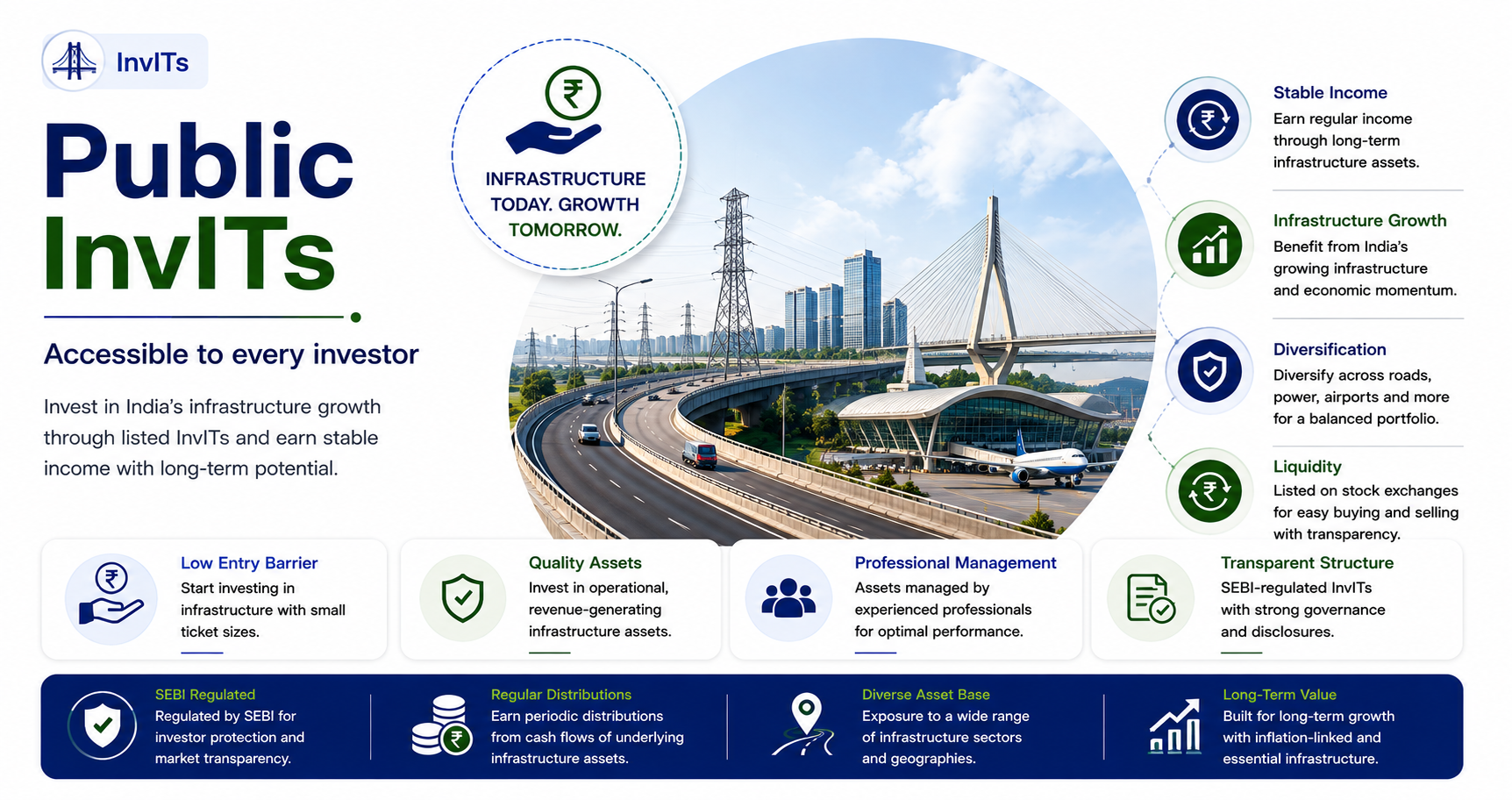
A public infrastructure investment trust is listed on an exchange and holds operating infrastructure assets — toll roads, power transmission lines, gas pipelines, telecom towers. It distributes the cash those assets generate to unitholders.
The yields look high compared with most listed income instruments, and there is a structural reason for that which is frequently missed. Most infrastructure assets operate under a concession for a defined period, after which they revert to the granting authority. Part of every distribution is therefore your own capital returning to you, not purely income.
That does not make InvITs a poor investment. It makes the headline yield a misleading comparison against a bond or a REIT, and it means the right question is how much of the distribution is genuinely surplus and what the trust does to replace assets as concessions expire.
Who should consider it
Income-focused investors who understand the finite-life structure. Investors seeking exposure to operating infrastructure without project or construction risk. Anyone diversifying income sources beyond bonds and deposits.
Benefits
- Exposure to operating infrastructure assets at retail ticket sizes
- Regulated distribution of the majority of distributable cash flows
- Revenue frequently underpinned by long-term contracts
- Listed liquidity, unlike direct infrastructure investment
- Assets already operating, so no construction risk
- Distributions typically higher than most listed income instruments
What is included, and what is not
Read the right-hand column first. It is the one that tends to surprise people later.
Included
- Units in a listed infrastructure investment trust
- Periodic distributions from operating cash flows
- Exposure to a portfolio of operating infrastructure assets
- Quarterly financial and operational disclosure
- Holding in your demat account
Not included
- Any guarantee of distribution amount
- Protection against unit price movement
- Perpetual asset life — most concessions have an end date
- Tax exemption; distribution components are taxed differently
Terms vary between providers and between plans from the same provider. The offer document you receive is what governs — we will walk you through it before you commit.
How it works with us
- 1 We explain the finite-life point first Most InvIT assets have a concession period. Part of the yield is your own capital returning, and that changes how to read it.
- 2 Distribution quality examined, not just the number How much is genuinely surplus cash and how much is capital return, and what happens to it as the concession runs down.
- 3 Counterparty and concession terms read carefully Who pays the revenue, under what contract, and for how long. That is where the real risk in an InvIT sits.
- 4 Purchase through the exchange Listed InvIT units trade like shares and settle into your demat account.
- 5 Distributions tracked and taxed by component Interest, dividend and return of capital are taxed differently. Reporting them correctly is part of holding these.
Important considerations
The things a brochure tends to leave out. Read these before you decide.
- Understand how much of the distribution is return of capital. A twelve per cent yield where a third is capital coming back is not comparable to a twelve per cent bond coupon.
- Look at the weighted average remaining concession life across the portfolio and at what the trust is doing to acquire replacement assets.
- Read the counterparty. Revenue from a state utility under a long-term contract carries a different risk from toll revenue dependent on traffic volumes.
- Regulatory and policy risk is real in infrastructure. Tariff determinations and concession terms can change.
- Distribution components — interest, dividend, return of capital — are taxed differently. The trust publishes the breakdown and it needs reporting correctly.
Documents required
- PAN card
- Aadhaar or other identity proof
- Address proof
- Demat account details
- Bank account proof for distribution credit
- Completed KYC with the broker
Frequently Asked Questions
Why are InvIT yields so much higher than REITs?
Largely because part of the distribution is your own capital returning. Most infrastructure assets operate under a finite concession, after which they revert to the granting authority, so the trust must return capital over the asset's life. A high InvIT yield and a bond coupon are not comparable numbers.
What happens when a concession expires?
The asset generally reverts to the granting authority and stops generating revenue for the trust. A well-managed InvIT acquires replacement assets to maintain distributions, and how successfully it does that is one of the most important things to assess.
What is the biggest risk?
Counterparty and policy risk. Revenue depends on who pays and under what contract — a state utility, a concession authority, or road users. Regulatory changes to tariffs or concession terms can materially affect cash flows, and this is a sector where policy matters.
How are the distributions taxed?
By component. Interest, dividend and return of capital each have their own treatment, and the trust publishes a breakdown after each distribution. Return of capital is not taxed as income but reduces your cost base, which matters when you eventually sell.
Are distributions guaranteed?
No. Regulations require distribution of the majority of distributable cash flows, but the amount depends on what the assets actually generate. Traffic volumes, availability payments and operating costs all affect it.
Want a shortlist instead of a catalogue?
Tell us the situation and an advisor comes back with two or three options that actually fit — and names what each one gives up.