
Plan your investment
What Our Plans Cover
-
Debentures issued through a public...
-
Fixed coupon at the stated frequen...
-
Return of face value at maturity
-
Listing on the exchange for second...
-
Security by way of charge
Who Can Consider This Plan?
- Indian resident individual, HUF, trust, firm or company
- NRIs, subject to the specific issue permitting NRI investment
- A demat account for holding the securities
- PAN and completed KYC
- Minimum investment as specified in the issue terms
What May Not Be Covered?
- Any deposit insurance or government guarantee
- Conversion into equity — these are non-convertible by definition
- Protection if the issuer defaults, particularly on unsecured issues
- Reliable secondary market liquidity
- Tax exemption — interest is taxable at slab rate
Always check the policy wording before you commit.
Why Choose Wealth & Covers?
- Expert advice to choose the right plan
- Plans from leading investments companies
- Hassle-free process and documentation
- End-to-end support, including claim assistance
- Dedicated relationship manager
- Expert Guidance Personalised advice from experienced investments professionals.
- End-to-End Support From choosing the right plan to claim assistance, we are with you always.
- Claims Assistance Hassle-free claim support to ensure you get what you deserve.
- Transparent Process Clear information, easy documentation and a hassle-free experience.
Overview
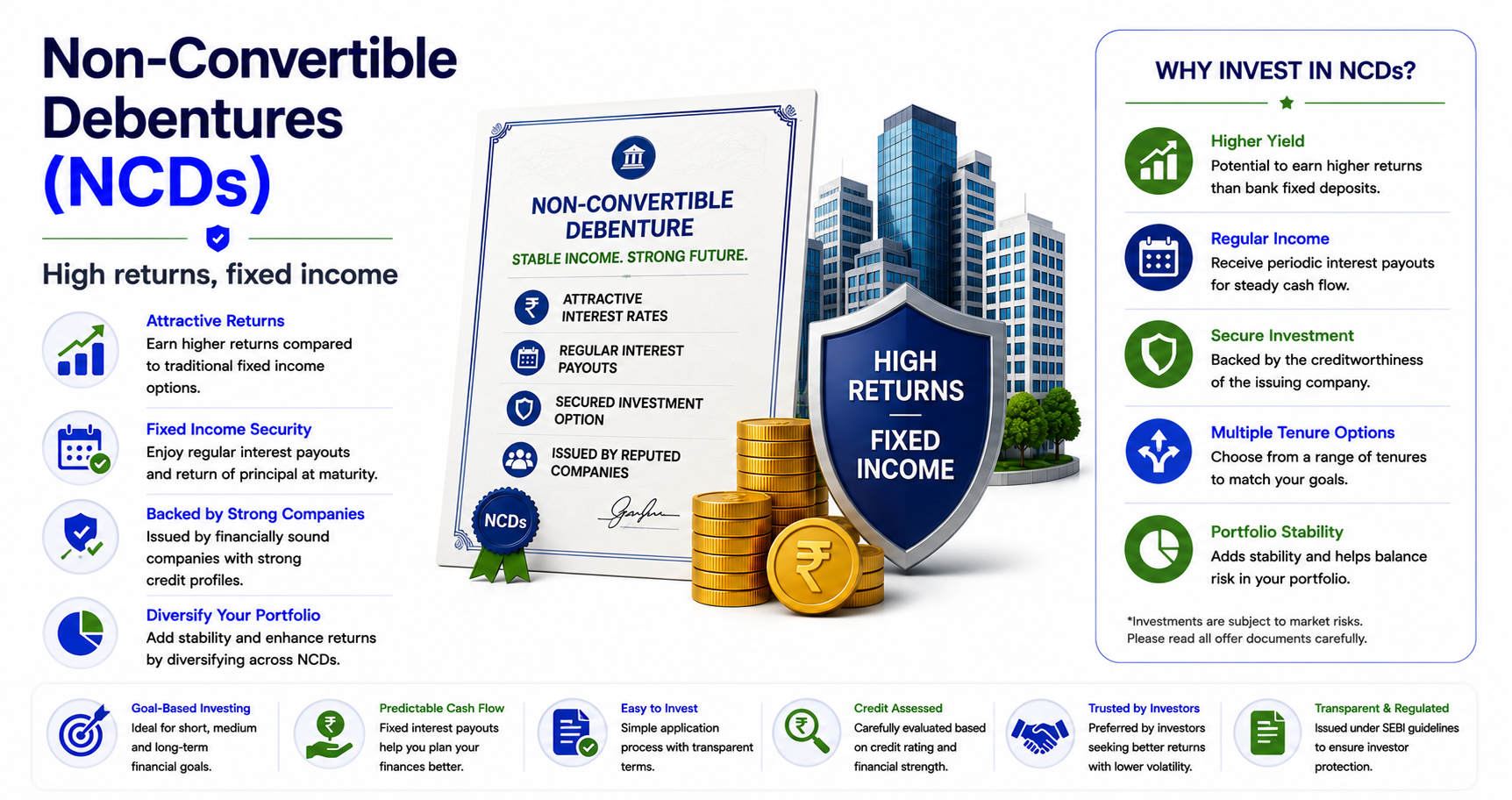
A non-convertible debenture is a debt instrument issued by a company that cannot be converted into shares. Public issues are offered to retail investors directly, listed on the exchange, and typically pay a higher coupon than bank deposits of similar tenure.
The distinction that matters most is secured against unsecured. A secured NCD is backed by a charge on the issuer's assets, giving holders a claim ahead of unsecured creditors in a default. An unsecured NCD has no such backing and yields more for that reason. Both are sold in the same format, and the difference is in the prospectus rather than the advertising.
NCDs from non-banking financial companies are the most common retail issues. Those businesses lend money, so their credit quality depends on their own loan book — which is worth understanding before lending to them.
Who should consider it
Investors seeking higher fixed income yields who will read the prospectus. Investors holding to maturity. Anyone diversifying fixed income beyond bank deposits, with a modest allocation per issuer.
Benefits
- Higher coupons than bank deposits of similar tenure
- Public issues accessible at retail ticket sizes
- Listed on the exchange, so exit before maturity is possible
- Choice of monthly, annual or cumulative interest options
- Secured issues carry a charge on the issuer's assets
- Credit rating published for every public issue
What is included, and what is not
Read the right-hand column first. It is the one that tends to surprise people later.
Included
- Debentures issued through a public issue or private placement
- Fixed coupon at the stated frequency
- Return of face value at maturity
- Listing on the exchange for secondary trading
- Security by way of charge, on secured issues
Not included
- Any deposit insurance or government guarantee
- Conversion into equity — these are non-convertible by definition
- Protection if the issuer defaults, particularly on unsecured issues
- Reliable secondary market liquidity
- Tax exemption — interest is taxable at slab rate
Terms vary between providers and between plans from the same provider. The offer document you receive is what governs — we will walk you through it before you commit.
How it works with us
- 1 We separate the two risks before anything else Credit risk is whether you get repaid. Rate risk is what the bond is worth if you sell early. Different risks, different answers.
- 2 Horizon matched to maturity A bond held to maturity behaves very differently from one sold in year two. That decision comes before choosing the issuer.
- 3 Rating and issuer examined properly A yield well above the market is telling you something. We read the rating rationale, not just the letter.
- 4 Purchase through the exchange or a registered platform Bonds settle into your demat account. We handle the mechanics and confirm what you actually bought.
- 5 Coupons tracked, maturity diarised Interest dates, reinvestment and redemption. Bonds are simple to hold and easy to forget about.
Important considerations
The things a brochure tends to leave out. Read these before you decide.
- Establish whether the issue is secured or unsecured, and what the security actually is. This is in the prospectus, not the advertisement, and it is the most important distinction in the product.
- For an NBFC issuer, the credit quality rests on its own loan book. Read what the rating agency says about asset quality rather than only the grade.
- Listing does not guarantee liquidity. Many NCDs trade rarely, and selling before maturity can mean a poor price or no buyer.
- Spread across issuers and issues. Retail investors have lost principal in this category by concentrating in a single high-yielding name.
- A coupon well above the market is telling you about risk. It is not an opportunity that institutional investors overlooked.
Documents required
- PAN card
- Aadhaar or other identity proof
- Address proof
- Demat account details
- Bank account proof for coupon and redemption credit
- Completed KYC with the intermediary
Frequently Asked Questions
What is the difference between secured and unsecured NCDs?
A secured NCD is backed by a charge on the issuer's assets, placing holders ahead of unsecured creditors if the company defaults. An unsecured NCD has no such backing and pays more for it. Both are sold in the same format, so the distinction lives in the prospectus rather than the marketing.
Are NCDs safer than fixed deposits?
No. Bank deposits carry DICGC insurance up to five lakh rupees per depositor per bank; NCDs carry none. The higher coupon is compensation for taking the issuer's credit risk directly, and that risk is real.
Can I sell before maturity?
They are listed, so in principle yes. In practice many NCDs trade thinly, and selling can mean accepting a poor price or finding no buyer at all. If you may need the money before maturity, treat the listing as a theoretical rather than a practical exit.
What should I check about an NBFC issuer?
Its loan book, because that is what backs your money. The rating agency's commentary on asset quality, provisioning and funding is more informative than the grade itself, and it is published alongside the rating.
How much should I invest in one issue?
A modest portion of your fixed income allocation, spread across several issuers. Retail investors have lost principal in this category by concentrating in a single high-yielding name, and the yield premium never compensated for that outcome.
Want a shortlist instead of a catalogue?
Tell us the situation and an advisor comes back with two or three options that actually fit — and names what each one gives up.