
Plan your investment
What Our Plans Cover
-
Investment across equity and debt...
-
Structured instruments such as con...
-
Manager discretion over allocation...
-
Periodic valuation and investor re...
-
Distributions as positions are rea...
Who Can Consider This Plan?
- Minimum commitment of ₹1 crore per investor, as regulated
- Indian resident individual, HUF, trust, company or NRI
- Completed KYC with the fund
- Ability to meet capital calls through the drawdown period
- Acceptance by the fund manager, which is discretionary
What May Not Be Covered?
- Clarity of a single-strategy mandate
- Liquidity before the fund's realisation period
- Any guarantee of return or of capital
- Predictable allocation between the two components
Always check the policy wording before you commit.
Why Choose Wealth & Covers?
- Expert advice to choose the right plan
- Plans from leading investments companies
- Hassle-free process and documentation
- End-to-end support, including claim assistance
- Dedicated relationship manager
- Expert Guidance Personalised advice from experienced investments professionals.
- End-to-End Support From choosing the right plan to claim assistance, we are with you always.
- Claims Assistance Hassle-free claim support to ensure you get what you deserve.
- Transparent Process Clear information, easy documentation and a hassle-free experience.
Overview
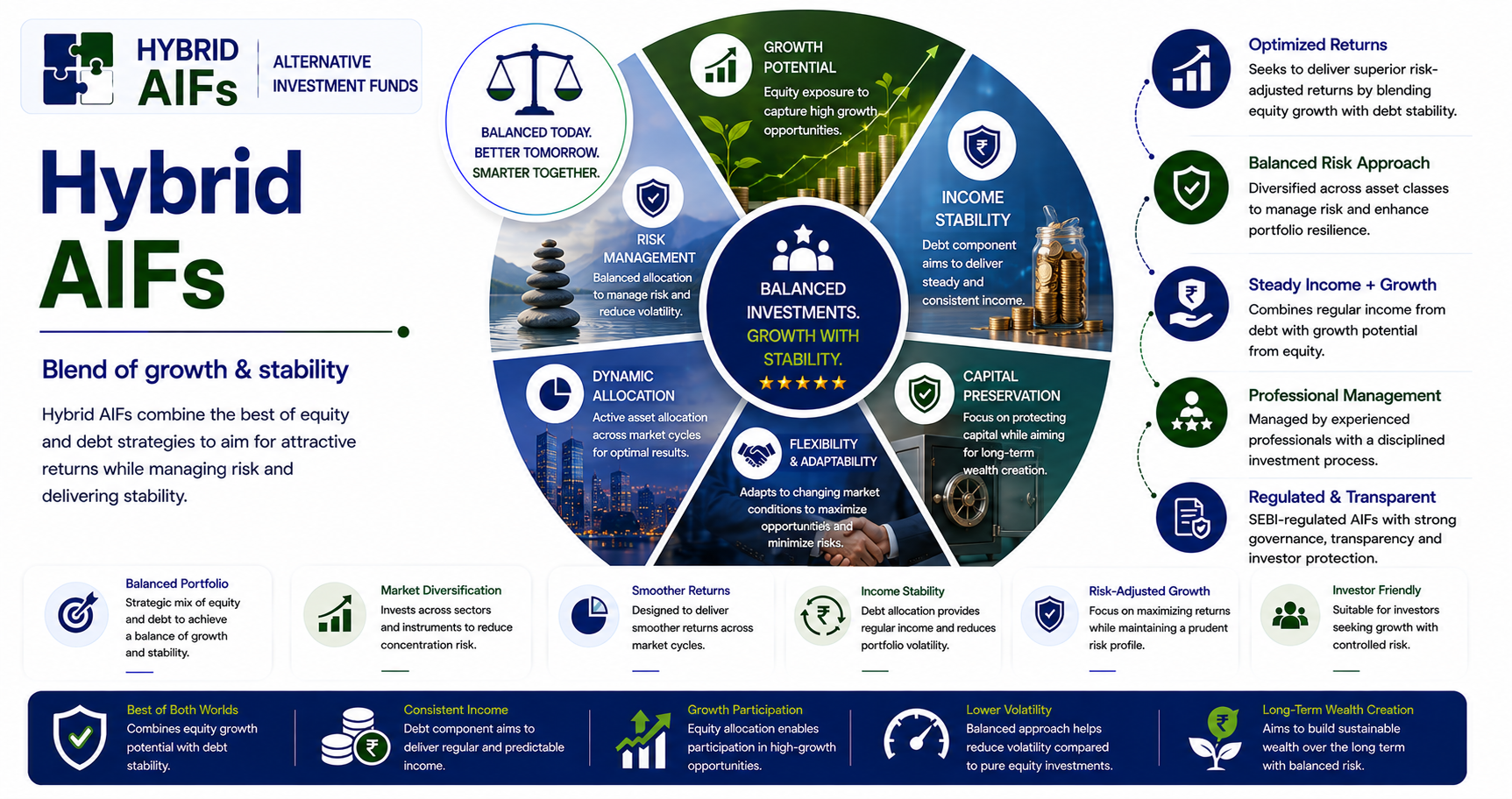
Hybrid alternative investment funds combine equity and debt within a single mandate, allowing the manager to shift allocation as opportunities change. Structured credit funds, mezzanine strategies and special situations funds frequently take this form.
The argument is flexibility. A manager who can lend when credit is attractive and take equity when it is not is less constrained than one confined to a single instrument, and structures combining both — convertible debt, debt with warrants — can capture upside while retaining downside protection.
The difficulty is assessment. Judging a hybrid fund means judging the manager's capability in two disciplines and their allocation judgement between them. Fewer managers are genuinely strong at both than claim to be.
Who should consider it
Investors who have identified a manager with demonstrated capability across both equity and credit. Investors seeking special situations or structured credit exposure.
Investors who want specific exposure — equity growth or credit yield — are usually better served by a dedicated fund where the mandate is clear and the manager's skill is directly assessable.
Benefits
- Flexibility to allocate between equity and credit as opportunities change
- Structured instruments capturing upside with downside protection
- Access to special situations that need both skill sets
- Less constrained than a single-instrument mandate
- Downside protection from the credit component in difficult periods
What is included, and what is not
Read the right-hand column first. It is the one that tends to surprise people later.
Included
- Investment across equity and debt positions
- Structured instruments such as convertibles and mezzanine debt
- Manager discretion over allocation within the mandate
- Periodic valuation and investor reporting
- Distributions as positions are realised
Not included
- Clarity of a single-strategy mandate
- Liquidity before the fund's realisation period
- Any guarantee of return or of capital
- Predictable allocation between the two components
Terms vary between providers and between plans from the same provider. The offer document you receive is what governs — we will walk you through it before you commit.
How it works with us
- 1 We start with whether an AIF suits you at all A one-crore minimum, multi-year lock-ins and higher fees. If a mutual fund does the same job, we will say so.
- 2 Category and strategy matched to the objective Category I, II and III are genuinely different things. Choosing between them is the substantive decision.
- 3 Fees and terms read in full Management fee, carry, hurdle rate, catch-up and drawdown schedule. These vary enormously and compound over a fund's life.
- 4 Commitment and drawdown planned You commit capital that is called over time. Liquidity has to be arranged for calls you cannot decline.
- 5 Reporting tracked through the fund life Valuations are periodic and taxation differs by category. We keep the reporting straight through to wind-up.
Important considerations
The things a brochure tends to leave out. Read these before you decide.
- Assess the manager on both disciplines separately. Strength in credit does not imply strength in equity, and the reverse is equally true.
- Understand the permitted allocation range. A fund that can be ninety per cent equity or ninety per cent credit is effectively two different funds at different times.
- Structured instruments sound like the best of both and are only as good as the terms negotiated. Read what the downside protection actually consists of.
- Special situations strategies depend heavily on the manager's ability to influence outcomes. Ask how they have done that in practice.
- If you want a specific exposure, a dedicated fund makes the manager's skill directly assessable in a way a hybrid does not.
Documents required
- PAN card
- Aadhaar or other identity proof
- Address proof
- Demat account details
- Bank account proof
- Net worth or income evidence, where the fund requires it
- Completed KYC and contribution agreement
Frequently Asked Questions
What is the advantage of combining equity and credit?
Flexibility. A manager who can lend when credit is attractively priced and take equity when it is not is less constrained than a single-instrument fund. Structured instruments such as convertible debt can also capture upside while retaining some downside protection.
What makes these harder to assess?
You are judging capability in two disciplines plus the allocation judgement between them. Fewer managers are genuinely strong at both equity and credit than claim to be, and a hybrid mandate makes the weaker discipline harder to see.
What is a special situations fund?
One investing where an event — a restructuring, a stressed balance sheet, a corporate action — creates an opportunity that requires both credit and equity skills to capture. These depend heavily on the manager's ability to influence outcomes, not just to select investments.
Is the downside protection real?
Only as good as the terms negotiated. Structured instruments sound like the best of both, and the actual protection depends on seniority, security and covenants. Read what the protection consists of rather than accepting the description.
Should I choose a hybrid or a dedicated fund?
If you want a specific exposure — equity growth or credit yield — a dedicated fund makes the manager's skill directly assessable. A hybrid earns its place where you have identified a manager with genuine capability across both and want them to allocate.
Want a shortlist instead of a catalogue?
Tell us the situation and an advisor comes back with two or three options that actually fit — and names what each one gives up.