
Get Expert Guidance
What Our Plans Cover
-
Unauthorised electronic fund trans...
-
Fraudulent use of credit and debit...
-
Phishing and social engineering lo...
-
Identity theft and the cost of res...
-
Legal expenses defending claims ar...
-
Online defamation and cyberstalkin...
-
Data restoration for personal devi...
-
Cyber extortion
Who Can Consider This Plan?
- Insurable interest in the property or activity being covered
- Accurate declaration of value and, where relevant, provenance
- Security and storage arrangements meeting the insurer's requirements
- Full disclosure of prior losses and claims
- Activity or property within the classes the insurer writes
What May Not Be Covered?
- Losses the bank or card issuer has already reimbursed
- Transactions authorised knowingly by the insured
- Losses from sharing credentials or OTPs voluntarily, on many wordings
- Business and professional losses, which need a commercial cyber policy
- Losses not reported to the bank and police within the stated period
Always check the policy wording before you commit.
Why Choose Wealth & Covers?
- Expert advice to choose the right plan
- Plans from leading insurance companies
- Hassle-free process and documentation
- End-to-end support, including claim assistance
- Dedicated relationship manager
Our Insurance Partners
- Star Health Insurance
- Care Health Insurance
- Niva Bupa Health Insurance
- HDFC ERGO
- ICICI Lombard
- Bajaj Allianz
We represent multiple providers to help you find the most suitable option at the best price.
- Expert Guidance Personalised advice from experienced insurance professionals.
- End-to-End Support From choosing the right plan to claim assistance, we are with you always.
- Claims Assistance Hassle-free claim support to ensure you get what you deserve.
- Transparent Process Clear information, easy documentation and a hassle-free experience.
Overview
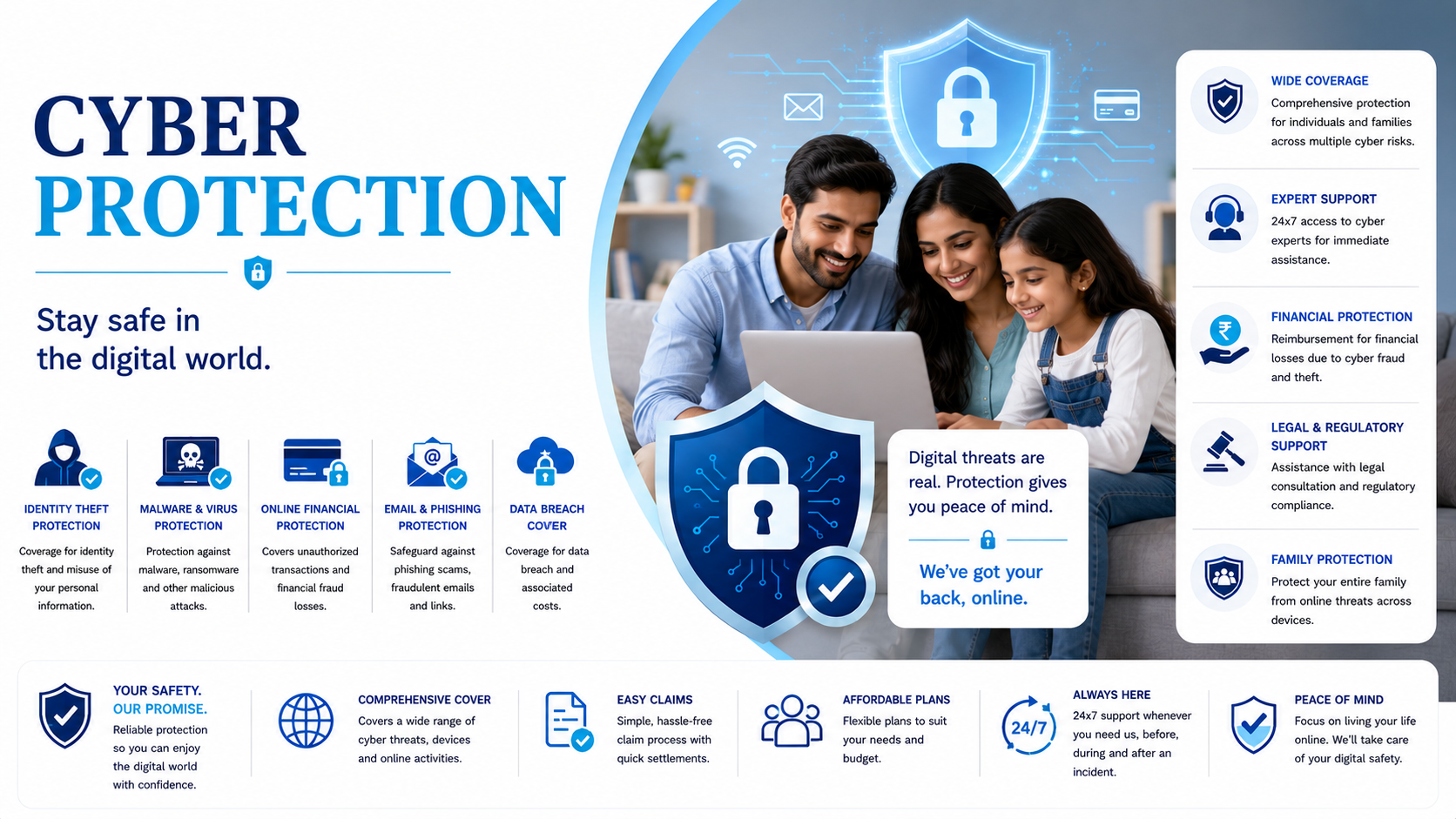
Personal cyber insurance covers an individual against financial loss from online fraud, identity theft, phishing and unauthorised transactions, along with the costs of recovering from them.
Bank and card protections cover a good deal, but not everything, and the gaps are wider than most people assume. Where a customer has been socially engineered into authorising a transaction themselves, or where reporting was delayed, the loss frequently stays with the customer.
The cover extends beyond the money. Identity theft restoration costs, legal expenses for defending a claim arising from your compromised identity, and cover for online defamation and cyberstalking are all included on most plans — and those costs are real even where no money was directly stolen.
Who should consider it
Anyone who banks, shops or transacts online, which is nearly everyone. Older family members, who are disproportionately targeted by phishing and impersonation. Anyone who has already experienced an attempt.
Benefits
- Covers unauthorised transactions the bank does not reimburse
- Identity theft restoration costs and assistance
- Legal expenses arising from a compromised identity
- Cover for online defamation and cyberstalking, on most plans
- Data restoration costs for personal devices
- Very low premium relative to the sum insured
What is covered, and what is not
Read the right-hand column first. It is the one that decides whether a claim is paid.
Typically covered
- Unauthorised electronic fund transfers from your accounts
- Fraudulent use of credit and debit cards
- Phishing and social engineering losses, subject to the terms
- Identity theft and the cost of restoring it
- Legal expenses defending claims arising from identity theft
- Online defamation and cyberstalking, where covered
- Data restoration for personal devices
- Cyber extortion, on some plans
Typically not covered
- Losses the bank or card issuer has already reimbursed
- Transactions authorised knowingly by the insured
- Losses from sharing credentials or OTPs voluntarily, on many wordings
- Business and professional losses, which need a commercial cyber policy
- Losses not reported to the bank and police within the stated period
- Cryptocurrency losses, on most plans
- Losses arising before the policy began
Inclusions and exclusions vary between providers and between plans from the same provider. The wording in your own policy document is what governs — we will walk you through it before you buy.
How it works with us
- 1 We establish whether you actually need it Specialist covers are easy to sell and easy to over-sell. If your existing policy already responds, we will say so.
- 2 Valuation and documentation first These covers turn on what you can prove you owned and what it was worth. Getting that right before cover is the whole job.
- 3 Two or three quotes, compared on wording Specialist policies vary far more between insurers than mainstream ones. The exclusions are where they differ.
- 4 Underwriting, and a survey where the value warrants it Higher-value risks are inspected. It is also the moment to fix anything that would reduce a claim.
- 5 Policy issued, with the schedule checked line by line On a scheduled policy, an item not on the list is an item not insured. We check it with you before it goes on cover.
Important considerations
The things a brochure tends to leave out. Read these before you decide.
- Report to the bank and the police immediately. Reporting within the stated window is a condition of cover, and the same promptness is what triggers the bank's own liability rules.
- Read the social engineering clause carefully. Where you were persuaded to authorise a transaction yourself, wordings differ considerably on whether the loss is covered.
- This covers personal use. Business losses, even on a personal device, need a commercial cyber policy.
- Never share an OTP. Most wordings exclude losses where credentials were voluntarily disclosed, and legitimate institutions never ask for one.
- Consider it for older relatives specifically. They are disproportionately targeted, and the restoration assistance is often more valuable to them than the money.
Documents required
- Identity and address proof
- Proof of ownership — invoices, receipts or certificates
- Valuation report, where the item value requires one
- Photographs of the insured items
- Details of storage and security arrangements
- Previous policy and claims history, where applicable
Frequently Asked Questions
Doesn't my bank already cover fraudulent transactions?
Partly. Banking regulations limit customer liability where fraud is reported promptly and the customer was not negligent. The gaps are where the customer was socially engineered into authorising the transaction, where reporting was delayed, or where negligence is alleged. Those gaps are what this cover addresses.
What if I shared an OTP with someone pretending to be from my bank?
This is the most important clause to read, and wordings differ. Some plans cover social engineering losses explicitly; many exclude losses where credentials were voluntarily shared. Compare that specific clause rather than the sum insured.
What does identity theft restoration cover?
The costs of putting your identity back together — legal fees, documentation, correspondence with institutions, and specialist assistance. Those costs are real even where no money was stolen, and the process is slow and frustrating without help.
Does it cover my business?
No. This is personal cover. Business losses, even those occurring on a personal device, require a commercial cyber policy, which is a different product with a different structure.
Is it worth it for my parents?
Often more than for you. Older people are disproportionately targeted by phishing and impersonation, and the restoration assistance — someone to handle the process on their behalf — is frequently worth more to them than the financial cover.
Want a shortlist instead of a catalogue?
Tell us the situation and an advisor comes back with two or three options that actually fit — and names what each one gives up.