
Plan your investment
What Our Plans Cover
-
Purchase of unlisted equity shares...
-
Transfer into your demat account
-
Shareholder rights as an equity ho...
-
Participation in corporate actions
Who Can Consider This Plan?
- Indian resident individual, HUF, trust or company
- NRIs, through a portfolio investment scheme account
- PAN and completed KYC
- A demat account with a registered depository participant
- A trading account with a registered broker
What May Not Be Covered?
- Any exchange, quoted price or reliable valuation
- Liquidity — there is no ready market to sell into
- Any assurance that a listing will occur
- Disclosure comparable to a listed company
- The ability to sell immediately on listing, given lock-in rules
Always check the policy wording before you commit.
Why Choose Wealth & Covers?
- Expert advice to choose the right plan
- Plans from leading investments companies
- Hassle-free process and documentation
- End-to-end support, including claim assistance
- Dedicated relationship manager
- Expert Guidance Personalised advice from experienced investments professionals.
- End-to-End Support From choosing the right plan to claim assistance, we are with you always.
- Claims Assistance Hassle-free claim support to ensure you get what you deserve.
- Transparent Process Clear information, easy documentation and a hassle-free experience.
Overview
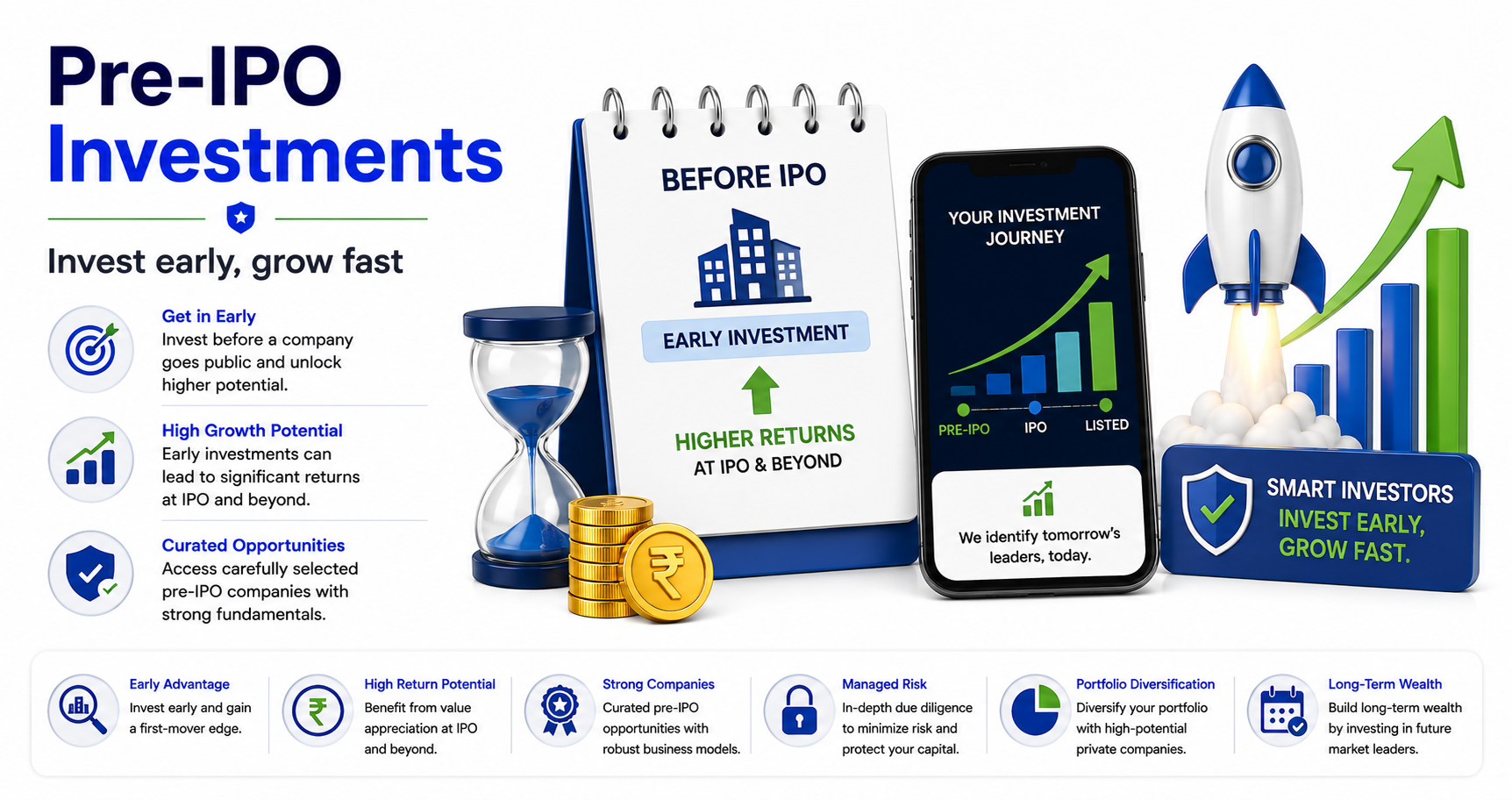
Pre-IPO investing buys shares in a company before it lists on an exchange, through the unlisted market. The attraction is entering before public investors and participating in any listing gain.
The risks are structural rather than incidental. There is no exchange, so pricing is negotiated rather than quoted and can differ substantially between dealers for the same company on the same day. There is no exit until a listing happens, and a listing may not happen. Disclosure requirements for unlisted companies are far lighter than for listed ones.
There is also a lock-in. Shares acquired before an IPO are typically subject to a restriction period after listing, so the ability to sell into any listing gain is limited. Investors frequently discover this after buying rather than before.
Who should consider it
Experienced investors with capital they can genuinely lock away indefinitely and lose entirely. Investors with the ability to assess an unlisted company's financials independently.
It is not appropriate for anyone who needs liquidity, cannot assess the business themselves, or is investing on the strength of a listing rumour.
Benefits
- Entry before public listing, at a negotiated price
- Exposure to businesses not available on the exchange
- Potential participation in growth before the market prices it
- Access to companies at an earlier stage than public markets allow
What is included, and what is not
Read the right-hand column first. It is the one that tends to surprise people later.
Included
- Purchase of unlisted equity shares through a registered dealer
- Transfer into your demat account
- Shareholder rights as an equity holder
- Participation in corporate actions
Not included
- Any exchange, quoted price or reliable valuation
- Liquidity — there is no ready market to sell into
- Any assurance that a listing will occur
- Disclosure comparable to a listed company
- The ability to sell immediately on listing, given lock-in rules
Terms vary between providers and between plans from the same provider. The offer document you receive is what governs — we will walk you through it before you commit.
How it works with us
- 1 We establish whether direct equity suits you at all For many investors a diversified fund does the same job with less to go wrong. That conversation comes before anything else.
- 2 Allocation set before any stock is discussed How much of your portfolio belongs in direct equity, and what stays in funds and fixed income. Position sizing prevents most permanent damage.
- 3 Demat and trading account set up properly KYC, nomination and the mandates. Done once, correctly, so nothing stalls when you want to transact.
- 4 Research shared, decisions left with you We provide analysis and context. We do not provide tips, and we will not tell you a stock will go up.
- 5 Reviewed against the thesis, not the price The question at review is whether the reason you bought still holds — not whether the price has moved since.
Important considerations
The things a brochure tends to leave out. Read these before you decide.
- Compare quotes from more than one dealer. The same unlisted share can be offered at materially different prices on the same day, and the spread is your cost.
- Assume there may be no listing. Companies postpone and abandon IPOs regularly, and there is no obligation to list at all.
- The post-listing lock-in restricts selling into any listing gain. Understand the applicable restriction before buying, not afterwards.
- Verify the transfer properly. Unlisted share transactions have been a target for fraud, and dealing through a registered, established intermediary matters.
- Equity investments carry market risk. Unlisted investments carry that plus illiquidity, valuation opacity and the possibility of total loss.
Documents required
- PAN card, mandatory for all securities transactions
- Aadhaar or other identity proof
- Address proof
- Bank account proof — cancelled cheque or statement
- Income proof, for derivatives segment activation
- Recent passport-size photograph
- Signature specimen and in-person verification
Frequently Asked Questions
Can I sell immediately when the company lists?
Generally not. Shares acquired before an IPO are subject to a lock-in period after listing, which restricts selling into any listing gain. Investors frequently discover this after buying, so establish the applicable restriction before you commit.
How is the price decided?
By negotiation with a dealer, not by an exchange. The same unlisted share can be quoted at materially different prices by different dealers on the same day. Comparing across dealers is essential, because that spread is a direct cost to you.
What if the company never lists?
Then you hold an illiquid unlisted share with no ready market. Companies postpone and abandon IPOs regularly, and there is no obligation to list. This is the central risk of the category and it should be assumed rather than discounted.
How do I assess the company?
With more difficulty than a listed one. Disclosure requirements for unlisted companies are far lighter, financial information is less frequent and less standardised, and there is no analyst coverage. If you cannot assess the financials yourself, you are relying on the seller's description.
Is this suitable for most investors?
No. It requires capital you can lock away indefinitely and lose entirely, plus the ability to evaluate an unlisted business independently. For investors seeking equity growth, listed markets offer the same asset class with liquidity, disclosure and transparent pricing.
Want a shortlist instead of a catalogue?
Tell us the situation and an advisor comes back with two or three options that actually fit — and names what each one gives up.