
Get Expert Guidance
What Our Plans Cover
-
Office fit-out and interior improv...
-
Furniture
-
Computers
-
Fire
-
Burglary and housebreaking
-
Cost of reconstituting business re...
-
Business interruption and temporar...
-
Public liability to visitors
Who Can Consider This Plan?
- Legal ownership, or an insurable interest such as a lease
- Property of permanent construction, meeting the insurer's standards
- Accurate declaration of occupancy and use
- Sum insured set on a defensible valuation basis
- Compliance with any fire safety requirements applicable to the premises
What May Not Be Covered?
- Data loss without physical damage — that is a cyber exposure
- Software errors and system failures unrelated to physical damage
- Wear, tear and obsolescence of equipment
- Portable equipment off the premises, unless extended
- Employee dishonesty, unless a fidelity cover is taken
Always check the policy wording before you commit.
Why Choose Wealth & Covers?
- Expert advice to choose the right plan
- Plans from leading insurance companies
- Hassle-free process and documentation
- End-to-end support, including claim assistance
- Dedicated relationship manager
Our Insurance Partners
- Star Health Insurance
- Care Health Insurance
- Niva Bupa Health Insurance
- HDFC ERGO
- ICICI Lombard
- Bajaj Allianz
We represent multiple providers to help you find the most suitable option at the best price.
- Expert Guidance Personalised advice from experienced insurance professionals.
- End-to-End Support From choosing the right plan to claim assistance, we are with you always.
- Claims Assistance Hassle-free claim support to ensure you get what you deserve.
- Transparent Process Clear information, easy documentation and a hassle-free experience.
Overview
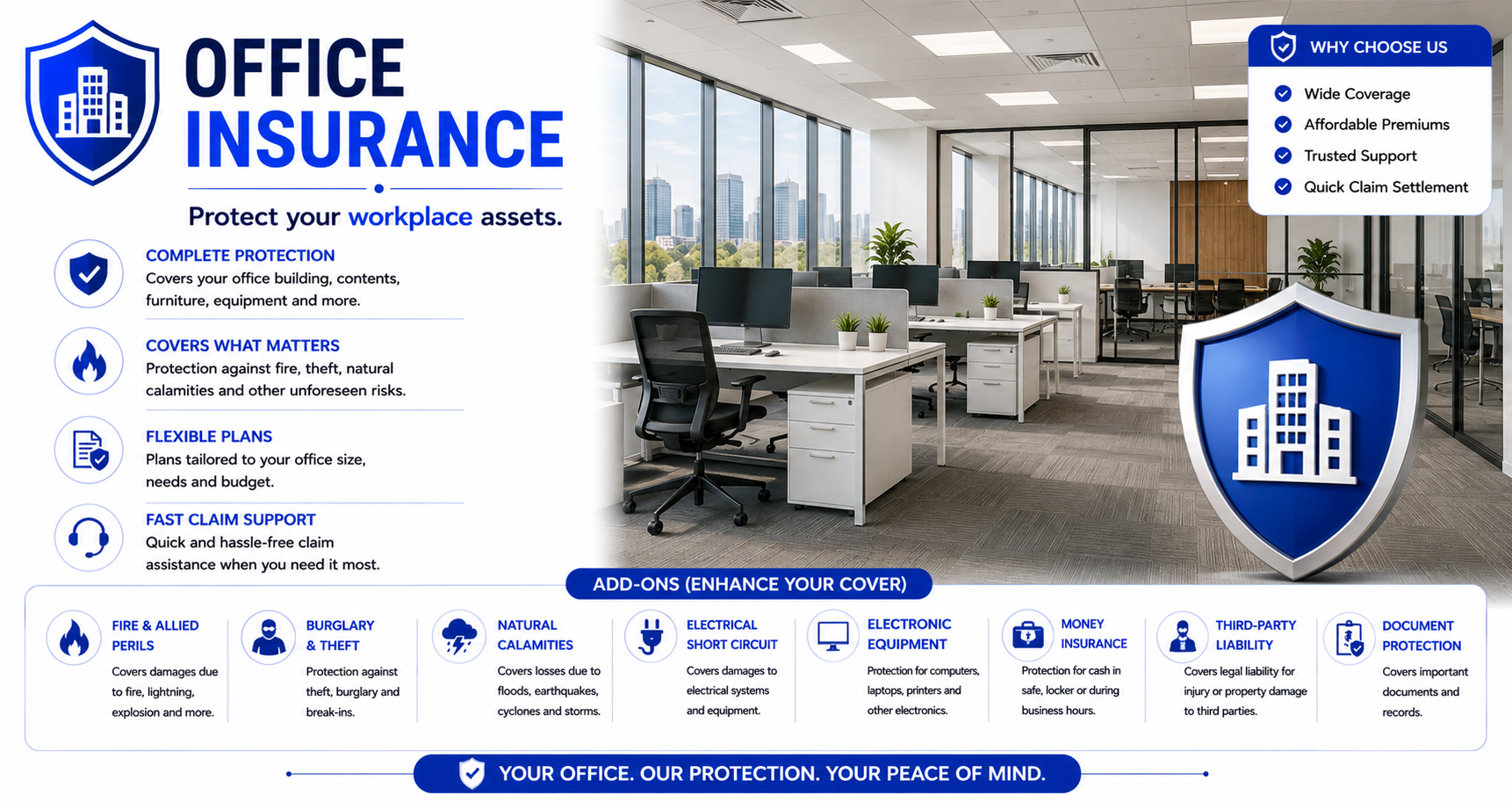
An office policy covers the premises, fit-out, furniture and equipment, along with the liabilities arising from occupying the space. The exposure profile is different from retail: less stock, more electronics, and considerably more dependence on data and systems.
That shifts the emphasis. Electronic equipment cover, which responds to failures and damage that a plain fire policy does not, matters more here. So does cover for the cost of reconstituting records and data after a loss, which is frequently more expensive than replacing the hardware it sat on.
For most offices the largest uninsured exposure is interruption. An office that cannot be occupied stops the business, and the cost of temporary premises and lost productivity dwarfs the value of the furniture.
Who should consider it
Businesses occupying their own or leased office space. Professional practices with significant equipment and records. Any office where a period of closure would materially disrupt revenue.
Benefits
- Fit-out, furniture and equipment covered under one policy
- Electronic equipment cover beyond the standard fire perils
- Cost of reconstituting records and data after a loss
- Business interruption including temporary premises
- Public liability for visitors to the office
- Portable equipment covered away from the premises, where extended
What is covered, and what is not
Read the right-hand column first. It is the one that decides whether a claim is paid.
Typically covered
- Office fit-out and interior improvements
- Furniture, fixtures and fittings
- Computers, servers and electronic equipment
- Fire, flood, storm and other natural perils
- Burglary and housebreaking
- Cost of reconstituting business records
- Business interruption and temporary premises
- Public liability to visitors
Typically not covered
- Data loss without physical damage — that is a cyber exposure
- Software errors and system failures unrelated to physical damage
- Wear, tear and obsolescence of equipment
- Portable equipment off the premises, unless extended
- Employee dishonesty, unless a fidelity cover is taken
- Consequential loss without business interruption cover
- Professional liability, which is a separate class
Inclusions and exclusions vary between providers and between plans from the same provider. The wording in your own policy document is what governs — we will walk you through it before you buy.
How it works with us
- 1 We value the risk before we quote it Reinstatement cost of the structure, current value of the contents, and what a total loss would actually cost to rebuild today.
- 2 Perils matched to the location A coastal warehouse, a basement in a flood-prone city and a first-floor office are three different risks. The policy should reflect which one you are.
- 3 Quotes compared on sum insured basis, not premium Market value against reinstatement value changes what you receive far more than the premium difference between insurers.
- 4 Survey where the value warrants it Larger risks are surveyed before cover. It is also the moment to fix anything that would reduce a claim later.
- 5 Policy issued, and reviewed annually We revisit the sum insured every renewal. Under-insurance is the single most common reason property claims are cut.
Important considerations
The things a brochure tends to leave out. Read these before you decide.
- Insure IT equipment on reinstatement rather than market value. Depreciated settlements on computers rarely buy replacements.
- This policy responds to physical damage. Data lost to a ransomware attack with no physical damage is a cyber exposure and needs a cyber policy.
- Extend cover to laptops taken off the premises. A significant proportion of office equipment now spends most of its life somewhere else.
- Cover for reconstituting records is often overlooked and frequently exceeds the hardware loss. Rebuilding files, drawings and case papers is slow and expensive.
- Business interruption should include the cost of temporary premises. Finding and fitting out alternative space quickly is expensive, and it is the first thing you will need to do.
Documents required
- Proof of ownership or the lease agreement
- Details of construction — age, materials, number of floors
- Valuation or reinstatement cost estimate of the structure
- Inventory and value of contents, stock or equipment
- Details of fire protection and security arrangements
- Previous policy and claims history, where applicable
- Photographs of the premises, for larger risks
Frequently Asked Questions
Does this cover a cyber attack?
No. Office policies respond to physical damage. Data encrypted by ransomware, a network breach or a privacy claim are cyber exposures requiring a cyber policy. The two sit alongside each other, and the gap between them is where most modern office losses fall.
Are laptops covered when employees take them home?
Only with a portable equipment extension. A standard policy covers property at the insured premises, and a growing share of office equipment is rarely there.
What is cover for reconstituting records?
It pays the cost of recreating your business records after physical damage — rebuilding files, drawings, ledgers and case papers. That work is labour-intensive and often costs considerably more than replacing the computers the records sat on.
Should I insure equipment at market value?
Reinstatement is better for IT. A depreciated market value on a three-year-old laptop rarely buys a replacement, and the gap falls on you at exactly the point you need to be operating again quickly.
Is my professional liability included?
No. Claims arising from advice or services are professional indemnity, an entirely separate class. An office policy covers your property and your occupancy of the premises, not the quality of your work.
Want a shortlist instead of a catalogue?
Tell us the situation and an advisor comes back with two or three options that actually fit — and names what each one gives up.