
Plan your investment
What Our Plans Cover
-
Units in a REIT holding warehousin...
-
Distributions from rental income
-
Exposure across multiple facilitie...
-
Quarterly operational and financia...
-
Listed trading and demat holding
Who Can Consider This Plan?
- Indian resident individual, HUF, trust or company
- NRIs, subject to the applicable investment routes
- A demat account and a trading account
- PAN and completed KYC
- Minimum investment as per the exchange lot size
What May Not Be Covered?
- Any guarantee of occupancy or distribution
- Protection against new supply in the same catchment
- Protection against unit price falls
- Ownership of any specific facility
Always check the policy wording before you commit.
Why Choose Wealth & Covers?
- Expert advice to choose the right plan
- Plans from leading investments companies
- Hassle-free process and documentation
- End-to-end support, including claim assistance
- Dedicated relationship manager
- Expert Guidance Personalised advice from experienced investments professionals.
- End-to-End Support From choosing the right plan to claim assistance, we are with you always.
- Claims Assistance Hassle-free claim support to ensure you get what you deserve.
- Transparent Process Clear information, easy documentation and a hassle-free experience.
Overview
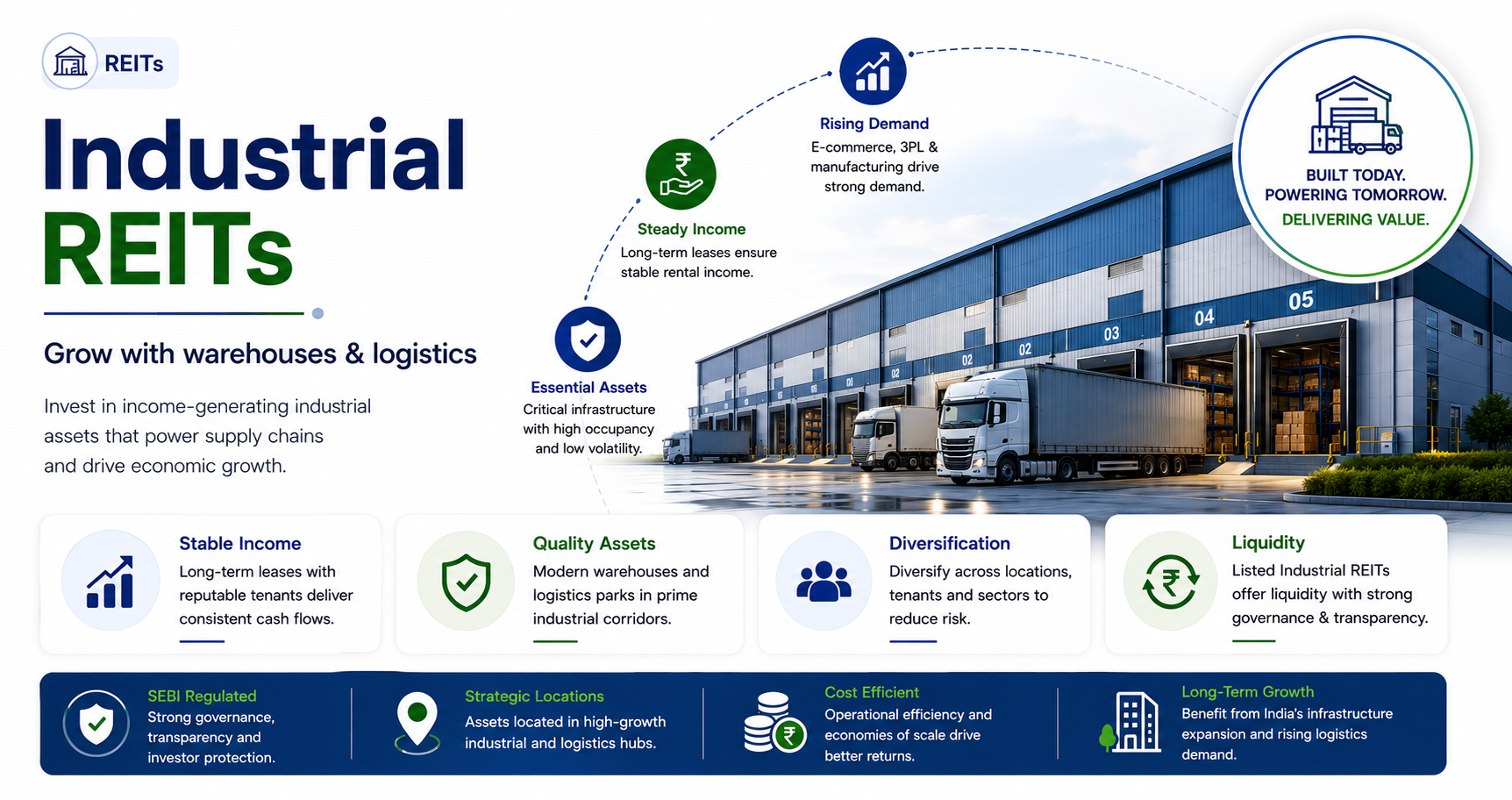
Industrial REITs own warehousing and logistics facilities let to e-commerce operators, third-party logistics companies, manufacturers and retailers. The category has grown alongside organised retail and online commerce.
The economics differ from offices in a useful way. Warehouses are cheaper to build, quicker to fit out and let to tenants whose need for the space is operational rather than discretionary. Leases tend to be long, and relocation is disruptive enough that renewals are relatively sticky.
Location is the whole game. A warehouse is valuable because of its proximity to consumption centres and transport infrastructure, and that advantage can erode as road networks change or as new supply arrives nearby. Two warehouses of identical specification can have very different economics.
Who should consider it
Investors wanting exposure to logistics and warehousing property. Investors seeking a REIT category with different drivers from offices. Anyone with a view on the growth of organised retail and e-commerce in India.
Benefits
- Exposure to a property category with structural demand growth
- Tenants whose space requirement is operational rather than discretionary
- Long leases with relatively sticky renewals
- Lower construction and fit-out costs than office assets
- Different demand drivers from commercial office REITs
- Regular distributions from rental income
What is included, and what is not
Read the right-hand column first. It is the one that tends to surprise people later.
Included
- Units in a REIT holding warehousing and logistics assets
- Distributions from rental income
- Exposure across multiple facilities and locations
- Quarterly operational and financial disclosure
- Listed trading and demat holding
Not included
- Any guarantee of occupancy or distribution
- Protection against new supply in the same catchment
- Protection against unit price falls
- Ownership of any specific facility
Terms vary between providers and between plans from the same provider. The offer document you receive is what governs — we will walk you through it before you commit.
How it works with us
- 1 We explain what a REIT actually is first Not a property purchase and not a fixed deposit. A listed security whose income comes from rent, and whose price moves with markets.
- 2 Distribution yield examined properly Yield alone is not the answer. The mix of rent, occupancy, lease expiries and debt is what tells you whether it is sustainable.
- 3 Allocation sized against your existing property exposure Most Indian households already hold a great deal of real estate. A REIT should complement that, not concentrate it further.
- 4 Purchase through the exchange REIT units trade like shares and settle into your demat account. The mechanics are simple; the analysis is where the work is.
- 5 Distributions tracked and taxed correctly REIT distributions have several components with different tax treatments. We make sure they are reported properly.
Important considerations
The things a brochure tends to leave out. Read these before you decide.
- New supply is the specific risk here. Warehouses are quicker and cheaper to build than offices, so a strong market attracts competing capacity faster.
- Location advantage can erode. A facility valuable for its proximity to a highway or a consumption centre can lose that edge as infrastructure and demand patterns change.
- Tenant concentration in e-commerce is common. A slowdown or a consolidation among large online retailers affects several facilities at once.
- Specification matters. Modern grade A warehousing with the right clear height, floor loading and dock configuration is not interchangeable with older stock.
- Distributions follow rent collected and are not guaranteed.
Documents required
- PAN card
- Aadhaar or other identity proof
- Address proof
- Demat account details
- Bank account proof for distribution credit
- Completed KYC with the broker
Frequently Asked Questions
Why has this category grown?
Organised retail and e-commerce need warehousing near consumption centres, and the shift from unorganised to organised supply chains has created sustained demand for grade A facilities that barely existed in India fifteen years ago.
How does it differ from an office REIT?
The tenants need the space operationally rather than discretionarily, construction is cheaper and faster, and the demand drivers are consumption and logistics rather than corporate headcount. That makes the two categories genuinely different exposures rather than variations on the same one.
What is the main risk?
New supply. Because warehouses are quicker and cheaper to build than offices, a strong market attracts competing capacity relatively fast, and a facility's location advantage can be eroded by a newer development nearby.
Does specification matter?
Considerably. Clear height, floor loading, dock configuration and last-mile access determine which tenants a facility can serve. Modern grade A stock and older warehousing are not substitutes, and portfolios differ substantially on this.
Is the tenant base concentrated?
Frequently in e-commerce and third-party logistics operators. That concentration means a slowdown or consolidation among a few large occupiers can affect several facilities at once, so the tenant breakdown in the disclosures is worth reading.
Want a shortlist instead of a catalogue?
Tell us the situation and an advisor comes back with two or three options that actually fit — and names what each one gives up.