
Plan your investment
What Our Plans Cover
-
Research and investment recommenda...
-
Execution only after your approval
-
Regular reporting of holdings and...
-
Direct holding in your demat accou...
-
Dividends and corporate actions re...
Who Can Consider This Plan?
- Minimum investment of ₹50 lakh, as regulated
- Indian resident individual, HUF, trust, company or NRI
- Completed KYC with the portfolio manager
- A demat account in the investor's own name
- Acceptance by the portfolio manager
What May Not Be Covered?
- Execution without your approval
- Any guarantee of return
- Protection against timing lost while approvals are pending
- Availability below the ₹50 lakh regulatory minimum
Always check the policy wording before you commit.
Why Choose Wealth & Covers?
- Expert advice to choose the right plan
- Plans from leading investments companies
- Hassle-free process and documentation
- End-to-end support, including claim assistance
- Dedicated relationship manager
- Expert Guidance Personalised advice from experienced investments professionals.
- End-to-End Support From choosing the right plan to claim assistance, we are with you always.
- Claims Assistance Hassle-free claim support to ensure you get what you deserve.
- Transparent Process Clear information, easy documentation and a hassle-free experience.
Overview
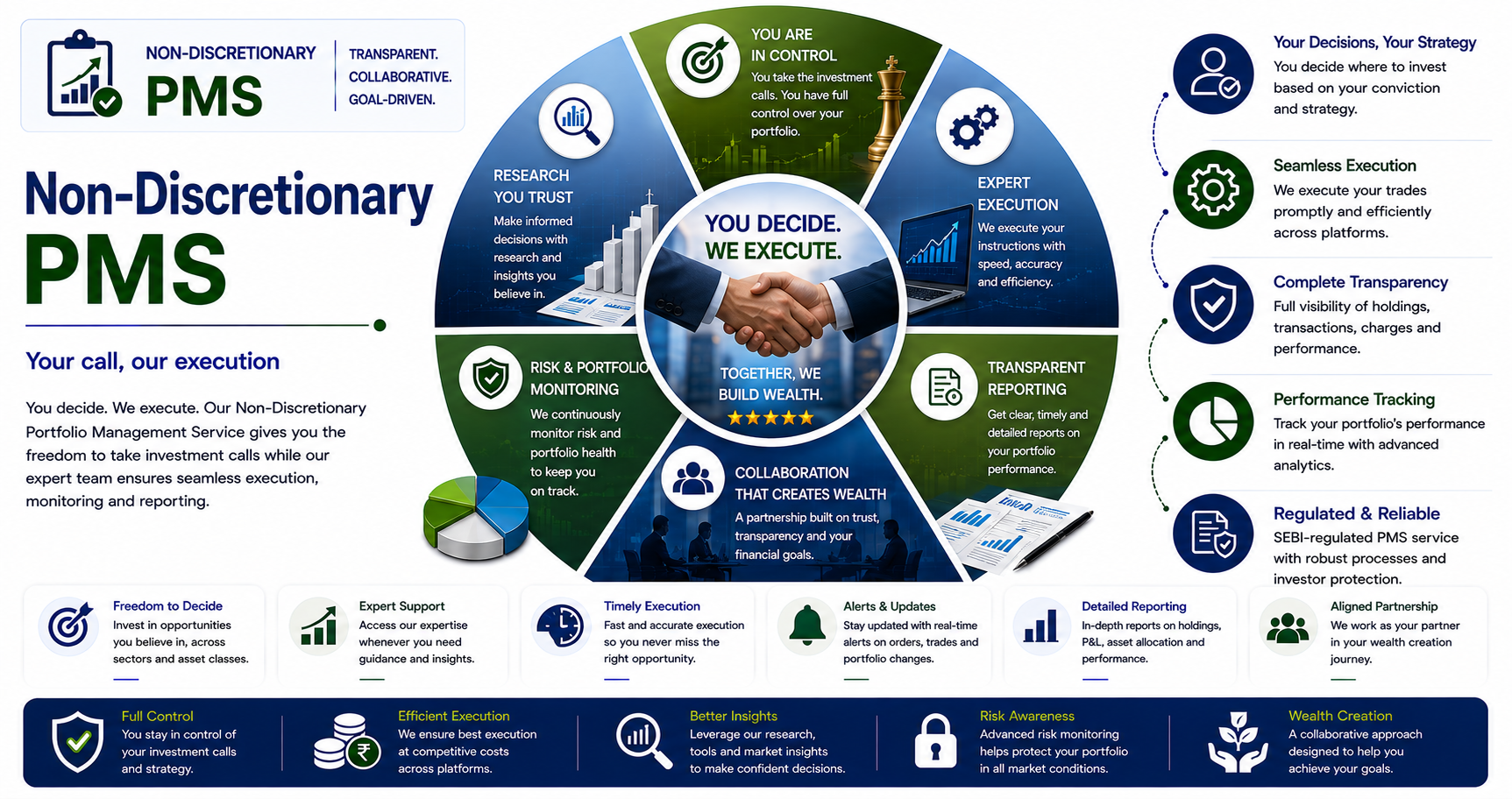
In a non-discretionary portfolio management service the manager researches and recommends, and you approve each transaction before it is executed. Nothing happens in your portfolio without your consent.
The appeal is control. Investors who want professional research but are uncomfortable delegating decisions get both, and can decline recommendations that do not suit them.
The cost is timing and, frequently, discipline. Markets move while approvals are pending, and investors who approve the comfortable recommendations and decline the uncomfortable ones end up with a portfolio that reflects their instincts rather than the manager's process — which is usually the opposite of what they were paying for.
Who should consider it
Investors who want professional research while retaining decision-making. Investors with constraints or views that require case-by-case judgement. Investors uncomfortable with full delegation.
Investors who will systematically decline recommendations during difficult periods are usually better served by discretionary management or a mutual fund.
Benefits
- Every decision requires your approval
- Professional research and recommendations
- Ability to decline anything that does not suit you
- Direct ownership in your own demat account
- Full transparency of holdings and transactions
- Your specific views can be accommodated case by case
What is included, and what is not
Read the right-hand column first. It is the one that tends to surprise people later.
Included
- Research and investment recommendations
- Execution only after your approval
- Regular reporting of holdings and performance
- Direct holding in your demat account
- Dividends and corporate actions received directly
Not included
- Execution without your approval
- Any guarantee of return
- Protection against timing lost while approvals are pending
- Availability below the ₹50 lakh regulatory minimum
Terms vary between providers and between plans from the same provider. The offer document you receive is what governs — we will walk you through it before you commit.
How it works with us
- 1 We test the case against a mutual fund first A ₹50 lakh minimum and higher fees need justifying. If a fund does the same job, that is the honest answer.
- 2 Strategy and manager assessed on process, not last year How the portfolio is constructed, how it behaved in a bad year, and how consistent the process has been.
- 3 Fee structure understood in full Fixed fee, performance fee, hurdle, high-water mark and exit load. These vary enormously and compound over time.
- 4 Account opened and portfolio built Shares are bought in your own name in your own demat account. You see every transaction as it happens.
- 5 Reviewed on process and reported for tax Every trade is a taxable event in your hands. We keep the reporting straight and review against the mandate, not the market.
Important considerations
The things a brochure tends to leave out. Read these before you decide.
- Be honest about whether you will approve recommendations you dislike. Systematically declining the uncomfortable ones defeats the purpose of hiring a manager.
- Approval delays cost timing. In fast-moving markets the price you get can differ meaningfully from the price at recommendation.
- Set expectations on response times at the outset. A manager who cannot reach you cannot act.
- The fee is usually lower than discretionary management, reflecting the reduced responsibility.
- Equity investments are subject to market risk regardless of who makes the decision.
Documents required
- PAN card
- Aadhaar or other identity proof
- Address proof
- Bank account proof
- Demat account details, or consent to open one
- Completed KYC and PMS agreement
- Power of attorney in favour of the portfolio manager
Frequently Asked Questions
Why choose non-discretionary over discretionary?
Control. You retain every decision and can decline anything that does not suit you. It works for investors with specific views or constraints that need case-by-case judgement, and for those genuinely uncomfortable delegating.
What is the practical downside?
Timing and discipline. Markets move while approvals are pending, and investors who approve comfortable recommendations while declining uncomfortable ones end up with a portfolio shaped by their instincts rather than the manager's process — which is the opposite of what they hired.
How quickly do I need to respond?
Quickly enough that recommendations remain actionable. Agree expected response times at the outset, because a manager who cannot reach you cannot act, and the resulting portfolio drift is nobody's fault but shows up in your returns.
Are the fees lower?
Generally yes, reflecting that the manager advises rather than decides. The difference is usually modest, and it should not be the deciding factor between the two structures.
Which suits most investors?
Discretionary, for most people who have decided to hire a manager at all. The value of professional management largely comes from acting consistently through difficult periods, which is precisely when approvals slow down and instincts take over.
Want a shortlist instead of a catalogue?
Tell us the situation and an advisor comes back with two or three options that actually fit — and names what each one gives up.