
Plan your investment
What Our Plans Cover
-
Units in an unlisted infrastructur...
-
Distributions per the trust terms
-
Exposure to the trust's specific a...
-
Reporting per the offering terms
Who Can Consider This Plan?
- Indian resident individual, HUF, trust or company
- NRIs, subject to the applicable investment routes
- A demat account and a trading account
- PAN and completed KYC
- Minimum investment as per the exchange lot size
What May Not Be Covered?
- Listing, market pricing and daily liquidity
- Accessibility at retail ticket sizes
- Disclosure comparable to a listed trust
- Exit outside the permitted arrangements
Always check the policy wording before you commit.
Why Choose Wealth & Covers?
- Expert advice to choose the right plan
- Plans from leading investments companies
- Hassle-free process and documentation
- End-to-end support, including claim assistance
- Dedicated relationship manager
- Expert Guidance Personalised advice from experienced investments professionals.
- End-to-End Support From choosing the right plan to claim assistance, we are with you always.
- Claims Assistance Hassle-free claim support to ensure you get what you deserve.
- Transparent Process Clear information, easy documentation and a hassle-free experience.
Overview
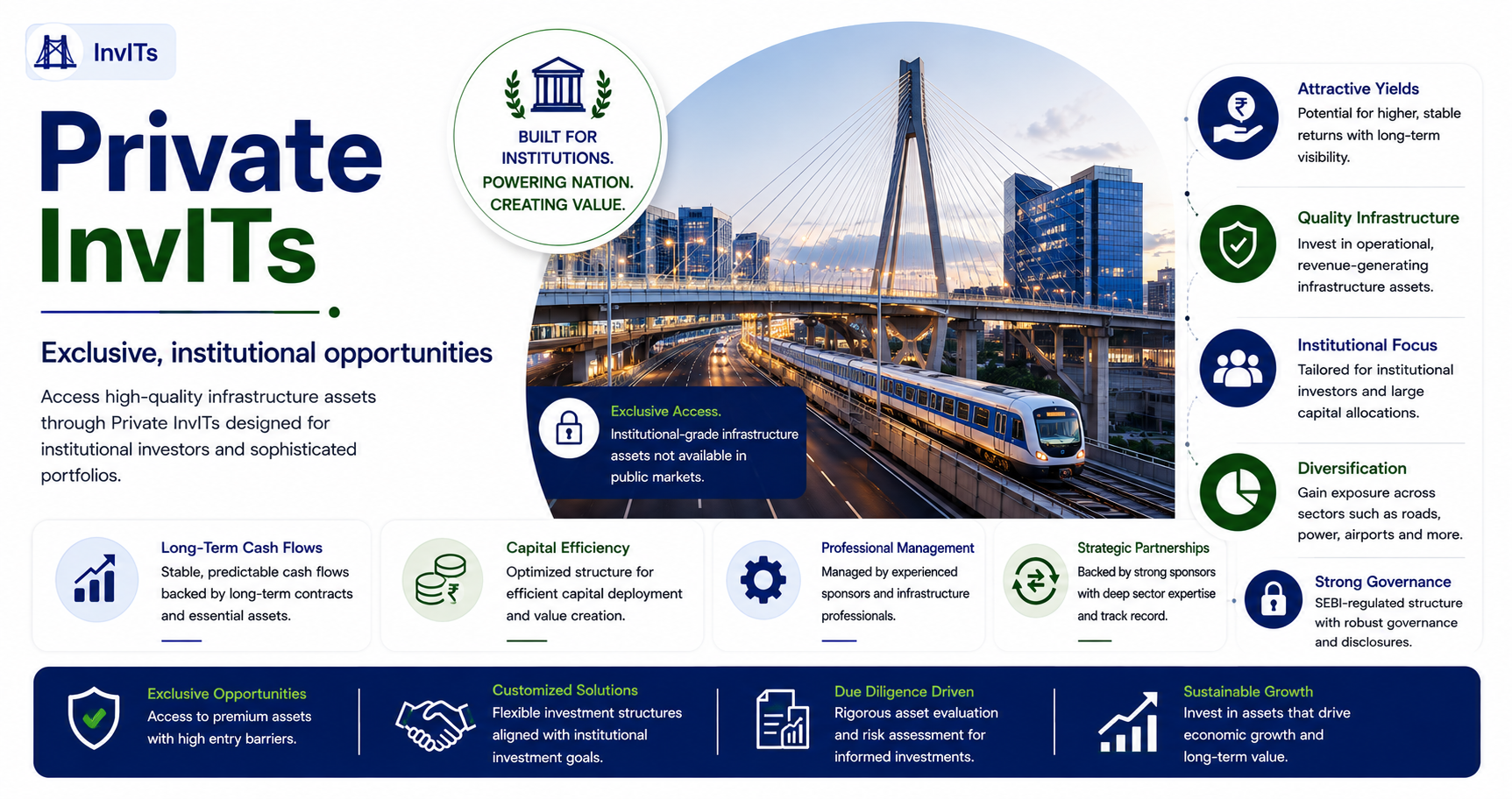
A private InvIT places units with a limited set of institutional and high net worth investors rather than listing on an exchange. Minimum commitments are very large, there is no market price, and exit depends on the trust's own arrangements.
The structure exists because infrastructure assets suit patient institutional capital. Pension funds, sovereign funds and insurers can hold twenty-year assets without needing daily liquidity, and a private structure avoids the cost and disclosure burden of listing.
For an individual investor the relevant point is accessibility. The minimums place these firmly outside retail reach, and the illiquidity means capital is genuinely committed for years. Public InvITs offer the same asset class with liquidity and disclosure at a fraction of the minimum.
Who should consider it
Institutional investors and family offices with long-horizon capital. Investors seeking exposure to specific assets not available in listed trusts.
Individual investors seeking infrastructure exposure should use listed InvITs, which provide the same asset class with liquidity and public disclosure.
Benefits
- Access to specific infrastructure assets not in listed vehicles
- No daily price movement to react to
- Terms negotiated directly in some structures
- Suited to genuinely long-horizon capital
- Lower disclosure and listing costs, potentially improving net returns
What is included, and what is not
Read the right-hand column first. It is the one that tends to surprise people later.
Included
- Units in an unlisted infrastructure investment trust
- Distributions per the trust terms
- Exposure to the trust's specific asset portfolio
- Reporting per the offering terms
Not included
- Listing, market pricing and daily liquidity
- Accessibility at retail ticket sizes
- Disclosure comparable to a listed trust
- Exit outside the permitted arrangements
Terms vary between providers and between plans from the same provider. The offer document you receive is what governs — we will walk you through it before you commit.
How it works with us
- 1 We explain the finite-life point first Most InvIT assets have a concession period. Part of the yield is your own capital returning, and that changes how to read it.
- 2 Distribution quality examined, not just the number How much is genuinely surplus cash and how much is capital return, and what happens to it as the concession runs down.
- 3 Counterparty and concession terms read carefully Who pays the revenue, under what contract, and for how long. That is where the real risk in an InvIT sits.
- 4 Purchase through the exchange Listed InvIT units trade like shares and settle into your demat account.
- 5 Distributions tracked and taxed by component Interest, dividend and return of capital are taxed differently. Reporting them correctly is part of holding these.
Important considerations
The things a brochure tends to leave out. Read these before you decide.
- The minimums place these outside retail reach, and that is by design rather than by accident.
- Exit arrangements determine everything about liquidity. Understand them precisely before committing, because there is no market to fall back on.
- Valuations are periodic and prepared by appointed valuers rather than set by transactions.
- The same concession-life and counterparty considerations apply as in a listed InvIT, with less public disclosure to assess them.
- For individual investors, listed InvITs provide the same asset class with liquidity, quarterly disclosure and accessible minimums.
Documents required
- PAN card
- Aadhaar or other identity proof
- Address proof
- Demat account details
- Bank account proof for distribution credit
- Completed KYC with the broker
Frequently Asked Questions
Can a retail investor participate?
Generally no. Minimum commitments are institutional in scale, and the structure is designed for pension funds, sovereign funds, insurers and family offices with long-horizon capital. Listed InvITs are the retail route into the same asset class.
Why do institutions prefer the private structure?
Because they do not need daily liquidity and can hold twenty-year assets to match long-dated liabilities. Avoiding listing costs and public disclosure requirements can also improve net returns, and terms can sometimes be negotiated directly.
How do I exit?
Through whatever arrangements the trust provides — which are limited, and sometimes gated. There is no market to sell into, so the exit mechanism should be understood in detail before committing rather than examined later.
How is value determined?
By periodic valuation from appointed valuers rather than by traded prices. That is a professional estimate rather than the price at which someone actually transacted, and the two can differ.
Are the underlying risks different from a listed InvIT?
No — the same concession-life, counterparty and policy risks apply. What differs is that you have less public disclosure with which to assess them, and no ability to exit if your view changes.
Want a shortlist instead of a catalogue?
Tell us the situation and an advisor comes back with two or three options that actually fit — and names what each one gives up.