
Plan your investment
What Our Plans Cover
-
Portfolio construction driven by t...
-
Systematic rebalancing per the rul...
-
Direct holding in your own demat a...
-
Regular reporting of holdings and...
Who Can Consider This Plan?
- Minimum investment of ₹50 lakh, as regulated
- Indian resident individual, HUF, trust, company or NRI
- Completed KYC with the portfolio manager
- A demat account in the investor's own name
- Acceptance by the portfolio manager
What May Not Be Covered?
- Any guarantee that the model will continue working
- Full transparency of proprietary model logic
- Discretionary judgement in unusual conditions
- Protection against market falls
Always check the policy wording before you commit.
Why Choose Wealth & Covers?
- Expert advice to choose the right plan
- Plans from leading investments companies
- Hassle-free process and documentation
- End-to-end support, including claim assistance
- Dedicated relationship manager
- Expert Guidance Personalised advice from experienced investments professionals.
- End-to-End Support From choosing the right plan to claim assistance, we are with you always.
- Claims Assistance Hassle-free claim support to ensure you get what you deserve.
- Transparent Process Clear information, easy documentation and a hassle-free experience.
Overview
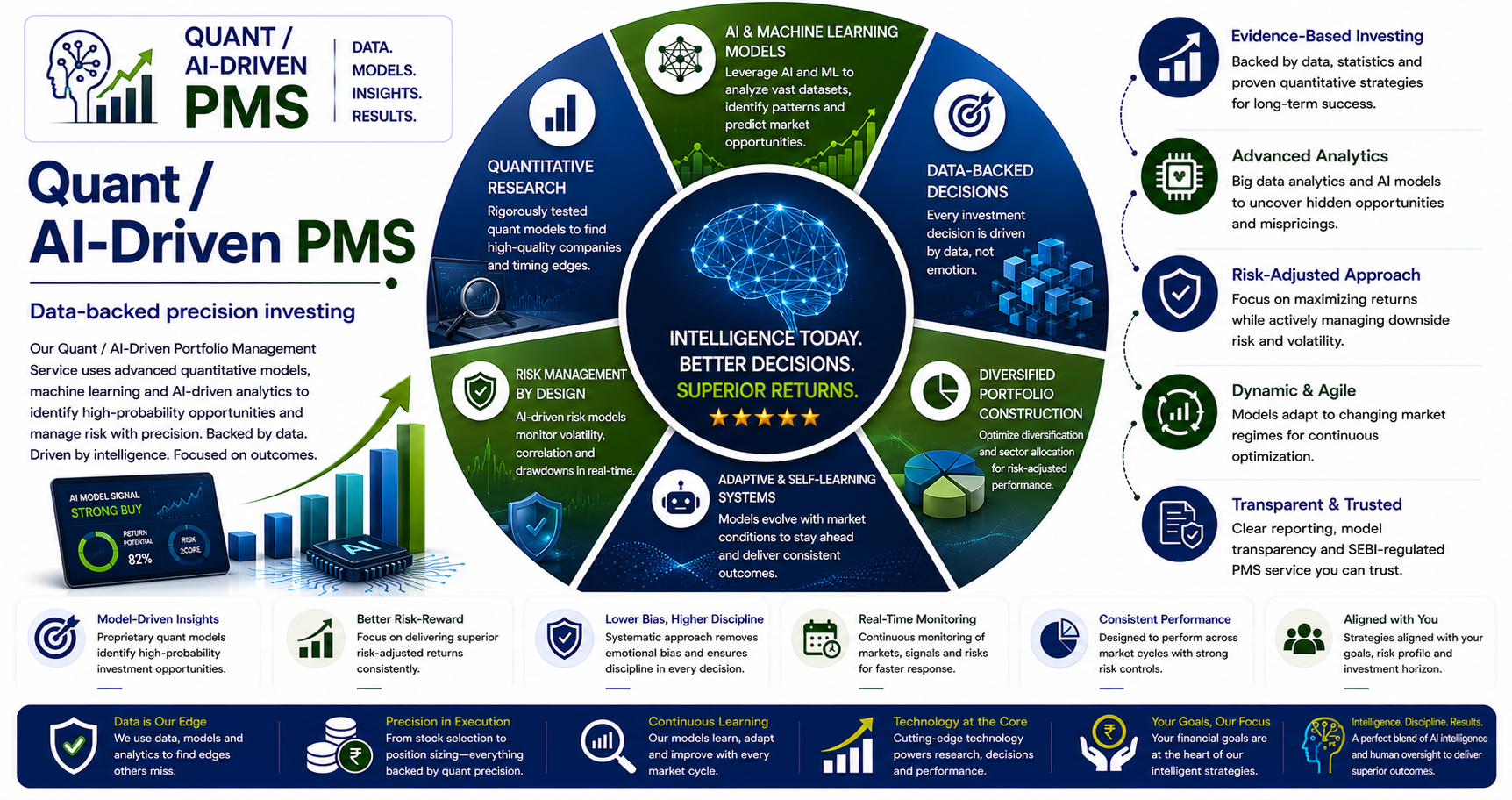
Quantitative and model-driven PMS strategies select and rebalance holdings using systematic rules rather than discretionary judgement. Factors, statistical relationships and increasingly machine learning models drive the decisions.
The genuine advantage is consistency. A model does not become fearful in a decline or greedy in a rally, and it applies the same criteria in every period. Behavioural error is the largest single drag on investor returns, and a systematic process removes it from execution.
The corresponding risk is that models are built on historical relationships that can stop holding. A strategy that worked for a decade can fail when the conditions it was fitted to change, and by the time that is clear the losses have occurred. Complexity also reduces transparency — a model you cannot interrogate is difficult to assess when it disappoints.
Who should consider it
Investors who understand the specific approach and can assess whether it has genuine logic behind it. Investors seeking systematic execution free of behavioural error.
Investors attracted by the terminology rather than the methodology should be cautious; "AI-driven" describes a tool, not a result.
Benefits
- Systematic execution free of behavioural error
- The same criteria applied consistently in every period
- Rules-based rebalancing without emotion
- Ability to process more data than a discretionary manager
- Direct ownership of every holding
- Full transparency of transactions, if not always of the model
What is included, and what is not
Read the right-hand column first. It is the one that tends to surprise people later.
Included
- Portfolio construction driven by the stated model
- Systematic rebalancing per the rules
- Direct holding in your own demat account
- Regular reporting of holdings and performance
Not included
- Any guarantee that the model will continue working
- Full transparency of proprietary model logic
- Discretionary judgement in unusual conditions
- Protection against market falls
Terms vary between providers and between plans from the same provider. The offer document you receive is what governs — we will walk you through it before you commit.
How it works with us
- 1 We test the case against a mutual fund first A ₹50 lakh minimum and higher fees need justifying. If a fund does the same job, that is the honest answer.
- 2 Strategy and manager assessed on process, not last year How the portfolio is constructed, how it behaved in a bad year, and how consistent the process has been.
- 3 Fee structure understood in full Fixed fee, performance fee, hurdle, high-water mark and exit load. These vary enormously and compound over time.
- 4 Account opened and portfolio built Shares are bought in your own name in your own demat account. You see every transaction as it happens.
- 5 Reviewed on process and reported for tax Every trade is a taxable event in your hands. We keep the reporting straight and review against the mandate, not the market.
Important considerations
The things a brochure tends to leave out. Read these before you decide.
- Ask what economic logic underlies the model. A statistical relationship without an explanation for why it should persist is a fitted pattern, not a strategy.
- Model risk is real. Strategies that worked for a decade have stopped working when conditions changed, and the losses precede the recognition.
- Systematic strategies often have higher turnover, which creates a real tax cost in your hands.
- "AI-driven" describes a tool rather than a result. Assess the process and the track record, not the terminology.
- Equity investments carry market risk, and model-driven strategies add model risk to it.
Documents required
- PAN card
- Aadhaar or other identity proof
- Address proof
- Bank account proof
- Demat account details, or consent to open one
- Completed KYC and PMS agreement
- Power of attorney in favour of the portfolio manager
Frequently Asked Questions
What is the advantage of a systematic approach?
Consistency. A model does not become fearful in a decline or greedy in a rally, and it applies the same criteria in every period. Behavioural error is the largest single drag on investor returns, and removing it from execution is a genuine benefit.
What is model risk?
The risk that the historical relationships a model was built on stop holding. Strategies that worked for a decade have failed when conditions changed, and the losses occur before the failure is recognised. It is the defining risk of the category.
Should "AI-driven" reassure me?
No — it describes a tool, not a result. What matters is whether the approach has genuine economic logic behind it, how it has performed through different conditions, and whether the manager can explain what it does. Terminology is not evidence.
How transparent are these strategies?
You see every transaction in your account, but the model itself is usually proprietary. That makes it harder to assess when performance disappoints, because you cannot easily tell whether the model is behaving as designed or has broken.
Does higher turnover matter?
Yes. Systematic strategies frequently trade more, and every trade realises gains in your own name. That tax drag is real and should be part of how you assess net outcomes rather than an afterthought.
Want a shortlist instead of a catalogue?
Tell us the situation and an advisor comes back with two or three options that actually fit — and names what each one gives up.