
Check your eligibility
What These Loans Fund
-
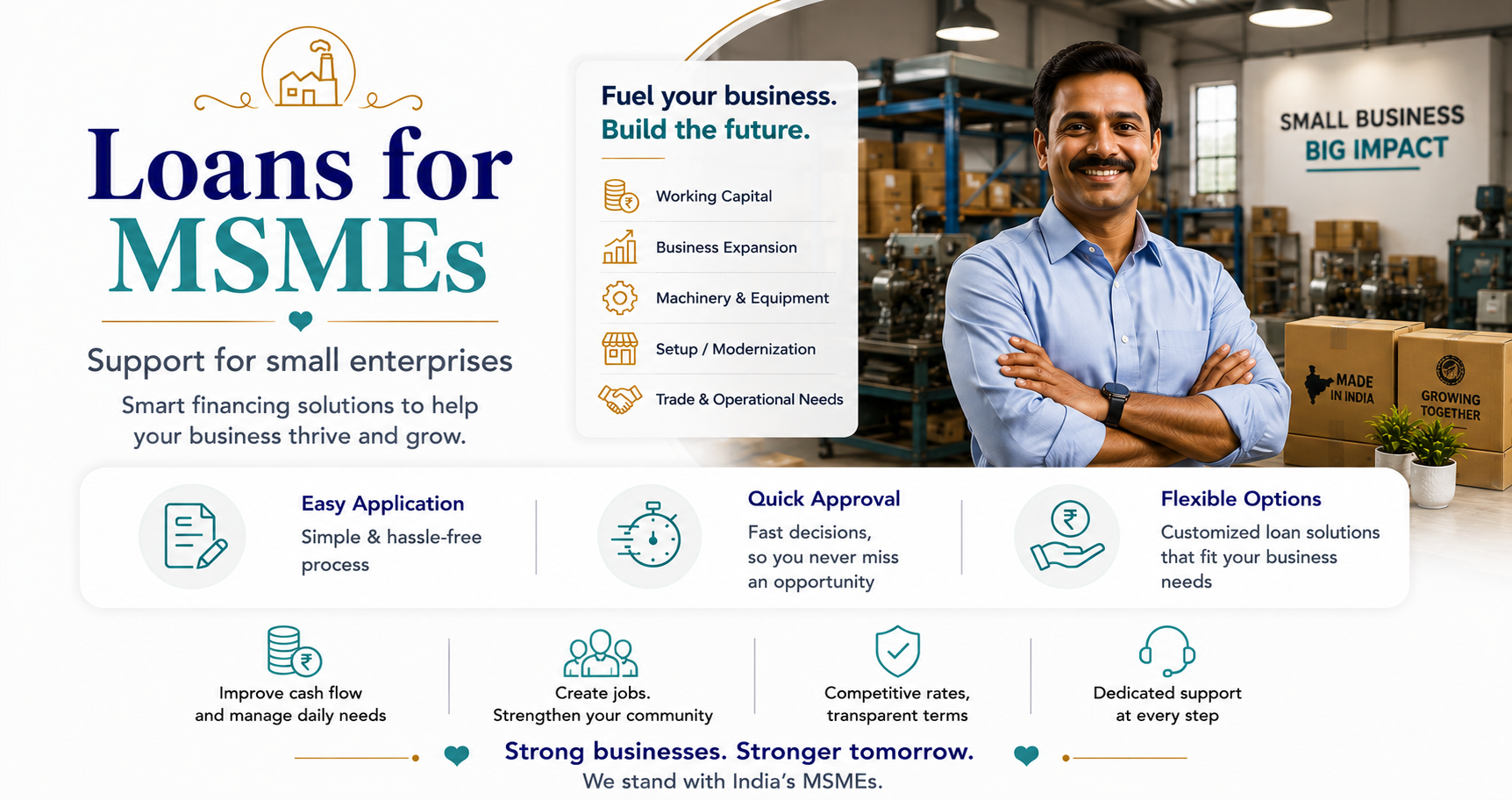
Working capital and inventory fund...
-
Plant
-
Business premises and fit-out
-
Technology upgrade and modernisati...
-
Export orders and order-backed fun...
-
Expansion into new capacity or loc...
Who Can Consider This Loan?
- Business vintage, commonly two to three years of operations
- Minimum annual turnover set by lender and segment
- Profitable operations, or a demonstrable path to profitability
- Clean banking conduct with no cheque returns
- Promoter credit scores, which lenders assess alongside the business
- GST registration and filing compliance, where applicable
What May Not Be Funded?
- Enterprises above the MSME investment and turnover thresholds
- Businesses without Udyam registration, for scheme benefits
- Sectors excluded from specific schemes
- Amounts above the applicable guarantee limits
- Speculative activity
Always check the sanction letter before you commit.
Why Choose Wealth & Covers?
- Expert advice to choose the right plan
- Plans from leading loans companies
- Hassle-free process and documentation
- End-to-end support, including claim assistance
- Dedicated relationship manager
- Expert Guidance Personalised advice from experienced loans professionals.
- End-to-End Support From choosing the right plan to claim assistance, we are with you always.
- Claims Assistance Hassle-free claim support to ensure you get what you deserve.
- Transparent Process Clear information, easy documentation and a hassle-free experience.
Overview
Micro, small and medium enterprises have access to a distinct lending framework in India, with priority sector treatment, credit guarantee support and interest subvention schemes that ordinary business lending does not offer.
Udyam registration is the gateway to all of it. An unregistered small business is simply a small business; a registered one is eligible for CGTMSE collateral-free guarantees, priority sector treatment at banks, and various central and state subvention schemes. The registration is free and takes minutes, and not having it is the most common self-inflicted obstacle we see.
Banks also have priority sector lending obligations, which means MSME lending is not merely permitted but required. That changes the posture of the conversation in a way small businesses frequently underestimate.
Who should consider it
Manufacturing and service enterprises within the MSME investment and turnover thresholds. Businesses that have not yet obtained Udyam registration. Any small business that has assumed formal credit is unavailable to it.
Benefits
- Priority sector treatment, which banks are obliged to meet
- CGTMSE guarantee enabling collateral-free lending within limits
- Interest subvention under various central and state schemes
- Lower rates than general unsecured business lending
- Longer tenures, commonly to seven years
- Protection under the MSME delayed payment provisions
What the loan funds, and what it does not
Read the right-hand column first. It is the one that decides how much you have to arrange yourself.
Usually funded
- Working capital and inventory funding
- Plant, machinery and equipment purchase
- Business premises and fit-out
- Technology upgrade and modernisation
- Export orders and order-backed funding
- Expansion into new capacity or locations
Usually not funded
- Enterprises above the MSME investment and turnover thresholds
- Businesses without Udyam registration, for scheme benefits
- Sectors excluded from specific schemes
- Amounts above the applicable guarantee limits
- Speculative activity
Funding limits and the treatment of add-ons vary between lenders and move with the borrower profile. The sanction letter you receive is what governs — we will walk you through it before you sign.
How it works with us
- 1 We read your financials before approaching anyone Turnover, margins, banking conduct and existing obligations. Lenders read the same numbers, and it is better to know what they will see.
- 2 Matched to lenders who write your segment Manufacturing, trading and services are underwritten differently. Applying to the wrong lender wastes weeks and marks your credit file.
- 3 Structure chosen before rate A term loan, a working capital line or an overdraft solve different problems. The cheapest wrong structure is still the wrong structure.
- 4 Documentation prepared properly, once Financials, GST returns, bank statements and projections in the format lenders expect. Incomplete files are the main cause of delay.
- 5 Sanction, disbursal and an eye on the covenants We flag the conditions attached to the sanction so a covenant breach is not the first you hear of a problem.
Important considerations
The things a brochure tends to leave out. Read these before you decide.
- Get Udyam registration if you do not have it. It is free, takes minutes, and unlocks the guarantee schemes, priority sector treatment and subventions that make MSME lending cheaper than general business lending.
- Check state-level schemes as well as central ones. Several states run their own subvention and margin money schemes that are considerably more generous than the central ones.
- Know your classification. Micro, small and medium enterprises access different limits, and the thresholds are based on investment and turnover together.
- Approach public sector banks as well as private ones. Priority sector obligations mean the posture towards MSME lending is different, and so is the pricing.
- The MSME delayed payment provisions are worth knowing. Registered enterprises have statutory recourse against buyers who delay beyond the prescribed period.
Documents required
- Business registration — incorporation, partnership deed or proprietorship proof
- PAN of the business and of the promoters
- Last two to three years of audited financial statements
- Last two to three years of income tax returns with computation
- GST returns for the last twelve months
- Bank statements for the last twelve months
- KYC of promoters, partners or directors
- Existing loan sanction letters and repayment records
Frequently Asked Questions
What does Udyam registration actually get me?
Access to the CGTMSE collateral-free guarantee scheme, priority sector treatment at banks, eligibility for central and state interest subventions, and statutory protection against delayed payments from buyers. It is free, takes minutes online, and not having it is the most common avoidable obstacle a small business faces.
Can I get a loan without collateral?
Within the CGTMSE limits, yes. The scheme guarantees a substantial portion of the lender's exposure, which is what makes collateral-free lending to small enterprises viable. Beyond those limits, ordinary security requirements apply.
Are MSME rates really lower?
Generally yes, once you factor in priority sector treatment and any applicable subvention. The effective rate after subvention can be well below what an equivalent unsecured business loan would cost.
Should I approach a public sector bank?
It is worth including them. Priority sector lending obligations mean public sector banks have targets to meet in this segment, which changes both the willingness to lend and the pricing. Private lenders are often faster; public ones are often cheaper.
What are the delayed payment provisions?
Registered MSMEs have statutory recourse where a buyer delays payment beyond the prescribed period, including interest at a penal rate. It does not help with borrowing directly, but it is one of the more useful practical benefits of registration.
Want a shortlist instead of a catalogue?
Tell us the situation and an advisor comes back with two or three options that actually fit — and names what each one gives up.