
Plan your investment
What Our Plans Cover
-
Units in a trust holding both prop...
-
Distributions from rental and inte...
-
Exposure to both property values a...
-
Listed trading where available
Who Can Consider This Plan?
- Indian resident individual, HUF, trust or company
- NRIs, subject to the applicable investment routes
- A demat account and a trading account
- PAN and completed KYC
- Minimum investment as per the exchange lot size
What May Not Be Covered?
- Simplicity of analysis, which a single-strategy trust offers
- Any guarantee of distribution
- Genuine independence between the two exposures
- An established Indian retail market for this structure
Always check the policy wording before you commit.
Why Choose Wealth & Covers?
- Expert advice to choose the right plan
- Plans from leading investments companies
- Hassle-free process and documentation
- End-to-end support, including claim assistance
- Dedicated relationship manager
- Expert Guidance Personalised advice from experienced investments professionals.
- End-to-End Support From choosing the right plan to claim assistance, we are with you always.
- Claims Assistance Hassle-free claim support to ensure you get what you deserve.
- Transparent Process Clear information, easy documentation and a hassle-free experience.
Overview
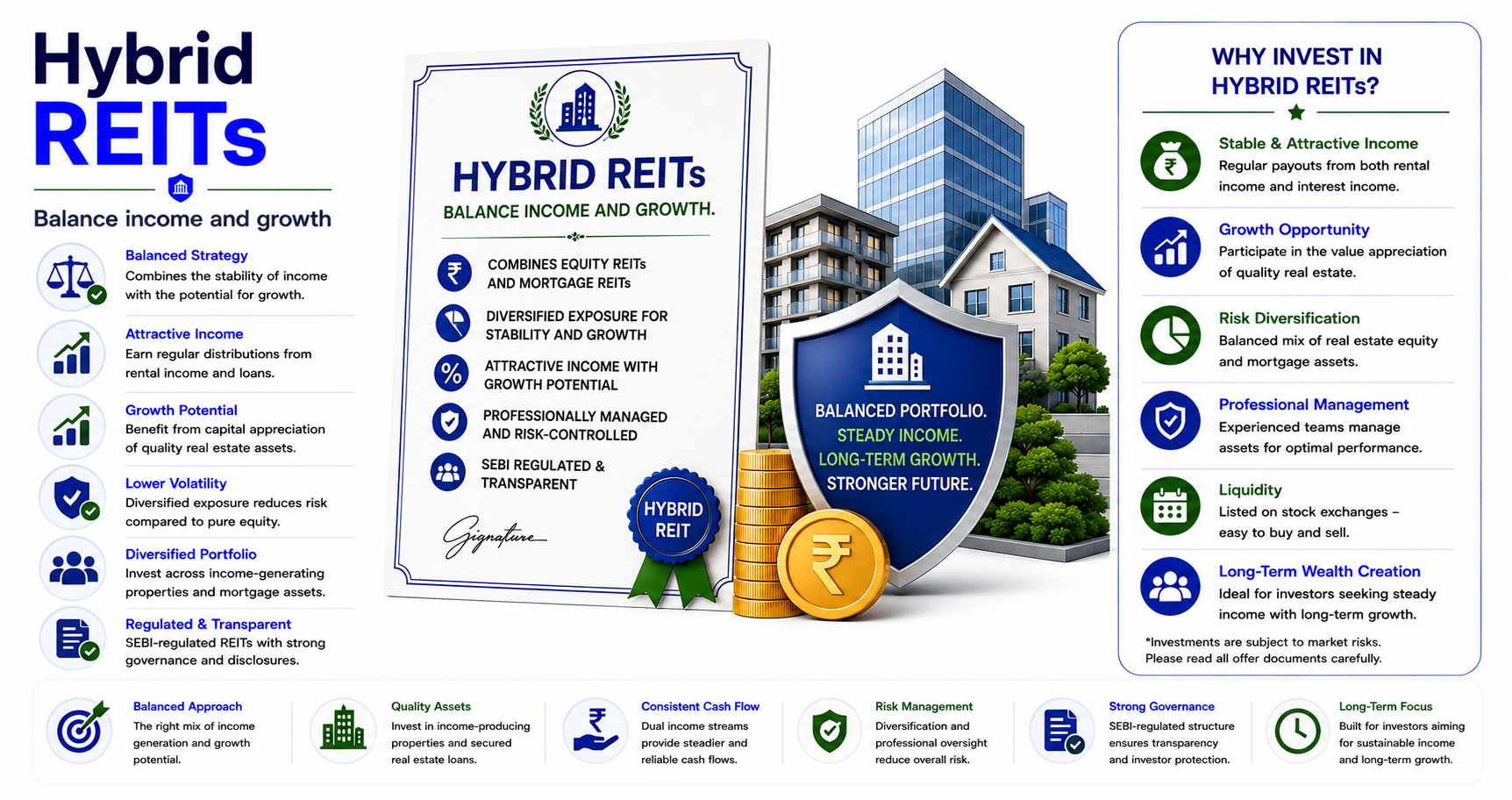
A hybrid REIT combines direct property ownership with holdings of mortgages or property-related debt. It draws income from both rent and interest, on the argument that the two respond differently to economic conditions.
The theoretical appeal is diversification within one structure. When rates rise, the debt portfolio may benefit; when property markets are strong, the equity portfolio does. In practice the two are more correlated than the argument suggests, since both depend on property values and the health of borrowers and tenants.
The practical difficulty is analysis. Assessing a hybrid REIT means assessing both a property portfolio and a loan book, which is harder than either alone. As with mortgage REITs, this is not an established Indian retail category.
Who should consider it
Sophisticated investors comfortable analysing both property and credit. Investors with a specific reason to want both exposures in a single vehicle.
Most investors seeking property exposure are better served by a straightforward equity REIT, where the analysis is more tractable.
Benefits
- Two income sources — rent and interest — in one structure
- Some diversification between property and credit cycles
- Managers can shift emphasis between the two allocations
- Potential for higher yield than a pure equity REIT
- Listed liquidity where available
What is included, and what is not
Read the right-hand column first. It is the one that tends to surprise people later.
Included
- Units in a trust holding both property and property debt
- Distributions from rental and interest income
- Exposure to both property values and mortgage credit
- Listed trading where available
Not included
- Simplicity of analysis, which a single-strategy trust offers
- Any guarantee of distribution
- Genuine independence between the two exposures
- An established Indian retail market for this structure
Terms vary between providers and between plans from the same provider. The offer document you receive is what governs — we will walk you through it before you commit.
How it works with us
- 1 We explain what a REIT actually is first Not a property purchase and not a fixed deposit. A listed security whose income comes from rent, and whose price moves with markets.
- 2 Distribution yield examined properly Yield alone is not the answer. The mix of rent, occupancy, lease expiries and debt is what tells you whether it is sustainable.
- 3 Allocation sized against your existing property exposure Most Indian households already hold a great deal of real estate. A REIT should complement that, not concentrate it further.
- 4 Purchase through the exchange REIT units trade like shares and settle into your demat account. The mechanics are simple; the analysis is where the work is.
- 5 Distributions tracked and taxed correctly REIT distributions have several components with different tax treatments. We make sure they are reported properly.
Important considerations
The things a brochure tends to leave out. Read these before you decide.
- The diversification argument is weaker than it sounds. Property equity and property debt both depend on property values and on the health of tenants and borrowers.
- Analysis requires evaluating two quite different businesses. If you cannot do both, you cannot really assess the trust.
- Understand the manager's discretion to shift between allocations. A hybrid whose mix changes materially is a different investment at different times.
- This is not an established Indian retail category, so exposure generally comes through international routes.
- For straightforward commercial property exposure, an equity REIT is simpler to assess and does the job directly.
Documents required
- PAN card
- Aadhaar or other identity proof
- Address proof
- Demat account details
- Bank account proof for distribution credit
- Completed KYC with the broker
Frequently Asked Questions
Does holding both really diversify?
Less than the argument suggests. Property equity and property debt are both driven by property values and by the financial health of tenants and borrowers. In a serious property downturn both sides tend to suffer together, which is precisely when the diversification was meant to help.
What makes these harder to analyse?
You have to assess two different businesses — a property portfolio with its occupancy and lease profile, and a loan book with its credit quality and funding. Either alone is demanding; both together, in one vehicle, is considerably more so.
Can the manager change the mix?
Typically yes, within the mandate. That flexibility means the trust you bought can become something meaningfully different over time, so understanding the permitted range matters as much as the current allocation.
Are they available in India?
Not as an established retail category. Indian REIT regulation has focused on equity REITs holding income-producing property, so exposure to hybrid structures generally comes through international routes.
Should I choose this over a straightforward REIT?
For most investors, no. If the objective is commercial property exposure with rental income, an equity REIT delivers it directly and is far easier to evaluate. A hybrid earns its complexity only if you specifically want both exposures and can assess both.
Want a shortlist instead of a catalogue?
Tell us the situation and an advisor comes back with two or three options that actually fit — and names what each one gives up.