
Plan your investment
What Our Plans Cover
-
Investment in the fund's trading s...
-
Use of leverage and derivatives wi...
-
Periodic valuation and investor re...
-
Redemption at defined intervals on...
-
Participation through a contributi...
Who Can Consider This Plan?
- Minimum commitment of ₹1 crore per investor, as regulated
- Indian resident individual, HUF, trust, company or NRI
- Completed KYC with the fund
- Ability to meet capital calls through the drawdown period
- Acceptance by the fund manager, which is discretionary
What May Not Be Covered?
- Pass-through taxation — Category III is taxed at the fund level
- Any guarantee of return or of capital
- Daily liquidity
- Full transparency of positions, which most strategies do not provide
- Protection against leverage amplifying losses
Always check the policy wording before you commit.
Why Choose Wealth & Covers?
- Expert advice to choose the right plan
- Plans from leading investments companies
- Hassle-free process and documentation
- End-to-end support, including claim assistance
- Dedicated relationship manager
- Expert Guidance Personalised advice from experienced investments professionals.
- End-to-End Support From choosing the right plan to claim assistance, we are with you always.
- Claims Assistance Hassle-free claim support to ensure you get what you deserve.
- Transparent Process Clear information, easy documentation and a hassle-free experience.
Overview
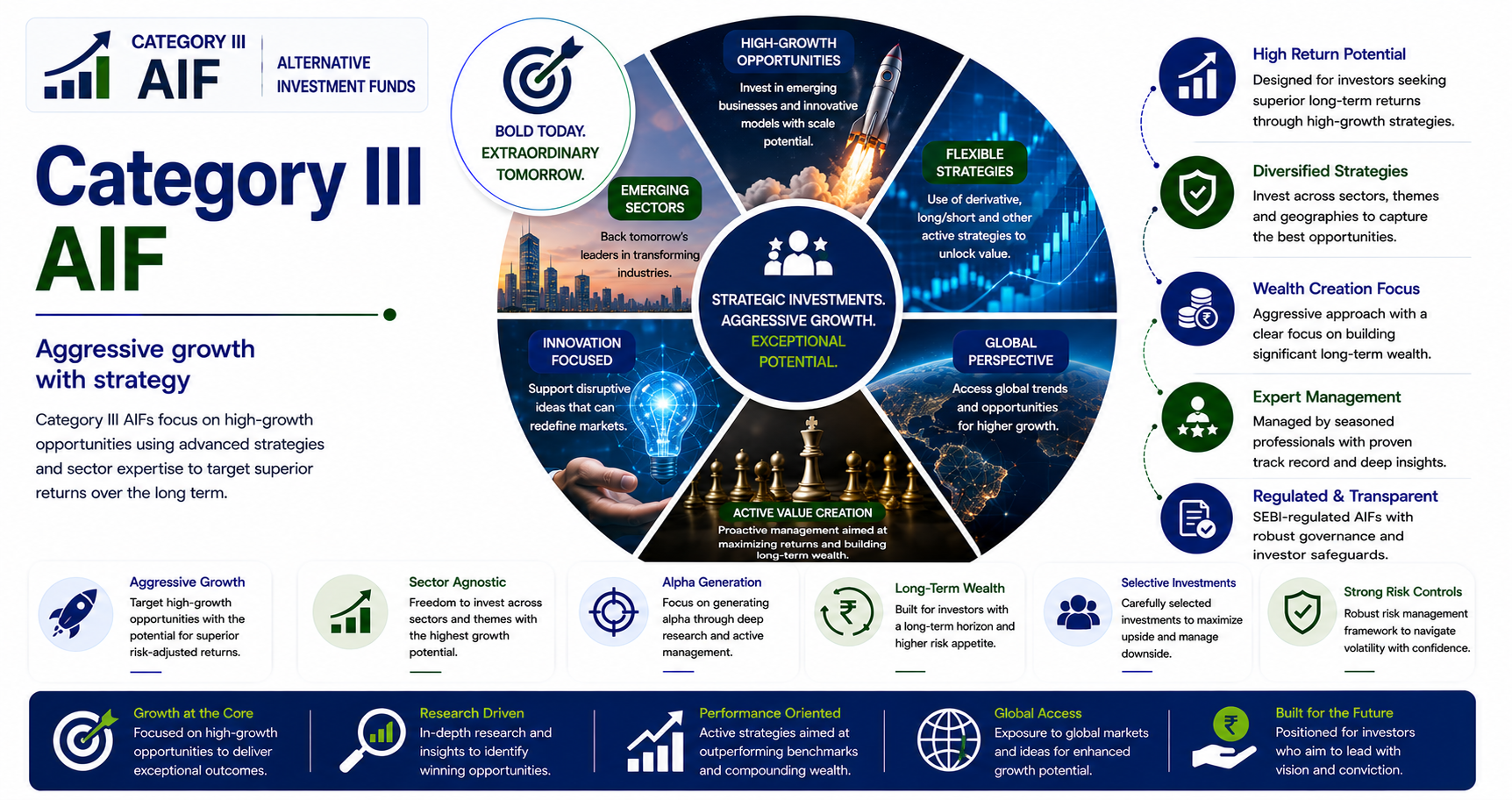
Category III alternative investment funds employ complex trading strategies, may use leverage, and trade derivatives. Long-short equity funds, arbitrage strategies and quantitative funds sit here. This is the closest Indian equivalent to a hedge fund.
Unlike Categories I and II, these funds are taxed at the fund level rather than passing through to investors, which changes the after-tax arithmetic and is worth understanding before committing.
The strategies are genuinely more complex than a long-only fund, and complexity cuts both ways. A well-executed long-short strategy can produce returns less correlated with the market, which has real portfolio value. A poorly executed one can lose money in rising and falling markets alike, and leverage amplifies both outcomes.
Who should consider it
Sophisticated investors who understand the specific strategy and can evaluate the manager's execution. Investors seeking returns less correlated with equity markets. Investors able to size the position as a genuine risk allocation.
It is not appropriate for anyone who cannot explain how the strategy makes money, or who is attracted primarily by the exclusivity of the structure.
Benefits
- Strategies that can produce returns less correlated with markets
- Ability to profit in falling markets through short positions
- Derivatives used for hedging as well as for return
- Access to quantitative and systematic strategies
- Professional risk management within the mandate
- Diversification from long-only equity exposure
What is included, and what is not
Read the right-hand column first. It is the one that tends to surprise people later.
Included
- Investment in the fund's trading strategy
- Use of leverage and derivatives within the mandate
- Periodic valuation and investor reporting
- Redemption at defined intervals on open-ended structures
- Participation through a contribution agreement
Not included
- Pass-through taxation — Category III is taxed at the fund level
- Any guarantee of return or of capital
- Daily liquidity
- Full transparency of positions, which most strategies do not provide
- Protection against leverage amplifying losses
Terms vary between providers and between plans from the same provider. The offer document you receive is what governs — we will walk you through it before you commit.
How it works with us
- 1 We start with whether an AIF suits you at all A one-crore minimum, multi-year lock-ins and higher fees. If a mutual fund does the same job, we will say so.
- 2 Category and strategy matched to the objective Category I, II and III are genuinely different things. Choosing between them is the substantive decision.
- 3 Fees and terms read in full Management fee, carry, hurdle rate, catch-up and drawdown schedule. These vary enormously and compound over a fund's life.
- 4 Commitment and drawdown planned You commit capital that is called over time. Liquidity has to be arranged for calls you cannot decline.
- 5 Reporting tracked through the fund life Valuations are periodic and taxation differs by category. We keep the reporting straight through to wind-up.
Important considerations
The things a brochure tends to leave out. Read these before you decide.
- If you cannot explain how the strategy makes money in one paragraph, you are not in a position to assess it.
- Category III is taxed at the fund level rather than passing through, which materially changes after-tax returns compared with Categories I and II.
- Leverage amplifies outcomes in both directions. A strategy with modest gross returns and significant leverage is a different risk from its net numbers suggest.
- Ask about the worst drawdown and how the strategy behaved during it. That is more informative than annualised returns over a favourable period.
- Fees on these funds are typically the highest in the AIF framework. Net of fees is the only number that matters.
Documents required
- PAN card
- Aadhaar or other identity proof
- Address proof
- Demat account details
- Bank account proof
- Net worth or income evidence, where the fund requires it
- Completed KYC and contribution agreement
Frequently Asked Questions
How is Category III different from the other categories?
It uses complex strategies, leverage and derivatives — long-short equity, arbitrage and quantitative approaches. It is also taxed at the fund level rather than passing through to investors, which materially changes the after-tax arithmetic compared with Categories I and II.
Can these funds make money when markets fall?
A long-short strategy can, by profiting on short positions. Whether it does depends entirely on execution — a poorly run long-short fund can lose on both sides simultaneously, which is a failure mode a long-only fund does not have.
How much leverage is involved?
It varies by strategy and is subject to regulatory limits. What matters is that leverage amplifies outcomes in both directions, so a strategy with modest gross returns and significant leverage carries more risk than its net figures suggest.
What should I ask a Category III manager?
How the strategy makes money, what the worst drawdown has been and what caused it, how leverage is managed, and what net-of-fee returns have actually been. Annualised returns over a favourable period tell you very little.
Are the fees higher?
Typically the highest in the AIF framework, with a management fee plus performance fees. Given that complexity and fees both work against the investor, net-of-fee returns over a full cycle are the only meaningful measure.
Want a shortlist instead of a catalogue?
Tell us the situation and an advisor comes back with two or three options that actually fit — and names what each one gives up.