
Plan your investment
What Our Plans Cover
-
Participation in the fund's loan p...
-
Interest distributions per the fun...
-
Security and covenant packages neg...
-
Periodic valuation and investor re...
-
Return of capital as loans are rep...
Who Can Consider This Plan?
- Minimum commitment of ₹1 crore per investor, as regulated
- Indian resident individual, HUF, trust, company or NRI
- Completed KYC with the fund
- Ability to meet capital calls through the drawdown period
- Acceptance by the fund manager, which is discretionary
What May Not Be Covered?
- Liquidity — there is no secondary market
- Any guarantee of return or of capital
- Protection against borrower default
- Redemption before the fund's realisation period
- Deposit insurance of any kind
Always check the policy wording before you commit.
Why Choose Wealth & Covers?
- Expert advice to choose the right plan
- Plans from leading investments companies
- Hassle-free process and documentation
- End-to-end support, including claim assistance
- Dedicated relationship manager
- Expert Guidance Personalised advice from experienced investments professionals.
- End-to-End Support From choosing the right plan to claim assistance, we are with you always.
- Claims Assistance Hassle-free claim support to ensure you get what you deserve.
- Transparent Process Clear information, easy documentation and a hassle-free experience.
Overview
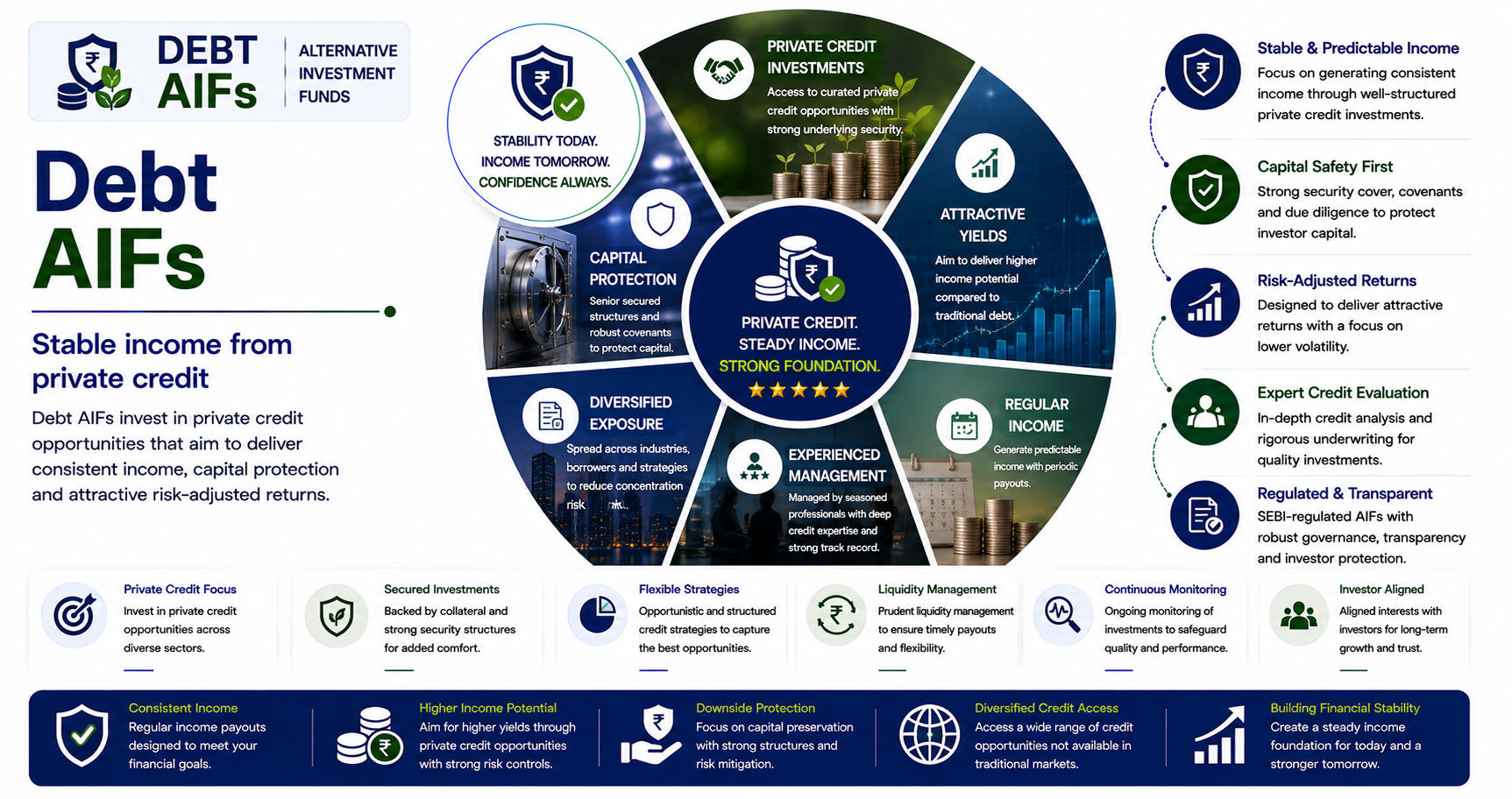
Debt-focused alternative investment funds lend directly to companies, typically at yields well above listed corporate bonds. Borrowers are usually businesses that banks cannot serve — because of the sector, the structure required, the timeline, or the borrower's stage.
Loans are frequently secured against assets, receivables or cash flows, and structured with covenants that a listed bond would not carry. That structuring is genuinely valuable and is part of what the manager is paid for.
The defining characteristic remains illiquidity. There is no secondary market for these loans. If a borrower deteriorates, there is no price at which to sell — only enforcement of security and a recovery process measured in years. That is the risk the yield premium is paying for.
Who should consider it
Investors seeking yields above listed debt who can lock capital for the fund life. Investors diversifying fixed income beyond listed markets. Investors who can assess the manager's underwriting and recovery capability.
It is not a substitute for liquid fixed income, and it should not be sized as one.
Benefits
- Yields materially above listed corporate debt
- Loans frequently secured against assets or cash flows
- Covenants and structuring unavailable in listed bonds
- Regular income distributions on many structures
- Diversification from listed credit markets
- Professional origination, structuring and monitoring
What is included, and what is not
Read the right-hand column first. It is the one that tends to surprise people later.
Included
- Participation in the fund's loan portfolio
- Interest distributions per the fund terms
- Security and covenant packages negotiated by the manager
- Periodic valuation and investor reporting
- Return of capital as loans are repaid
Not included
- Liquidity — there is no secondary market
- Any guarantee of return or of capital
- Protection against borrower default
- Redemption before the fund's realisation period
- Deposit insurance of any kind
Terms vary between providers and between plans from the same provider. The offer document you receive is what governs — we will walk you through it before you commit.
How it works with us
- 1 We start with whether an AIF suits you at all A one-crore minimum, multi-year lock-ins and higher fees. If a mutual fund does the same job, we will say so.
- 2 Category and strategy matched to the objective Category I, II and III are genuinely different things. Choosing between them is the substantive decision.
- 3 Fees and terms read in full Management fee, carry, hurdle rate, catch-up and drawdown schedule. These vary enormously and compound over a fund's life.
- 4 Commitment and drawdown planned You commit capital that is called over time. Liquidity has to be arranged for calls you cannot decline.
- 5 Reporting tracked through the fund life Valuations are periodic and taxation differs by category. We keep the reporting straight through to wind-up.
Important considerations
The things a brochure tends to leave out. Read these before you decide.
- Ask why each borrower is not using a bank. The answer defines the risk, and a good manager will explain it clearly for every position.
- Assess the manager's recovery record, not just their underwriting. In this asset class what happens after a default matters as much as avoiding one.
- Portfolio concentration is critical. A fund with a handful of large exposures behaves very differently from a granular one.
- Gross yield and net yield diverge substantially after management fees and carry. Work from net.
- This is not liquid fixed income and should not be sized as though it were. Capital is committed for the fund life.
Documents required
- PAN card
- Aadhaar or other identity proof
- Address proof
- Demat account details
- Bank account proof
- Net worth or income evidence, where the fund requires it
- Completed KYC and contribution agreement
Frequently Asked Questions
Why do these loans yield so much more?
Because they are illiquid and the borrowers are outside conventional bank lending. The premium compensates for both. Understanding why a specific borrower cannot use a bank is the essential diligence — the answer is the risk you are being paid to take.
What happens when a borrower defaults?
The manager enforces the security and pursues recovery, which takes years and produces a partial outcome. Unlike a listed bond there is no price at which to exit a deteriorating credit, which is why the manager's recovery record matters as much as their underwriting.
Can I redeem if I need the money?
Generally not. Capital is committed for the fund life and returned as loans are repaid. This is not liquid fixed income, and treating it as a substitute for one is the most common sizing error in the category.
How diversified is the portfolio?
It varies enormously, and it matters more here than the headline yield. A fund with a handful of large exposures can be materially damaged by one default; a granular portfolio absorbs the same event. Ask for the exposure breakdown.
How do fees affect the yield?
Substantially. A gross yield in the mid-teens can become considerably less after management fees and carry. Always work from net-of-fee figures, and ask how the carry is calculated including any hurdle and catch-up.
Want a shortlist instead of a catalogue?
Tell us the situation and an advisor comes back with two or three options that actually fit — and names what each one gives up.