
Get Expert Guidance
What Our Plans Cover
-
Theft from the home
-
Accidental loss and mysterious dis...
-
Accidental damage to the item
-
Loss while being worn
-
Loss while travelling
-
Loss in a bank locker
-
Loss during repair or cleaning
-
Newly acquired items
Who Can Consider This Plan?
- Insurable interest in the property or activity being covered
- Accurate declaration of value and, where relevant, provenance
- Security and storage arrangements meeting the insurer's requirements
- Full disclosure of prior losses and claims
- Activity or property within the classes the insurer writes
What May Not Be Covered?
- Items not on the schedule
- Wear, tear and gradual deterioration of settings
- Damage during professional cleaning or repair, on some policies
- Loss from an unattended vehicle
- Items left in unsecured premises
Always check the policy wording before you commit.
Why Choose Wealth & Covers?
- Expert advice to choose the right plan
- Plans from leading insurance companies
- Hassle-free process and documentation
- End-to-end support, including claim assistance
- Dedicated relationship manager
Our Insurance Partners
- Star Health Insurance
- Care Health Insurance
- Niva Bupa Health Insurance
- HDFC ERGO
- ICICI Lombard
- Bajaj Allianz
We represent multiple providers to help you find the most suitable option at the best price.
- Expert Guidance Personalised advice from experienced insurance professionals.
- End-to-End Support From choosing the right plan to claim assistance, we are with you always.
- Claims Assistance Hassle-free claim support to ensure you get what you deserve.
- Transparent Process Clear information, easy documentation and a hassle-free experience.
Overview
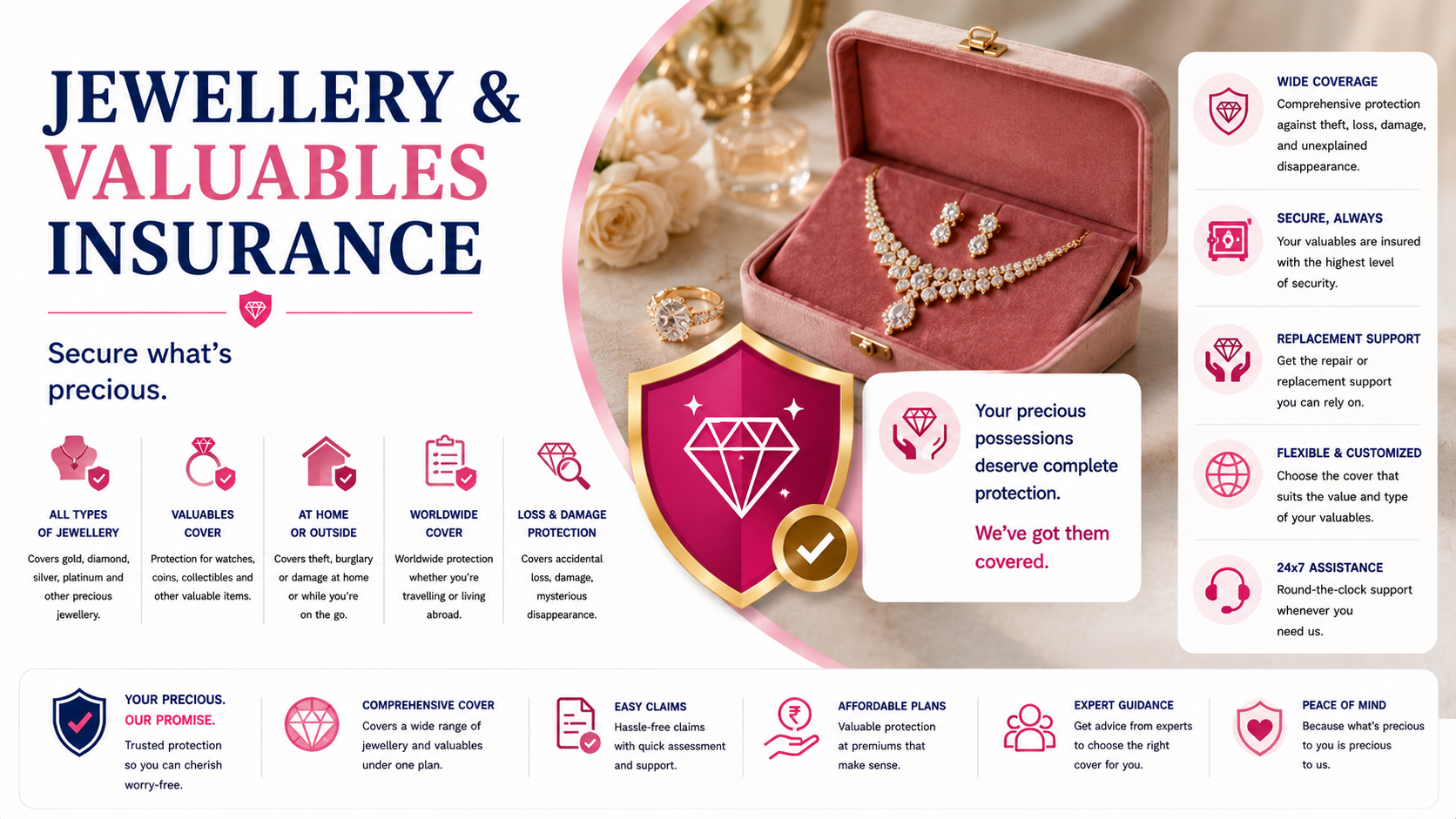
A specific jewellery and valuables policy covers named items on an all-risk basis: theft, loss, accidental damage and disappearance, at home, in a locker, while being worn, and while travelling.
It exists because home insurance is inadequate for this purpose. A standard household policy carries a low sub-limit for jewellery, covers it only against named perils, and generally only while it is in the home. Jewellery, by its nature, spends a good deal of time elsewhere.
The policy is written on a scheduled basis with valuations. That documentation requirement is the product working as intended — it establishes ownership and value before a loss, which is the single thing that makes these claims settle cleanly.
Who should consider it
Anyone holding jewellery worth substantially more than their home policy's sub-limit. Families with inherited pieces. Anyone who wears valuable jewellery outside the home, which is most people who own it.
Benefits
- All-risk cover rather than the named perils of a home policy
- Covers items while worn, travelling, and in a bank locker
- Worldwide cover on most policies
- Accidental loss and mysterious disappearance covered
- Agreed value on scheduled items, removing valuation disputes
- Cover far above the sub-limit in a household policy
What is covered, and what is not
Read the right-hand column first. It is the one that decides whether a claim is paid.
Typically covered
- Theft from the home, a locker or elsewhere
- Accidental loss and mysterious disappearance
- Accidental damage to the item
- Loss while being worn
- Loss while travelling, including abroad
- Loss in a bank locker
- Loss during repair or cleaning, on some policies
- Newly acquired items, within a declaration window
Typically not covered
- Items not on the schedule
- Wear, tear and gradual deterioration of settings
- Damage during professional cleaning or repair, on some policies
- Loss from an unattended vehicle
- Items left in unsecured premises
- Loss without a police report where one is required
- Pairs and sets valued as a whole where only one piece is lost, on some wordings
- Confiscation and government action
Inclusions and exclusions vary between providers and between plans from the same provider. The wording in your own policy document is what governs — we will walk you through it before you buy.
How it works with us
- 1 We establish whether you actually need it Specialist covers are easy to sell and easy to over-sell. If your existing policy already responds, we will say so.
- 2 Valuation and documentation first These covers turn on what you can prove you owned and what it was worth. Getting that right before cover is the whole job.
- 3 Two or three quotes, compared on wording Specialist policies vary far more between insurers than mainstream ones. The exclusions are where they differ.
- 4 Underwriting, and a survey where the value warrants it Higher-value risks are inspected. It is also the moment to fix anything that would reduce a claim.
- 5 Policy issued, with the schedule checked line by line On a scheduled policy, an item not on the list is an item not insured. We check it with you before it goes on cover.
Important considerations
The things a brochure tends to leave out. Read these before you decide.
- An item not on the schedule is not insured. Review the list when you buy, inherit or receive a piece, and use the declaration window for new acquisitions.
- Keep valuations current. Gold prices move, and a valuation from a decade ago will understate a settlement substantially.
- Photograph every scheduled item and store the images and invoices separately from the jewellery itself.
- Check the pairs-and-sets clause. Losing one earring from a pair is a common claim and wordings differ considerably on how it is settled.
- If most items live permanently in a bank locker, say so. Locker-stored items rate more cheaply, and separating them from items in regular use reduces the premium.
Documents required
- Identity and address proof
- Proof of ownership — invoices, receipts or certificates
- Valuation report, where the item value requires one
- Photographs of the insured items
- Details of storage and security arrangements
- Previous policy and claims history, where applicable
Frequently Asked Questions
Isn't my jewellery covered by my home insurance?
Only up to a low sub-limit, only against named perils, and generally only inside the home. Since jewellery spends much of its life being worn, travelling or sitting in a locker, a household policy covers it exactly where it usually is not.
Do I need a valuation for every item?
Above a threshold value per item, yes, and it is worth having regardless. A valuation establishes what you owned and what it was worth before the loss — which is what makes these claims settle without argument.
Is it covered in a bank locker?
Yes, and usually at a lower premium rate because the risk is lower. If most of your jewellery lives in a locker and only some is in regular use, splitting the schedule that way reduces the cost.
What if I simply lose an item?
All-risk cover includes accidental loss and mysterious disappearance, which is one of the main advantages over a household policy. A police report is generally required, and the item must be on the schedule.
I have just been given a new piece. Is it covered?
Most policies provide automatic cover for newly acquired items for a limited period, on condition that you declare them within that window. Miss the window and the item is uninsured, which is the most common gap in this class.
Want a shortlist instead of a catalogue?
Tell us the situation and an advisor comes back with two or three options that actually fit — and names what each one gives up.