
Plan your investment
What Our Plans Cover
-
Units in a REIT holding office and...
-
Distributions from rental income
-
Exposure to a portfolio across mul...
-
Quarterly operational and financia...
-
Listed trading and demat holding
Who Can Consider This Plan?
- Indian resident individual, HUF, trust or company
- NRIs, subject to the applicable investment routes
- A demat account and a trading account
- PAN and completed KYC
- Minimum investment as per the exchange lot size
What May Not Be Covered?
- Any guarantee of occupancy or distribution
- Protection against sectoral concentration in tenants
- Protection against unit price falls
- Direct ownership of any specific building
Always check the policy wording before you commit.
Why Choose Wealth & Covers?
- Expert advice to choose the right plan
- Plans from leading investments companies
- Hassle-free process and documentation
- End-to-end support, including claim assistance
- Dedicated relationship manager
- Expert Guidance Personalised advice from experienced investments professionals.
- End-to-End Support From choosing the right plan to claim assistance, we are with you always.
- Claims Assistance Hassle-free claim support to ensure you get what you deserve.
- Transparent Process Clear information, easy documentation and a hassle-free experience.
Overview
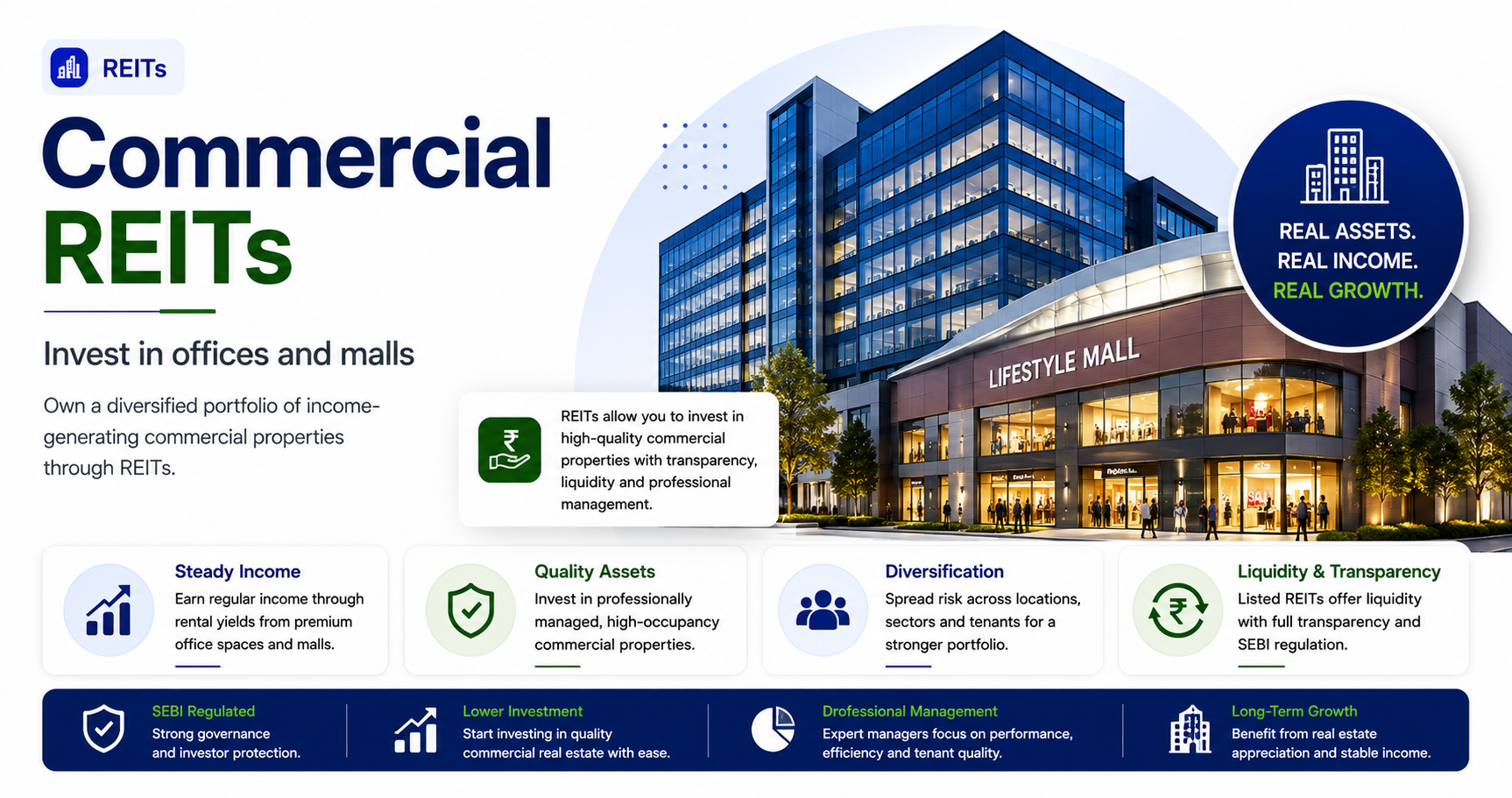
Commercial REITs own office buildings and business parks let to corporate tenants. This is the dominant REIT category in India, built largely on grade A office assets in the major technology and services hubs.
The economics rest on corporate demand for office space. Long leases with contractual escalation clauses give the income a degree of predictability that residential property does not offer, and blue-chip tenants reduce collection risk.
The concentration in technology and services occupiers is the risk worth naming. Where a large share of rent comes from one sector, a downturn in that sector — or a structural shift in how much office space it needs — affects occupancy, renewals and rent across the portfolio at the same time.
Who should consider it
Investors wanting exposure to Indian commercial real estate. Income-focused investors seeking distributions with rent escalation. Anyone diversifying from residential property into commercial.
Benefits
- Exposure to grade A office assets otherwise unreachable
- Long leases with contractual rent escalation
- Blue-chip corporate tenants reducing collection risk
- Regular distributions mandated by regulation
- Professional asset and facilities management
- India's deepest and most established REIT category
What is included, and what is not
Read the right-hand column first. It is the one that tends to surprise people later.
Included
- Units in a REIT holding office and business park assets
- Distributions from rental income
- Exposure to a portfolio across multiple buildings and cities
- Quarterly operational and financial disclosure
- Listed trading and demat holding
Not included
- Any guarantee of occupancy or distribution
- Protection against sectoral concentration in tenants
- Protection against unit price falls
- Direct ownership of any specific building
Terms vary between providers and between plans from the same provider. The offer document you receive is what governs — we will walk you through it before you commit.
How it works with us
- 1 We explain what a REIT actually is first Not a property purchase and not a fixed deposit. A listed security whose income comes from rent, and whose price moves with markets.
- 2 Distribution yield examined properly Yield alone is not the answer. The mix of rent, occupancy, lease expiries and debt is what tells you whether it is sustainable.
- 3 Allocation sized against your existing property exposure Most Indian households already hold a great deal of real estate. A REIT should complement that, not concentrate it further.
- 4 Purchase through the exchange REIT units trade like shares and settle into your demat account. The mechanics are simple; the analysis is where the work is.
- 5 Distributions tracked and taxed correctly REIT distributions have several components with different tax treatments. We make sure they are reported properly.
Important considerations
The things a brochure tends to leave out. Read these before you decide.
- Read the tenant concentration. Where a large share of rent comes from a handful of occupiers or one sector, that is the risk that matters most.
- Weighted average lease expiry tells you how much of the rent roll has to be renegotiated and when. A short WALE with a soft leasing market is a real concern.
- Structural shifts in office demand affect this category directly. Hybrid working patterns and consolidation decisions by large occupiers show up in renewals.
- Rent escalation clauses provide some inflation linkage, which is one of the genuine advantages over fixed income.
- Distributions follow rent actually collected. They are regulated in proportion, not guaranteed in amount.
Documents required
- PAN card
- Aadhaar or other identity proof
- Address proof
- Demat account details
- Bank account proof for distribution credit
- Completed KYC with the broker
Frequently Asked Questions
What drives a commercial REIT's income?
Rent from corporate tenants under long leases, most of which carry contractual escalation clauses. That combination gives the income more predictability than residential property and some inflation linkage — provided occupancy holds and leases renew.
What is WALE and why does it matter?
Weighted average lease expiry — how long, on average, the leases in the portfolio still have to run. It tells you how much of the rent roll has to be renegotiated and when. A short WALE in a soft leasing market is one of the clearer warning signs in this category.
Does hybrid working threaten these REITs?
It affects the category directly. Occupiers reassessing how much space they need show up in renewal decisions and in net absorption. Whether that becomes a structural reduction or a shift towards better quality space is the live question, and it is worth watching in the quarterly disclosures.
How concentrated are the tenants?
Frequently more than investors assume, both in individual occupiers and in the technology and services sector overall. The disclosures give the breakdown, and it is the single most useful thing to read before buying.
Are distributions guaranteed?
No. Regulations require a REIT to distribute the majority of its distributable cash flows, but the amount depends on rent actually collected. Falling occupancy or a tenant default reduces distributions.
Want a shortlist instead of a catalogue?
Tell us the situation and an advisor comes back with two or three options that actually fit — and names what each one gives up.