
Get Expert Guidance
What Our Plans Cover
-
Veterinary consultation and treatm...
-
Treatment for accidental injury
-
Surgery and hospitalisation
-
Diagnostics
-
Third-party liability for injury o...
-
Theft or straying
-
Mortality benefit
Who Can Consider This Plan?
- Insurable interest in the property or activity being covered
- Accurate declaration of value and, where relevant, provenance
- Security and storage arrangements meeting the insurer's requirements
- Full disclosure of prior losses and claims
- Activity or property within the classes the insurer writes
What May Not Be Covered?
- Pre-existing conditions at the time of enrolment
- Breed-specific hereditary conditions, on many plans
- Routine vaccination, deworming and preventive care
- Elective procedures including cosmetic and behavioural
- Pregnancy and breeding-related treatment, on most plans
Always check the policy wording before you commit.
Why Choose Wealth & Covers?
- Expert advice to choose the right plan
- Plans from leading insurance companies
- Hassle-free process and documentation
- End-to-end support, including claim assistance
- Dedicated relationship manager
Our Insurance Partners
- Star Health Insurance
- Care Health Insurance
- Niva Bupa Health Insurance
- HDFC ERGO
- ICICI Lombard
- Bajaj Allianz
We represent multiple providers to help you find the most suitable option at the best price.
- Expert Guidance Personalised advice from experienced insurance professionals.
- End-to-End Support From choosing the right plan to claim assistance, we are with you always.
- Claims Assistance Hassle-free claim support to ensure you get what you deserve.
- Transparent Process Clear information, easy documentation and a hassle-free experience.
Overview
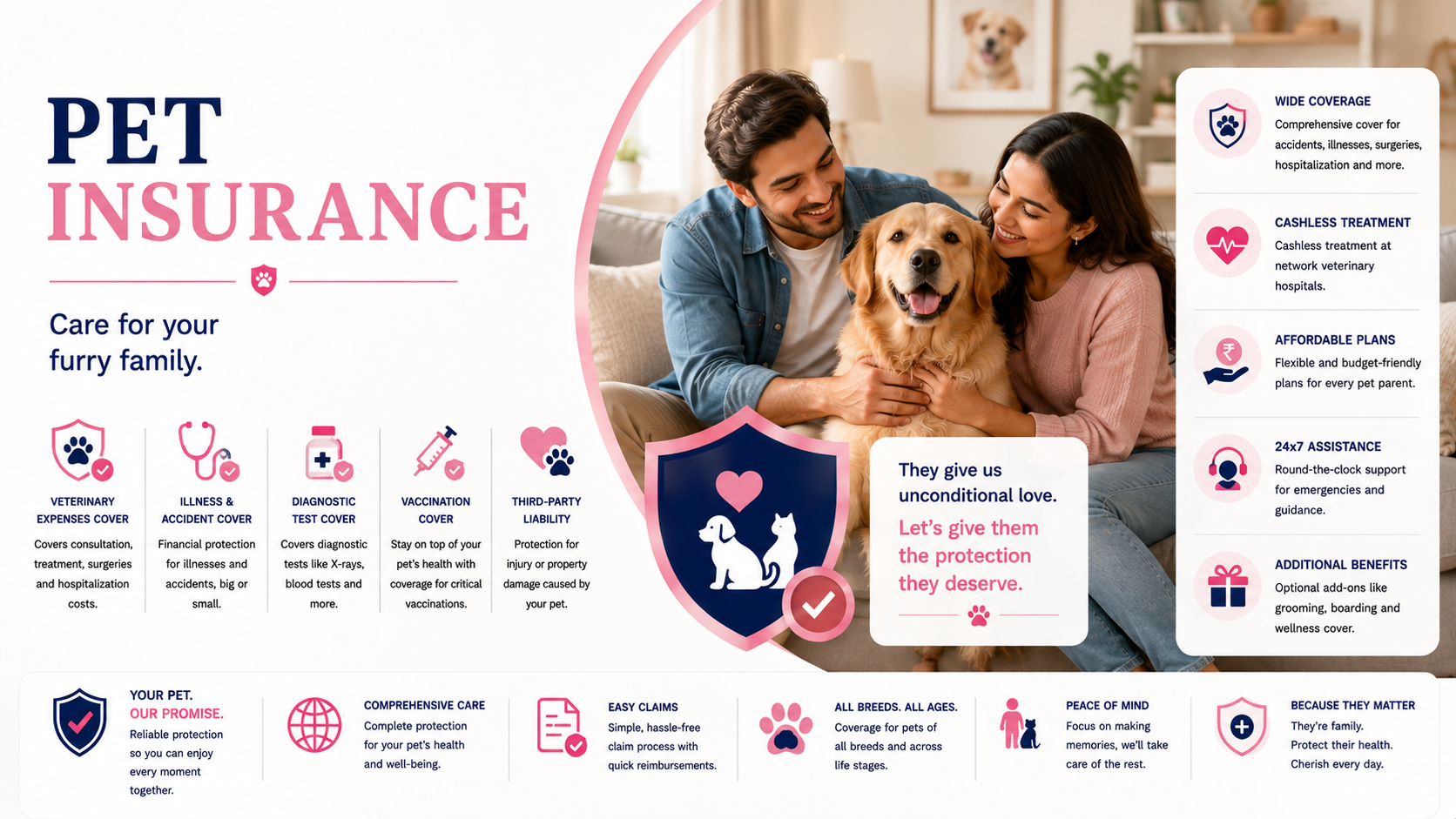
Pet insurance covers veterinary treatment for illness and injury, and on most plans third-party liability if your pet injures someone or damages property. It is a young market in India and the plans vary considerably.
The case for it has strengthened as veterinary medicine has advanced. Orthopaedic surgery, oncology and long-term management of chronic conditions are now available, and they cost what specialist medicine costs. A cruciate ligament repair or a course of chemotherapy runs into serious money.
Underwriting works much as it does in human health insurance. Breed matters, because breed-specific conditions are predictable. Age matters, and entry after a certain age is often unavailable. Pre-existing conditions are excluded, which makes buying early the whole game.
Who should consider it
Owners of dogs and cats, particularly pedigree breeds with known hereditary conditions. Owners of young animals, where entry is cheap and nothing is yet pre-existing. Anyone for whom a sudden ₹80,000 surgery bill would be a genuine problem.
Benefits
- Veterinary treatment for illness and injury covered
- Surgery and hospitalisation, where costs are highest
- Third-party liability if your pet injures someone
- Some plans cover theft or straying of the pet
- Cashless treatment at network veterinary hospitals, on some plans
- Removes the position where treatment decisions are made on cost
What is covered, and what is not
Read the right-hand column first. It is the one that decides whether a claim is paid.
Typically covered
- Veterinary consultation and treatment for illness
- Treatment for accidental injury
- Surgery and hospitalisation
- Diagnostics — imaging, pathology and specialist referral
- Third-party liability for injury or damage caused by the pet
- Theft or straying, on plans that include it
- Mortality benefit, on some plans
Typically not covered
- Pre-existing conditions at the time of enrolment
- Breed-specific hereditary conditions, on many plans
- Routine vaccination, deworming and preventive care
- Elective procedures including cosmetic and behavioural
- Pregnancy and breeding-related treatment, on most plans
- Treatment during the initial waiting period
- Pets outside the entry age limits
- Dental treatment, on most plans
Inclusions and exclusions vary between providers and between plans from the same provider. The wording in your own policy document is what governs — we will walk you through it before you buy.
How it works with us
- 1 We establish whether you actually need it Specialist covers are easy to sell and easy to over-sell. If your existing policy already responds, we will say so.
- 2 Valuation and documentation first These covers turn on what you can prove you owned and what it was worth. Getting that right before cover is the whole job.
- 3 Two or three quotes, compared on wording Specialist policies vary far more between insurers than mainstream ones. The exclusions are where they differ.
- 4 Underwriting, and a survey where the value warrants it Higher-value risks are inspected. It is also the moment to fix anything that would reduce a claim.
- 5 Policy issued, with the schedule checked line by line On a scheduled policy, an item not on the list is an item not insured. We check it with you before it goes on cover.
Important considerations
The things a brochure tends to leave out. Read these before you decide.
- Enrol young. Anything diagnosed before enrolment is excluded permanently, and the conditions that generate claims tend to appear later.
- Check the breed-specific exclusions carefully. Hereditary conditions in pedigree breeds — hip dysplasia, brachycephalic airway problems — are exactly what you would want covered and exactly what is often excluded.
- Look for a plan that covers chronic conditions across renewals. A plan that excludes a condition after the first year of treatment is of limited use for long-term management.
- Confirm the vet network or whether reimbursement is available anywhere. In many Indian cities the network is thin, and reimbursement flexibility matters more than the cashless promise.
- Read the co-payment. Many plans apply one, and it rises with the pet's age just as it does on senior human health cover.
Documents required
- Identity and address proof
- Proof of ownership — invoices, receipts or certificates
- Valuation report, where the item value requires one
- Photographs of the insured items
- Details of storage and security arrangements
- Previous policy and claims history, where applicable
Frequently Asked Questions
Is it worth the premium?
It depends on whether an unexpected bill of fifty to a hundred thousand rupees would be a problem for you. Modern veterinary surgery and oncology cost what specialist medicine costs. The strongest argument for the cover is that it removes the position where a treatment decision is made on affordability.
Are hereditary conditions covered?
Often not, and this is the most important thing to check for a pedigree dog. Hip dysplasia in large breeds and airway problems in flat-faced breeds are predictable, which is precisely why many plans exclude them. Compare this clause specifically rather than the headline sum insured.
When should I enrol my pet?
As young as the plan allows. Pre-existing conditions are excluded permanently, so every month you wait is a month in which something can be diagnosed and become uninsurable.
Does it cover vaccinations and routine care?
Generally no. Preventive care — vaccination, deworming, routine check-ups — is predictable expenditure rather than insurable risk. Some plans offer a small wellness allowance, but the core cover is for illness and injury.
What if my dog bites someone?
Most plans include third-party liability for injury or property damage caused by your pet. For owners of larger breeds this is a genuine exposure and a real part of the value of the policy.
Want a shortlist instead of a catalogue?
Tell us the situation and an advisor comes back with two or three options that actually fit — and names what each one gives up.