
Plan your investment
What Our Plans Cover
-
A portfolio of both equity and deb...
-
Automatic rebalancing to the manda...
-
Aggressive
-
SIP
-
Growth and income distribution opt...
Who Can Consider This Plan?
- Indian resident individual, HUF, trust or company
- NRIs, subject to the fund house accepting the country of residence
- Completed KYC with a registered KYC registration agency
- PAN, which is mandatory for all mutual fund investments
- A bank account in the investor's own name for transactions
What May Not Be Covered?
- Any guarantee of return or protection of capital
- Immunity from equity falls — an aggressive hybrid will fall meaningfully
- Control over the equity-debt split, which the mandate sets
- Exit without load inside the stated period
Always check the policy wording before you commit.
Why Choose Wealth & Covers?
- Expert advice to choose the right plan
- Plans from leading investments companies
- Hassle-free process and documentation
- End-to-end support, including claim assistance
- Dedicated relationship manager
- Expert Guidance Personalised advice from experienced investments professionals.
- End-to-End Support From choosing the right plan to claim assistance, we are with you always.
- Claims Assistance Hassle-free claim support to ensure you get what you deserve.
- Transparent Process Clear information, easy documentation and a hassle-free experience.
Overview
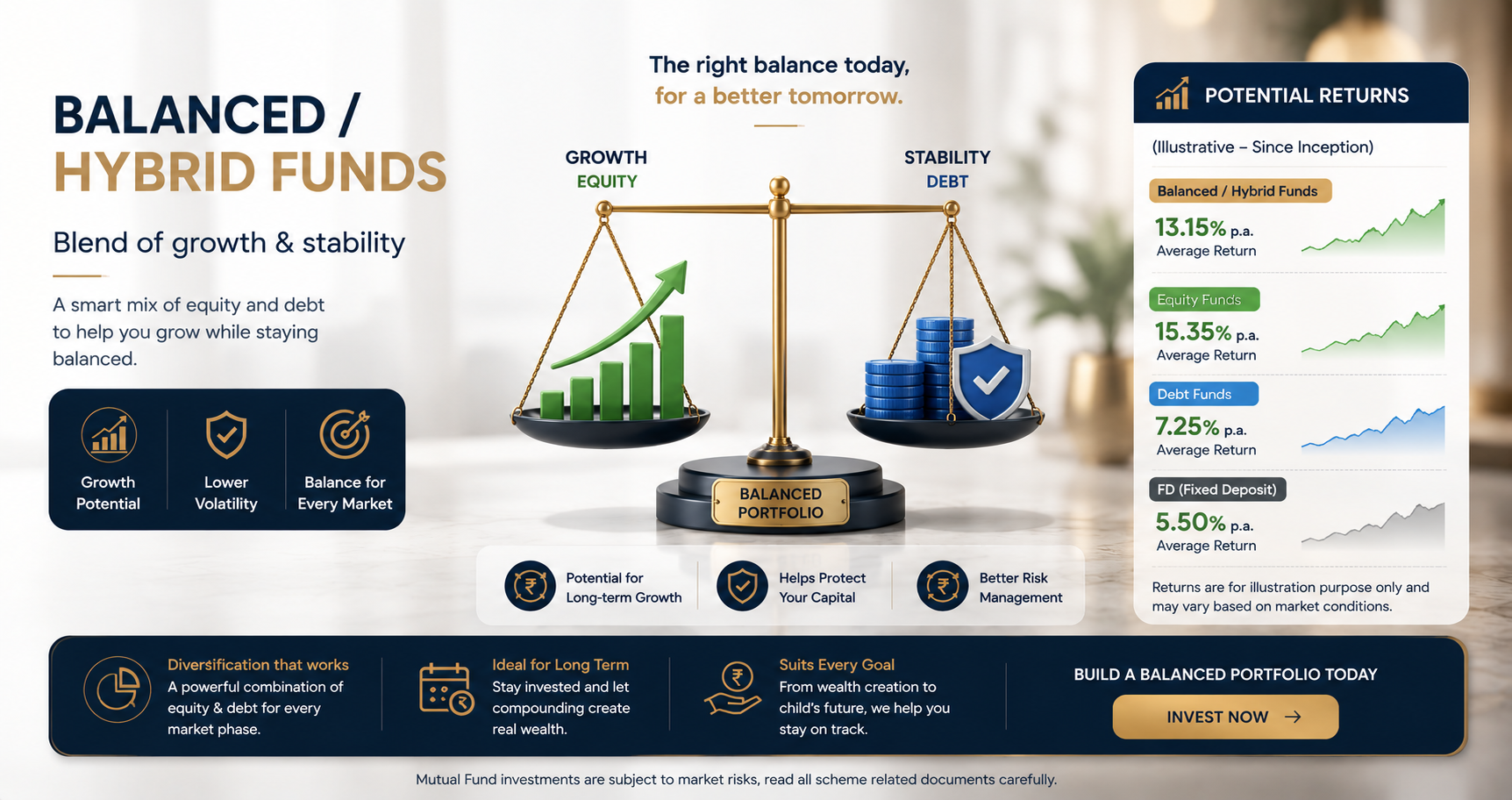
Hybrid funds hold both equity and debt within a single scheme, in proportions set by the mandate. An aggressive hybrid holds mostly equity; a conservative hybrid holds mostly debt; a balanced advantage fund moves between the two based on a model.
Their practical advantage is internal rebalancing. When equity rises, the fund trims it back to the mandated proportion; when it falls, the fund adds. That happens inside the scheme without a redemption, so it does not trigger a tax event for you — which doing it yourself across two separate funds would.
Hybrid funds reduce volatility relative to pure equity. They do not eliminate it. In a serious equity fall an aggressive hybrid will decline meaningfully, and investors who expect otherwise are usually disappointed at exactly the wrong moment.
Who should consider it
Investors who want equity participation with somewhat less volatility. First-time equity investors easing in. Investors with medium-term horizons of three to five years. Anyone who would otherwise not rebalance a two-fund portfolio.
Benefits
- Equity and debt in one scheme with automatic internal rebalancing
- Rebalancing inside the fund does not create a tax event for you
- Lower volatility than a pure equity fund
- A single scheme to monitor rather than a portfolio to manage
- Balanced advantage variants adjust exposure dynamically
- Suits medium-term horizons better than pure equity
What is included, and what is not
Read the right-hand column first. It is the one that tends to surprise people later.
Included
- A portfolio of both equity and debt securities
- Automatic rebalancing to the mandated allocation
- Aggressive, conservative and dynamic variants
- SIP, lumpsum, STP and SWP facilities
- Growth and income distribution options
Not included
- Any guarantee of return or protection of capital
- Immunity from equity falls — an aggressive hybrid will fall meaningfully
- Control over the equity-debt split, which the mandate sets
- Exit without load inside the stated period
Terms vary between providers and between plans from the same provider. The offer document you receive is what governs — we will walk you through it before you commit.
How it works with us
- 1 Goal and horizon before fund selection What the money is for and when you need it decides the asset class. The fund name is the last decision, not the first.
- 2 Risk profiling that is honest rather than flattering Capacity to take risk and willingness to sit through a fall are different things. We assess both, because the second is what breaks plans.
- 3 Shortlist built on process, not last year's return Mandate, expense ratio, fund manager tenure and how the fund behaved in a bad year. Past performance is not a forecast.
- 4 KYC, onboarding and the first investment One-time KYC, then the folio and the mandate. We set up the SIP so it runs without depending on you remembering.
- 5 Review annually, rebalance deliberately A yearly review against the goal, not a monthly reaction to markets. Most damage in investing is self-inflicted.
Important considerations
The things a brochure tends to leave out. Read these before you decide.
- Read the mandate rather than the category name. An aggressive hybrid can hold seventy-five per cent equity, which behaves much more like an equity fund than the word "balanced" suggests.
- The tax classification follows the equity proportion, and it materially affects your after-tax return. Check which side of the threshold your scheme sits on.
- Do not expect protection in a serious fall. Reduced volatility is not the same as capital protection, and this is where hybrid investors are most often disappointed.
- Balanced advantage funds move exposure by model. Understand the model before assuming it will do what you would have done.
- Mutual fund investments are subject to market risk. A hybrid fund reduces volatility; it does not remove the possibility of loss.
Documents required
- PAN card
- Aadhaar or other identity proof
- Address proof
- Cancelled cheque or bank account details
- Recent passport-size photograph
- Completed KYC, or KYC documents to complete it
- FATCA and nominee declaration
Frequently Asked Questions
How is a hybrid fund different from holding an equity fund and a debt fund?
Mainly in the rebalancing. A hybrid rebalances internally, so trimming equity after a rise does not create a redemption or a tax event for you. Doing the same across two separate funds means selling one and buying the other, with tax consequences each time.
Will a hybrid fund protect me in a crash?
It will fall less than a pure equity fund, and it will still fall. An aggressive hybrid holding seventy-five per cent equity behaves substantially like an equity fund in a serious decline. Reduced volatility is not capital protection, and expecting otherwise is where investors get hurt.
Which variant should I choose?
It follows your horizon and tolerance rather than a preference. Aggressive hybrids suit longer horizons and more tolerance; conservative hybrids suit shorter horizons and less. Balanced advantage funds sit between and move with a model, so understand that model before relying on it.
How are hybrid funds taxed?
By their equity proportion, which determines whether they are treated as equity or debt schemes for tax. That distinction materially affects after-tax returns, so check which side of the threshold your specific scheme sits on rather than assuming.
Are they suitable for a first equity investment?
Often, yes. The lower volatility makes a first experience of market falls less alarming, which matters because the main risk for a new investor is abandoning the plan during a decline. Mutual fund investments remain subject to market risk.
Want a shortlist instead of a catalogue?
Tell us the situation and an advisor comes back with two or three options that actually fit — and names what each one gives up.