
Plan your investment
What Our Plans Cover
-
Allocation across equity
-
Selection within each asset class
-
Periodic rebalancing to the target...
-
Direct holding in your own demat a...
-
Regular reporting of allocation
Who Can Consider This Plan?
- Minimum investment of ₹50 lakh, as regulated
- Indian resident individual, HUF, trust, company or NRI
- Completed KYC with the portfolio manager
- A demat account in the investor's own name
- Acceptance by the portfolio manager
What May Not Be Covered?
- Any guarantee of return or of capital
- Protection against falls in any asset class
- A single obvious benchmark for assessment
- Availability below the ₹50 lakh minimum
Always check the policy wording before you commit.
Why Choose Wealth & Covers?
- Expert advice to choose the right plan
- Plans from leading investments companies
- Hassle-free process and documentation
- End-to-end support, including claim assistance
- Dedicated relationship manager
- Expert Guidance Personalised advice from experienced investments professionals.
- End-to-End Support From choosing the right plan to claim assistance, we are with you always.
- Claims Assistance Hassle-free claim support to ensure you get what you deserve.
- Transparent Process Clear information, easy documentation and a hassle-free experience.
Overview
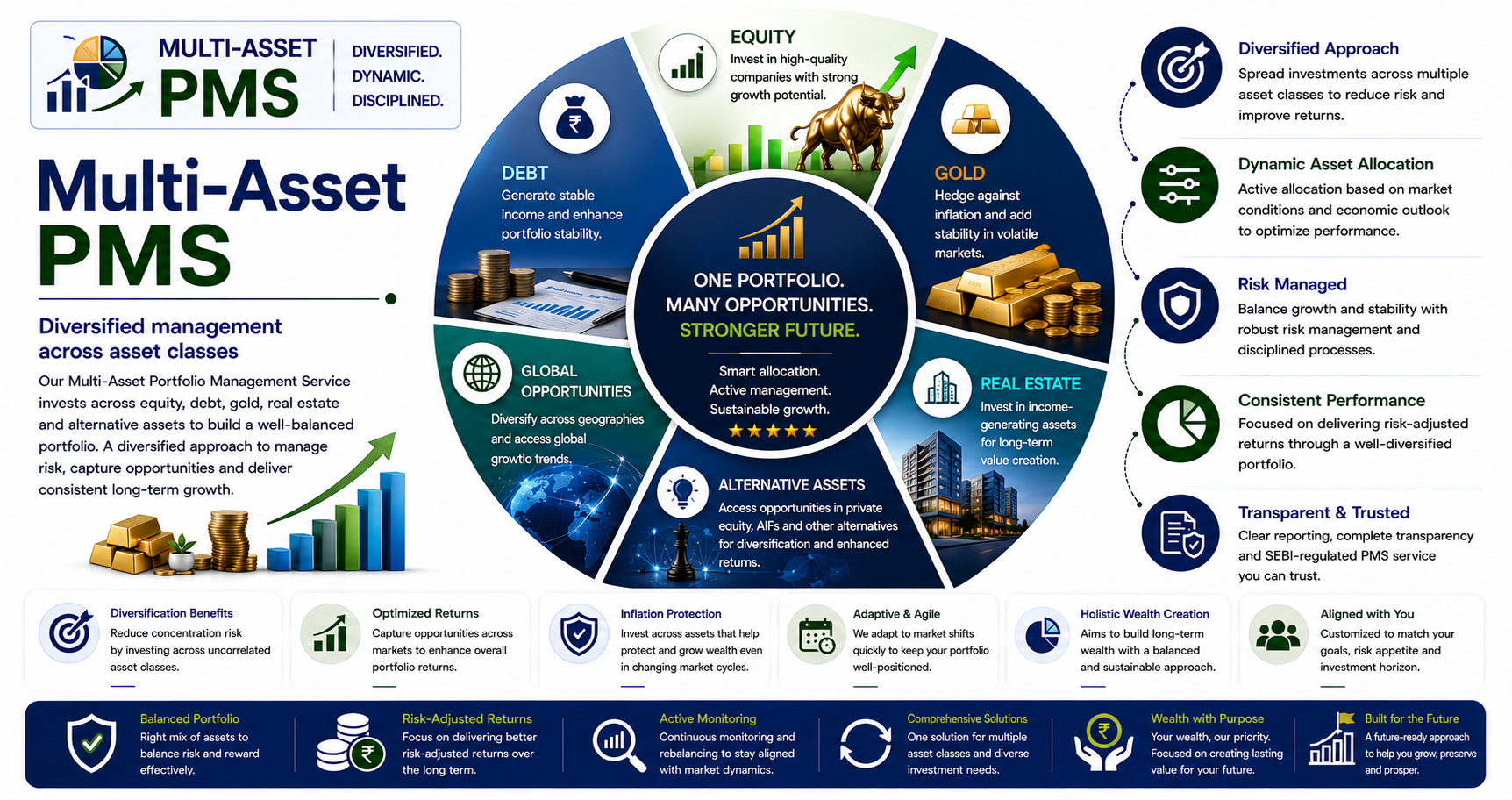
Multi-asset PMS strategies allocate across equity, debt, gold and sometimes international assets within a single managed portfolio. The manager sets and adjusts the allocation as well as selecting within each asset class.
The value proposition is that asset allocation drives most of a portfolio's outcome, and delegating it to someone who will actually rebalance is worth more than most stock selection. Investors who intend to rebalance and never do are the natural audience.
The complication is assessment. Judging a multi-asset manager means judging their allocation calls and their selection within each asset class, and benchmarking is genuinely difficult because there is no single obvious comparison.
Who should consider it
Investors who want the whole allocation decision delegated. Investors who know they will not rebalance a multi-fund portfolio themselves. Investors seeking a single managed solution above the PMS minimum.
Benefits
- Asset allocation managed rather than left to you
- Systematic rebalancing that most investors never do themselves
- Diversification across asset classes within one mandate
- Direct ownership of the underlying holdings
- Full transparency of allocation and transactions
- Lower volatility than a pure equity portfolio
What is included, and what is not
Read the right-hand column first. It is the one that tends to surprise people later.
Included
- Allocation across equity, debt and other permitted assets
- Selection within each asset class
- Periodic rebalancing to the target allocation
- Direct holding in your own demat account
- Regular reporting of allocation, holdings and performance
Not included
- Any guarantee of return or of capital
- Protection against falls in any asset class
- A single obvious benchmark for assessment
- Availability below the ₹50 lakh minimum
Terms vary between providers and between plans from the same provider. The offer document you receive is what governs — we will walk you through it before you commit.
How it works with us
- 1 We test the case against a mutual fund first A ₹50 lakh minimum and higher fees need justifying. If a fund does the same job, that is the honest answer.
- 2 Strategy and manager assessed on process, not last year How the portfolio is constructed, how it behaved in a bad year, and how consistent the process has been.
- 3 Fee structure understood in full Fixed fee, performance fee, hurdle, high-water mark and exit load. These vary enormously and compound over time.
- 4 Account opened and portfolio built Shares are bought in your own name in your own demat account. You see every transaction as it happens.
- 5 Reviewed on process and reported for tax Every trade is a taxable event in your hands. We keep the reporting straight and review against the mandate, not the market.
Important considerations
The things a brochure tends to leave out. Read these before you decide.
- Ask for the permitted allocation range. A mandate that can be twenty or eighty per cent equity is effectively several different portfolios at different times.
- Benchmarking is genuinely difficult here. Agree at the outset how performance will be assessed, or you will be comparing against nothing.
- Rebalancing creates taxable events in your hands. A systematically rebalanced portfolio has a tax cost a fund investor does not bear.
- Compare against a balanced or multi-asset mutual fund on cost and net outcome. That fund rebalances internally without a tax event.
- Asset allocation is where most of the outcome comes from. Assess the manager's allocation record specifically, not just their equity selection.
Documents required
- PAN card
- Aadhaar or other identity proof
- Address proof
- Bank account proof
- Demat account details, or consent to open one
- Completed KYC and PMS agreement
- Power of attorney in favour of the portfolio manager
Frequently Asked Questions
Why delegate asset allocation?
Because it drives most of a portfolio's outcome and almost nobody rebalances consistently on their own. Investors who intend to trim equity after a strong run and add after a fall very rarely do it. Delegating that discipline is often worth more than any stock selection.
How do I judge performance?
With difficulty, which is why the benchmark should be agreed at the outset. A multi-asset portfolio has no single obvious comparison, and without an agreed reference point you will be assessing it against whichever market happened to do well.
Does rebalancing cost me tax?
Yes. Each rebalancing trade realises gains in your own name, unlike a multi-asset mutual fund which rebalances internally with no tax event for the investor. That difference is worth quantifying against the fee differential.
How wide is the allocation range?
It varies by mandate, and it matters. A strategy permitted to hold anywhere from twenty to eighty per cent equity is effectively several different portfolios depending on when you look at it. Ask for the range, not just the current position.
Is this better than a balanced mutual fund?
It offers direct ownership, customisation and transparency; the fund offers lower cost, no tax on internal rebalancing and a much lower minimum. For most investors the fund wins on arithmetic; the PMS earns its place where customisation genuinely matters.
Want a shortlist instead of a catalogue?
Tell us the situation and an advisor comes back with two or three options that actually fit — and names what each one gives up.