
Get Expert Guidance
What Our Plans Cover
-
Ocean or air transit from the port...
-
Port handling and stevedoring dama...
-
Storage during the customs clearan...
-
Inland transit from the port to yo...
-
General average and salvage charge...
-
Jettison and washing overboard
-
Customs duty
Who Can Consider This Plan?
- Insurable interest in the goods at the time of loss
- Cover arranged before the transit begins
- Goods packed appropriately for the mode of transport
- Accurate declaration of the nature and value of the cargo
- Voyage within the territorial limits stated in the policy
What May Not Be Covered?
- Inherent vice and the ordinary nature of the goods
- Insufficient or unsuitable packing by the supplier
- Delay, and any loss arising from it
- Loss arising from the insolvency of the carrier
- Storage beyond the permitted clearance period
Always check the policy wording before you commit.
Why Choose Wealth & Covers?
- Expert advice to choose the right plan
- Plans from leading insurance companies
- Hassle-free process and documentation
- End-to-end support, including claim assistance
- Dedicated relationship manager
Our Insurance Partners
- Star Health Insurance
- Care Health Insurance
- Niva Bupa Health Insurance
- HDFC ERGO
- ICICI Lombard
- Bajaj Allianz
We represent multiple providers to help you find the most suitable option at the best price.
- Expert Guidance Personalised advice from experienced insurance professionals.
- End-to-End Support From choosing the right plan to claim assistance, we are with you always.
- Claims Assistance Hassle-free claim support to ensure you get what you deserve.
- Transparent Process Clear information, easy documentation and a hassle-free experience.
Overview
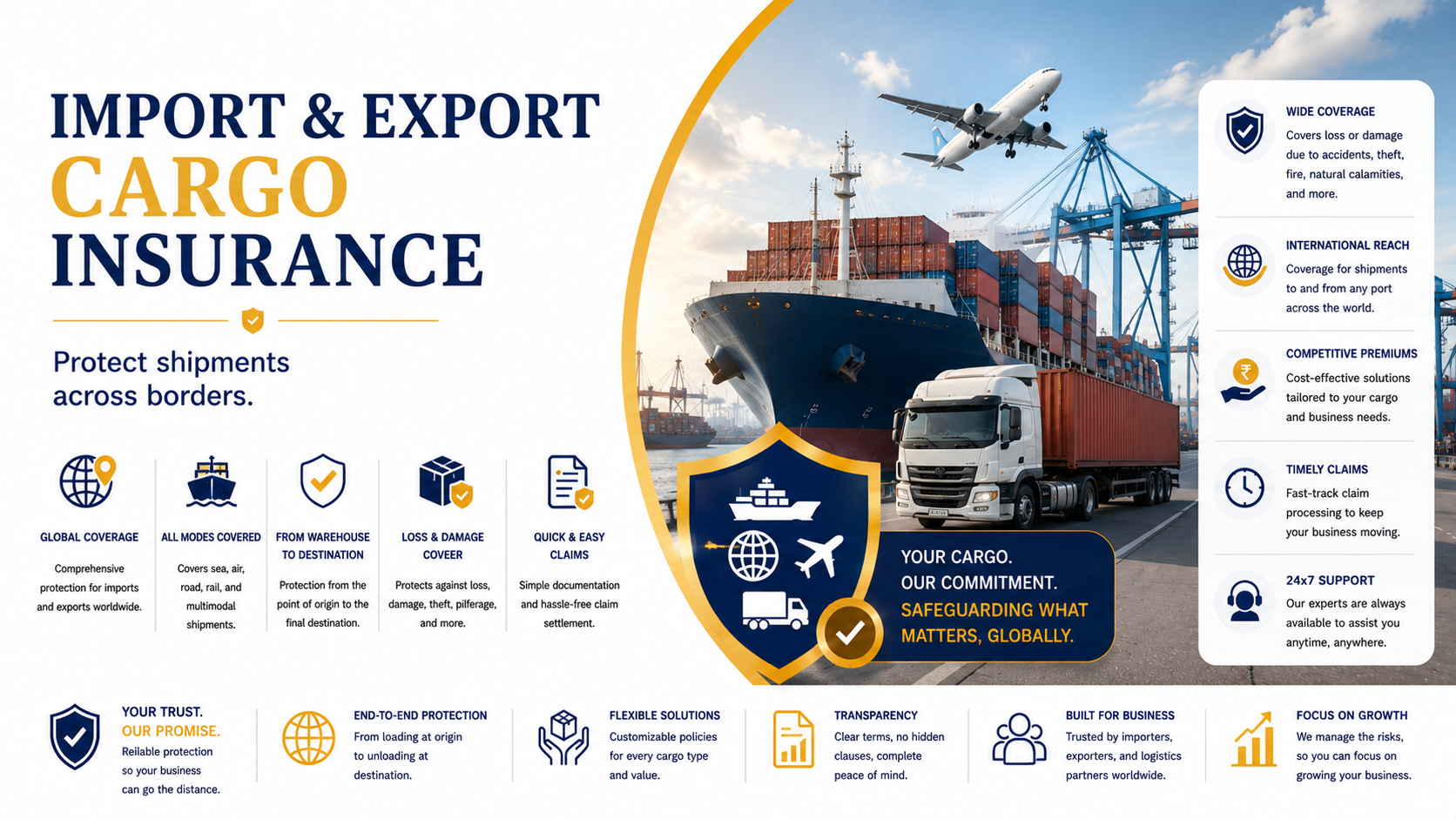
Import cargo insurance covers goods travelling from an overseas supplier to your premises in India, by sea, air or a combination. It covers the ocean or air leg, the port handling, customs clearance period and the inland transit to your warehouse.
The critical question is the Incoterm. Under CIF the seller arranges insurance to the destination port; under FOB the risk passes to you at the port of loading and you are responsible from there. Importers frequently assume they are covered under CIF terms and discover the seller's policy was thin, foreign-law governed, and difficult to claim on.
Where cargo is under a letter of credit, the bank will specify the insurance required — usually Institute Cargo Clauses A for 110% of the invoice value. Those requirements are not negotiable if you want the credit honoured.
Who should consider it
Importers of raw materials, components and finished goods. Traders bringing in stock. Any business buying on FOB or Ex Works terms, where the risk is theirs from the outset.
Benefits
- Cover under an Indian policy, claimable in India in rupees
- Warehouse-to-warehouse cover across ocean, port and inland legs
- Meets letter of credit insurance requirements
- Duty and clearing costs can be included in the insured value
- Annual open cover available for regular importers
- Survey and claim handled locally rather than through a foreign insurer
What is covered, and what is not
Read the right-hand column first. It is the one that decides whether a claim is paid.
Typically covered
- Ocean or air transit from the port of loading
- Port handling and stevedoring damage
- Storage during the customs clearance period, within stated limits
- Inland transit from the port to your warehouse
- General average and salvage charges
- Jettison and washing overboard, per the clauses selected
- Customs duty, where included in the insured value
Typically not covered
- Inherent vice and the ordinary nature of the goods
- Insufficient or unsuitable packing by the supplier
- Delay, and any loss arising from it
- Loss arising from the insolvency of the carrier
- Storage beyond the permitted clearance period
- War and strikes, unless the clauses are extended
- Losses not covered by the specific clauses selected
Inclusions and exclusions vary between providers and between plans from the same provider. The wording in your own policy document is what governs — we will walk you through it before you buy.
How it works with us
- 1 We map the movement, not just the goods Origin, destination, mode, transhipment points and who bears risk at each stage. The Incoterm decides who should be insuring at all.
- 2 Single transit or annual open cover A one-off shipment takes a specific policy. Regular movement takes an open cover with monthly declarations, which is cheaper and never forgotten.
- 3 Clauses chosen deliberately Institute Cargo Clauses A, B or C decide what is actually covered. Most disputes trace back to a C policy where A was needed.
- 4 Cover in force before despatch Marine cover must attach before the goods move. A policy arranged after loading is a policy with a gap at the start.
- 5 Survey and claim handled for you We appoint the surveyor, assemble the documents and pursue recovery against the carrier where one exists.
Important considerations
The things a brochure tends to leave out. Read these before you decide.
- Establish the Incoterm before assuming you are covered. Under FOB or Ex Works the risk is yours from the port of loading, and a supplier's CIF policy under foreign law is difficult to claim on even when it exists.
- Institute Cargo Clauses A is all-risk; B and C are named perils and considerably narrower. Most disputes in this class are a C policy where A was needed.
- Include customs duty in the insured value. Duty is paid whether or not the goods survive, and a policy insuring only the goods leaves that cost with you.
- Watch the clearance period. Goods held at port beyond the permitted days fall outside transit cover, and clearance delays are routine.
- For regular imports, take an annual open cover. It is cheaper, it applies automatically, and no shipment sails uninsured because a purchase order moved quickly.
Documents required
- Commercial invoice and packing list
- Bill of lading, airway bill or lorry receipt
- Details of the goods — nature, packing and value
- Voyage details — origin, destination, mode and transhipment
- Incoterm agreed with the counterparty
- Letter of credit terms, where the shipment is under one
- Previous claims history, for annual covers
Want a shortlist instead of a catalogue?
Tell us the situation and an advisor comes back with two or three options that actually fit — and names what each one gives up.