
Check your eligibility
What These Loans Fund
-
Inventory and raw material purchas...
-
Wages
-
Receivables funding while customer...
-
Order-backed funding for large con...
-
Seasonal stock build-up
Who Can Consider This Loan?
- Business vintage, commonly two to three years of operations
- Minimum annual turnover set by lender and segment
- Profitable operations, or a demonstrable path to profitability
- Clean banking conduct with no cheque returns
- Promoter credit scores, which lenders assess alongside the business
- GST registration and filing compliance, where applicable
What May Not Be Funded?
- Capital expenditure, which needs a term loan
- Repayment of other long-term borrowing
- Promoter drawings
- Drawings above the sanctioned limit
- Speculative activity
Always check the sanction letter before you commit.
Why Choose Wealth & Covers?
- Expert advice to choose the right plan
- Plans from leading loans companies
- Hassle-free process and documentation
- End-to-end support, including claim assistance
- Dedicated relationship manager
- Expert Guidance Personalised advice from experienced loans professionals.
- End-to-End Support From choosing the right plan to claim assistance, we are with you always.
- Claims Assistance Hassle-free claim support to ensure you get what you deserve.
- Transparent Process Clear information, easy documentation and a hassle-free experience.
Overview
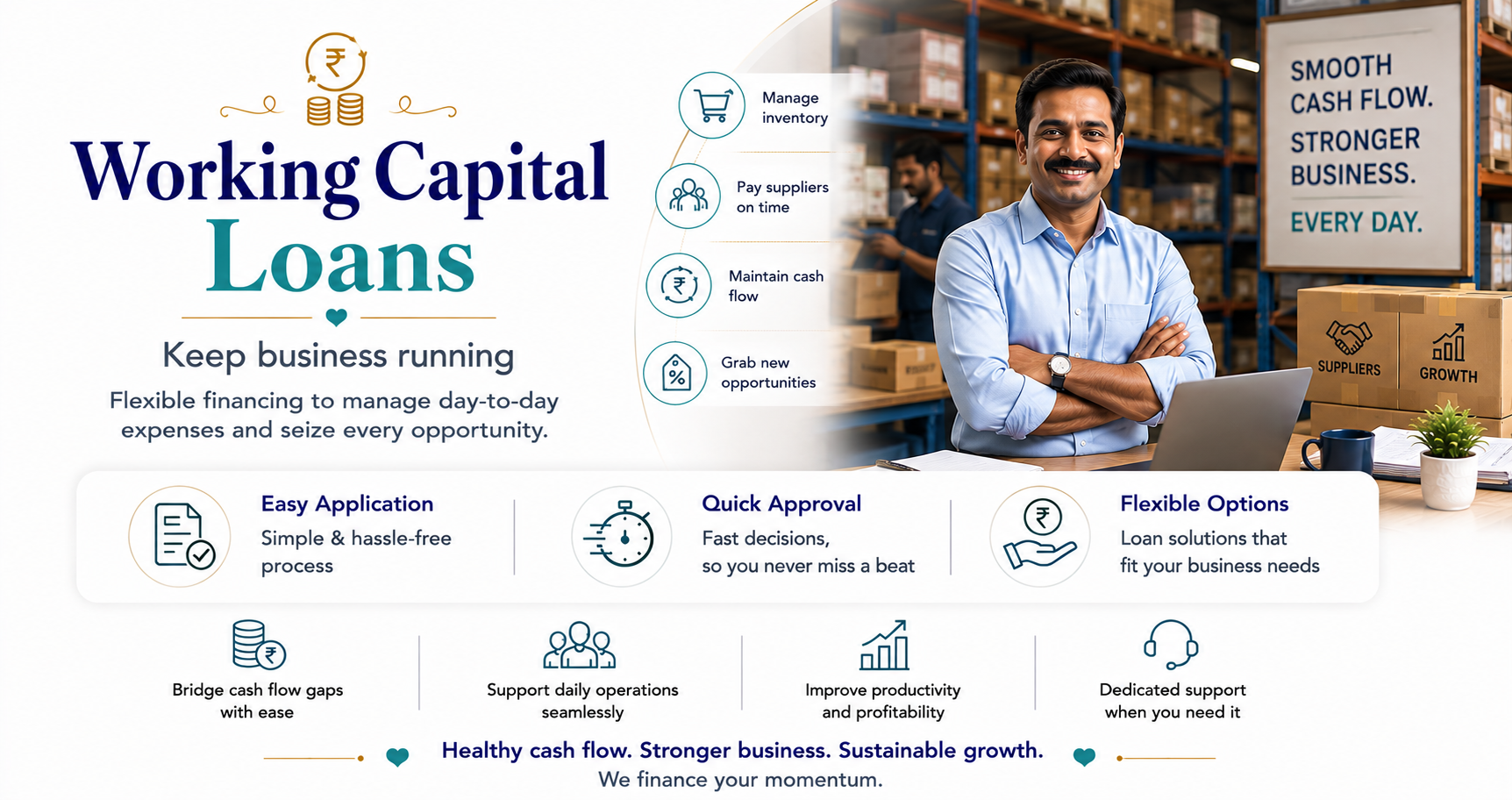
Working capital funding covers the operating gap between money going out and money coming in. A business buys stock, pays wages and meets overheads immediately, and is paid by customers sixty or ninety days later. That gap has to be funded by something.
The structure matters more than the rate here. A cash credit or overdraft limit, which you draw and repay as the cycle turns, is generally the right instrument. A term loan disbursed as a lump sum is the wrong one — you pay interest on the whole amount from day one, whether or not the cycle requires it.
Lenders size the facility on the working capital cycle: how long stock sits, how long receivables take, and how much credit suppliers extend. Shortening any of those reduces the funding you need, which is usually cheaper than borrowing more.
Who should consider it
Businesses with a genuine gap between payment and receipt — manufacturers, traders, distributors and contractors. Businesses whose sales are growing faster than their cash. Any business regularly stretched at month end.
Benefits
- Funds the operating cycle without disturbing long-term capital
- Cash credit and overdraft structures charge interest only on what is drawn
- Limits are renewable annually as the business grows
- Enables taking larger orders that the cycle could not otherwise fund
- Interest is a deductible business expense
- Faster to arrange than long-term facilities
What the loan funds, and what it does not
Read the right-hand column first. It is the one that decides how much you have to arrange yourself.
Usually funded
- Inventory and raw material purchase
- Wages, salaries and operating overheads
- Receivables funding while customers pay
- Order-backed funding for large contracts
- Seasonal stock build-up
Usually not funded
- Capital expenditure, which needs a term loan
- Repayment of other long-term borrowing
- Promoter drawings
- Drawings above the sanctioned limit
- Speculative activity
Funding limits and the treatment of add-ons vary between lenders and move with the borrower profile. The sanction letter you receive is what governs — we will walk you through it before you sign.
How it works with us
- 1 We read your financials before approaching anyone Turnover, margins, banking conduct and existing obligations. Lenders read the same numbers, and it is better to know what they will see.
- 2 Matched to lenders who write your segment Manufacturing, trading and services are underwritten differently. Applying to the wrong lender wastes weeks and marks your credit file.
- 3 Structure chosen before rate A term loan, a working capital line or an overdraft solve different problems. The cheapest wrong structure is still the wrong structure.
- 4 Documentation prepared properly, once Financials, GST returns, bank statements and projections in the format lenders expect. Incomplete files are the main cause of delay.
- 5 Sanction, disbursal and an eye on the covenants We flag the conditions attached to the sanction so a covenant breach is not the first you hear of a problem.
Important considerations
The things a brochure tends to leave out. Read these before you decide.
- Use a revolving structure, not a term loan. Working capital needs fluctuate, and paying interest on a lump sum you have not drawn is straightforwardly wasteful.
- Shortening the cycle is cheaper than funding it. Faster collections, tighter stock and better supplier terms reduce the facility you need.
- Never use working capital funding for capital expenditure. Funding a machine from a facility that has to revolve creates a permanent squeeze.
- Watch the drawing power calculation. Facilities secured on stock and receivables limit drawings to a percentage of those, so a slow month reduces what you can access.
- Limits are reviewed annually. Growing turnover justifies a larger limit, but you have to ask and evidence it.
Documents required
- Business registration — incorporation, partnership deed or proprietorship proof
- PAN of the business and of the promoters
- Last two to three years of audited financial statements
- Last two to three years of income tax returns with computation
- GST returns for the last twelve months
- Bank statements for the last twelve months
- KYC of promoters, partners or directors
- Existing loan sanction letters and repayment records
Frequently Asked Questions
How much working capital do I need?
It follows your cycle: how many days stock sits, how long customers take to pay, less how much credit suppliers give you. Multiply that net cycle by your daily cost of sales and you have a realistic figure. Lenders size the facility on the same calculation.
Cash credit or a term loan?
Cash credit or an overdraft, almost always. Working capital needs fluctuate through the month and the season, and a revolving facility charges interest only on what you have drawn. A term loan charges interest on the full amount from day one.
Can I use it to buy a machine?
You should not. Capital expenditure needs a term loan matched to the asset's life. Funding a machine from a facility that has to revolve leaves the facility permanently drawn and the business permanently squeezed.
What is drawing power?
Where the facility is secured on stock and receivables, your drawings are limited to a percentage of their current value. A slow month reduces the stock and receivables, which reduces what you can draw — often at exactly the moment you need it most.
Can I increase the limit as I grow?
Yes, at the annual review, with evidence of higher turnover and a healthy cycle. It is worth preparing for that review rather than treating it as a formality, because a limit that lags your growth becomes a constraint on it.
Want a shortlist instead of a catalogue?
Tell us the situation and an advisor comes back with two or three options that actually fit — and names what each one gives up.