
Plan your investment
What Our Plans Cover
-
A portfolio concentrated in one se...
-
Active management within that mand...
-
SIP and lumpsum investment options
-
Growth and income distribution opt...
Who Can Consider This Plan?
- Indian resident individual, HUF, trust or company
- NRIs, subject to the fund house accepting the country of residence
- Completed KYC with a registered KYC registration agency
- PAN, which is mandatory for all mutual fund investments
- A bank account in the investor's own name for transactions
What May Not Be Covered?
- Diversification — this is a deliberately concentrated portfolio
- Any guarantee of return
- Protection when the chosen sector underperforms
- Suitability as a core portfolio holding
Always check the policy wording before you commit.
Why Choose Wealth & Covers?
- Expert advice to choose the right plan
- Plans from leading investments companies
- Hassle-free process and documentation
- End-to-end support, including claim assistance
- Dedicated relationship manager
- Expert Guidance Personalised advice from experienced investments professionals.
- End-to-End Support From choosing the right plan to claim assistance, we are with you always.
- Claims Assistance Hassle-free claim support to ensure you get what you deserve.
- Transparent Process Clear information, easy documentation and a hassle-free experience.
Overview
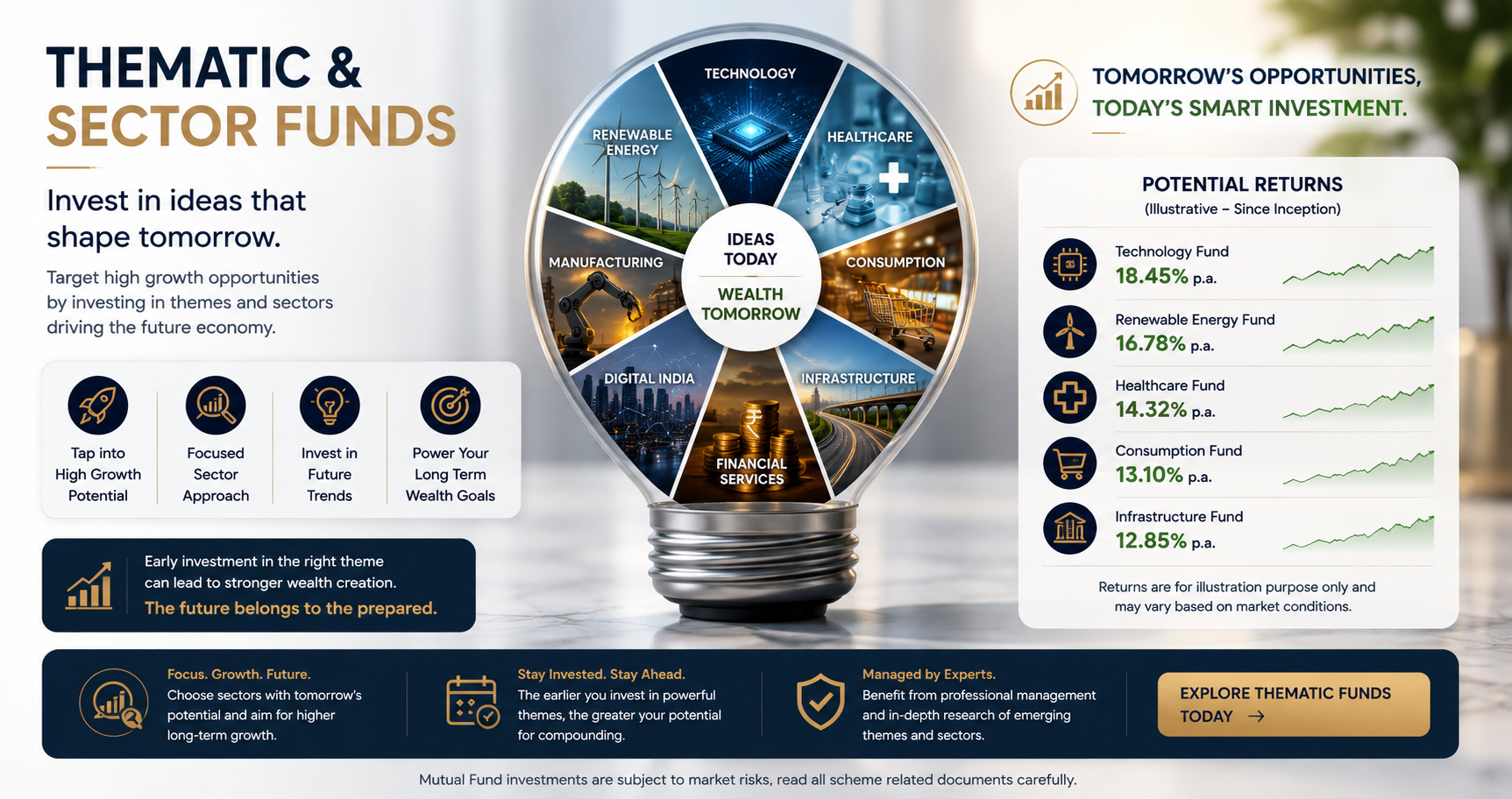
Thematic and sector funds concentrate a portfolio into one industry or idea — banking, technology, pharmaceuticals, infrastructure, consumption. They abandon diversification deliberately, on the view that the chosen sector will outperform.
That concentration cuts both ways and does so sharply. A sector fund that gets it right can outperform substantially; one that gets it wrong can underperform for years while a diversified fund does perfectly well.
The behavioural problem is worse than the mathematical one. Sector funds attract most money after a sector has already performed, which is systematically the worst time to buy them. The launches cluster at the top of a cycle because that is when the story sells, and investors who arrive then carry the subsequent decline.
Who should consider it
Experienced investors with a specific, researched view on a sector, allocating a small satellite portion of an already diversified portfolio.
It is not appropriate as a core holding, and not appropriate for anyone buying because a sector has been in the news. If the reason for buying is recent performance, that is the strongest argument against buying.
Benefits
- Concentrated exposure to a sector you have a view on
- Potential to outperform a diversified fund if the view is right
- Professional management within the chosen sector
- Useful as a small satellite allocation alongside a diversified core
- Access to sectors difficult to reach through direct stock selection
What is included, and what is not
Read the right-hand column first. It is the one that tends to surprise people later.
Included
- A portfolio concentrated in one sector or theme
- Active management within that mandate
- SIP and lumpsum investment options
- Growth and income distribution options
Not included
- Diversification — this is a deliberately concentrated portfolio
- Any guarantee of return
- Protection when the chosen sector underperforms
- Suitability as a core portfolio holding
Terms vary between providers and between plans from the same provider. The offer document you receive is what governs — we will walk you through it before you commit.
How it works with us
- 1 Goal and horizon before fund selection What the money is for and when you need it decides the asset class. The fund name is the last decision, not the first.
- 2 Risk profiling that is honest rather than flattering Capacity to take risk and willingness to sit through a fall are different things. We assess both, because the second is what breaks plans.
- 3 Shortlist built on process, not last year's return Mandate, expense ratio, fund manager tenure and how the fund behaved in a bad year. Past performance is not a forecast.
- 4 KYC, onboarding and the first investment One-time KYC, then the folio and the mandate. We set up the SIP so it runs without depending on you remembering.
- 5 Review annually, rebalance deliberately A yearly review against the goal, not a monthly reaction to markets. Most damage in investing is self-inflicted.
Important considerations
The things a brochure tends to leave out. Read these before you decide.
- If your reason for buying is that the sector has done well recently, that is the strongest argument against buying. Sector funds attract money at exactly the wrong point in the cycle.
- Keep the allocation small. A satellite position of five to ten per cent of a portfolio expresses a view; a core position in one sector is a concentrated bet on being right.
- Be prepared for years of underperformance. Sector cycles are long, and a fund can lag a diversified alternative for a very extended period without anything being wrong with it.
- Have an exit view before you enter. Sector positions without a thesis for when to leave tend to become permanent by accident.
- Mutual fund investments are subject to market risk, and concentrated funds carry materially higher risk than diversified ones.
Documents required
- PAN card
- Aadhaar or other identity proof
- Address proof
- Cancelled cheque or bank account details
- Recent passport-size photograph
- Completed KYC, or KYC documents to complete it
- FATCA and nominee declaration
Frequently Asked Questions
Should a sector fund be part of my core portfolio?
No. A core portfolio should be diversified; a sector fund is deliberately the opposite. Where these funds have a role it is as a small satellite allocation — perhaps five to ten per cent — alongside a diversified core, expressing a specific view you have actually researched.
When do most investors buy sector funds?
After the sector has already performed, which is systematically the worst time. New launches cluster at the top of a cycle because that is when the story is easiest to tell, and the investors who arrive then carry the decline that follows.
How much more volatile are they?
Substantially. Without diversification across sectors, the fund carries the full cycle of one industry — including extended periods of underperformance that have nothing to do with the fund manager's skill.
How do I decide when to exit?
Decide before you enter. A sector position taken without a thesis for when the view has played out tends to become a permanent holding by accident, which was never the intention.
Are these riskier than diversified funds?
Materially. All mutual fund investments are subject to market risk, and concentrating into a single sector removes the diversification that moderates it. These are appropriate for experienced investors sizing the position deliberately, not as a general recommendation.
Want a shortlist instead of a catalogue?
Tell us the situation and an advisor comes back with two or three options that actually fit — and names what each one gives up.