
Check your eligibility
What These Loans Fund
-
A sanctioned limit available for d...
-
Interest on the utilised amount on...
-
Repeated drawing and repayment wit...
-
Any lawful end use
-
Annual renewal of the facility on...
Who Can Consider This Loan?
- Indian resident, generally aged 21 to 60
- Salaried: minimum monthly income set by the lender and city
- Self-employed: two to three years of business vintage with filed returns
- Credit score is the dominant factor in both approval and rate
- Total EMI obligations usually capped at 50 to 55% of net income
- Employment with a recognised employer improves both terms and speed
What May Not Be Funded?
- Drawings above the sanctioned limit
- Annual maintenance or renewal charges, which apply regardless of use
- Tax deduction on interest for personal use
- Guaranteed renewal — the limit is reviewed annually
Always check the sanction letter before you commit.
Why Choose Wealth & Covers?
- Expert advice to choose the right plan
- Plans from leading loans companies
- Hassle-free process and documentation
- End-to-end support, including claim assistance
- Dedicated relationship manager
- Expert Guidance Personalised advice from experienced loans professionals.
- End-to-End Support From choosing the right plan to claim assistance, we are with you always.
- Claims Assistance Hassle-free claim support to ensure you get what you deserve.
- Transparent Process Clear information, easy documentation and a hassle-free experience.
Overview
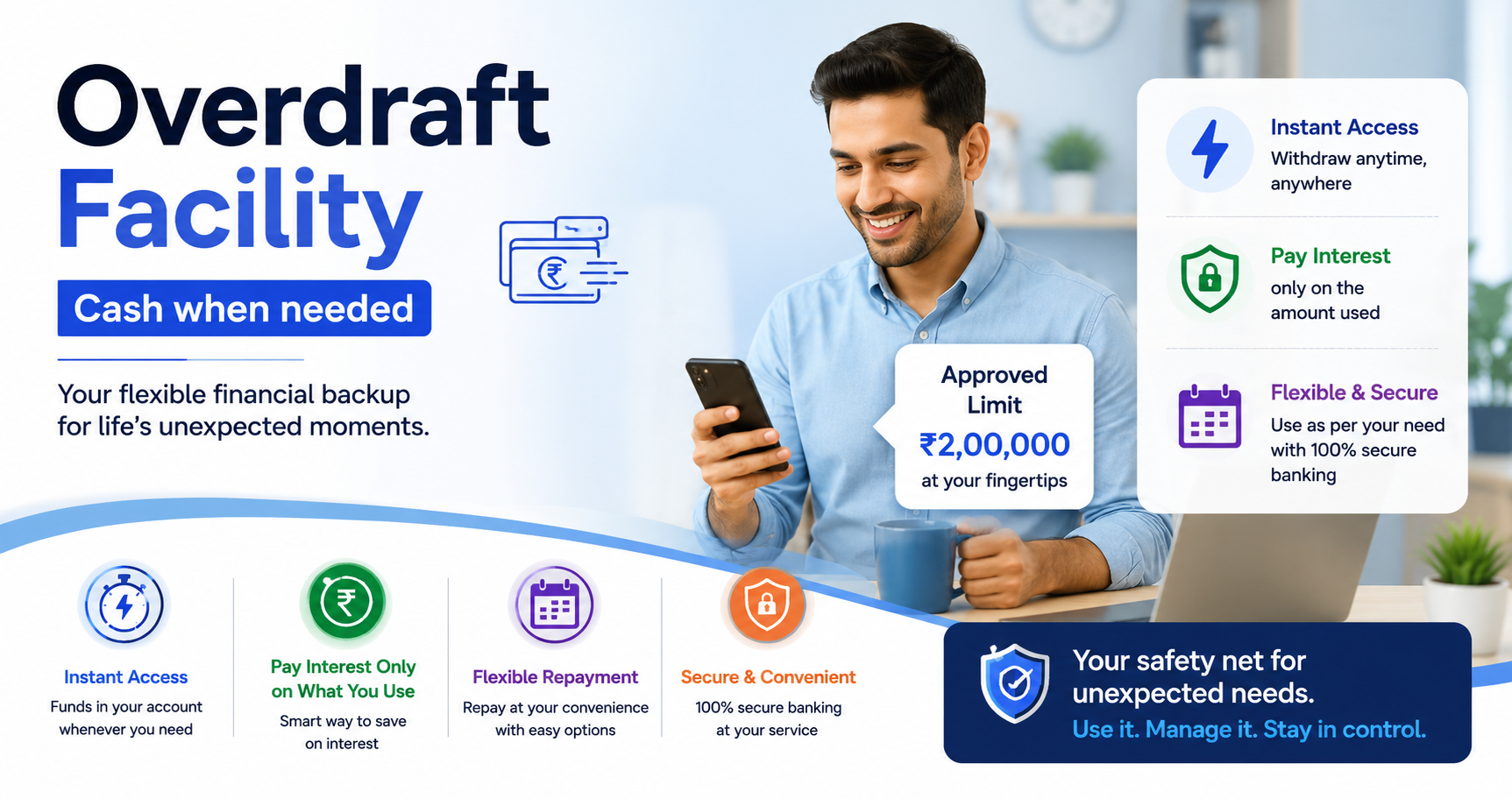
An overdraft facility is a sanctioned credit limit you draw against as required. Interest is charged only on the amount actually used and only for the days it is outstanding, and repayment is flexible rather than a fixed EMI.
That structure suits irregular needs far better than a term loan. A business with lumpy receivables, or a household facing a series of uncertain expenses, pays for what it uses rather than borrowing a lump sum and paying interest on all of it from day one.
The discipline it requires is the mirror image of its flexibility. Without a scheduled EMI forcing repayment, an overdraft can sit drawn indefinitely, and interest accrues quietly. Used well it is one of the most efficient borrowing structures available; used passively it is expensive.
Who should consider it
Self-employed borrowers with irregular income. Anyone facing a series of uncertain expenses rather than one known cost. Borrowers who want a standby facility available without drawing it.
Benefits
- Interest charged only on the amount drawn, for the days drawn
- Draw and repay repeatedly within the sanctioned limit
- No EMI obligation when the facility is not in use
- Suits irregular income and uncertain expenses
- Available as a standby without any cost until used
- Repaying reduces interest immediately
What the loan funds, and what it does not
Read the right-hand column first. It is the one that decides how much you have to arrange yourself.
Usually funded
- A sanctioned limit available for drawdown
- Interest on the utilised amount only
- Repeated drawing and repayment within the limit
- Any lawful end use
- Annual renewal of the facility on review
Usually not funded
- Drawings above the sanctioned limit
- Annual maintenance or renewal charges, which apply regardless of use
- Tax deduction on interest for personal use
- Guaranteed renewal — the limit is reviewed annually
Funding limits and the treatment of add-ons vary between lenders and move with the borrower profile. The sanction letter you receive is what governs — we will walk you through it before you sign.
How it works with us
- 1 Eligibility checked before any application is filed Each rejected application marks your credit file. We match your profile to lenders who will actually approve it, rather than applying everywhere.
- 2 Compared on total cost, not the advertised rate Processing fee, insurance bundling and prepayment terms often matter more than the headline number.
- 3 We name the cheaper alternative if there is one A top-up on your home loan or a loan against securities is often half the cost. If that applies to you, we will say so.
- 4 One document set, submitted once Prepared properly the first time, which is what makes same-day approval realistic.
- 5 Sanction, disbursal and a repayment plan The sanction states rate, fee and prepayment terms. We set out how prepaying would work before you need it.
Important considerations
The things a brochure tends to leave out. Read these before you decide.
- Set your own repayment discipline. Without an EMI compelling repayment, a drawn overdraft can persist for years and the interest compounds quietly.
- The maintenance charge applies whether or not you use the facility. Only keep a limit you genuinely expect to need.
- Compare against a term loan for a known, fixed expense. If the amount and timing are certain, a term loan is usually cheaper.
- The limit is reviewed annually and can be reduced. Do not build a plan that depends on it remaining available indefinitely.
- Interest calculated daily means every repayment helps immediately. Sweeping surplus balances against the overdraft is genuinely worthwhile.
Documents required
- Identity proof — Aadhaar, PAN or passport
- Address proof
- Salaried: last three months of salary slips and Form 16
- Self-employed: last two years of income tax returns with computation
- Bank statements for the last six months
- Employment proof or business registration
- Recent passport-size photograph
- Existing loan and credit card statements
Frequently Asked Questions
How is this different from a personal loan?
A personal loan disburses a lump sum and charges interest on all of it from day one, with a fixed EMI. An overdraft gives you a limit you draw against as needed, charging interest only on what is drawn and only for the days it is outstanding. For uncertain needs it is considerably cheaper.
What if I never use the limit?
You pay no interest, but most facilities carry an annual maintenance or renewal charge regardless of use. Only maintain a limit you genuinely expect to need.
Is there a fixed EMI?
No, and that is both the advantage and the risk. Without a scheduled repayment forcing the balance down, a drawn overdraft can persist indefinitely while interest accrues. Set your own repayment discipline at the outset.
Can the bank reduce my limit?
Yes. Facilities are reviewed annually and can be reduced or withdrawn based on your profile and usage. It is not a permanent entitlement, so do not build plans that depend on it being there in three years.
When is a term loan better?
When the amount and timing are both certain. For a known one-off expense a term loan is usually cheaper and enforces repayment. The overdraft earns its keep when the need is irregular or uncertain.
Want a shortlist instead of a catalogue?
Tell us the situation and an advisor comes back with two or three options that actually fit — and names what each one gives up.